Straight chop
0
Chop·KingstonSpiritCombat
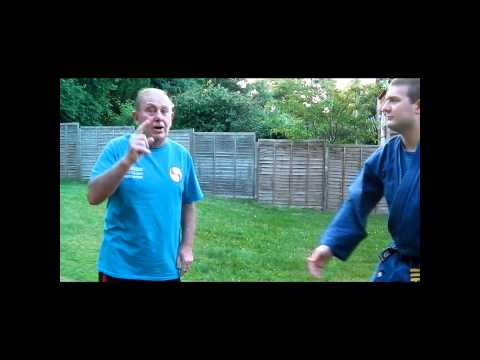
Soke Brian Dossett shows the importance of movement while blocking a straight chop / straight strike with a stick to the…
Translation: chop
The chop strike, delivered with the edge or flat of the hand in a downward or diagonal arc, appears across numerous martial traditions worldwide. [1] In karate, chopping techniques are classified under uchi (strikes) and include both knife hand and ridge hand variations. [2] Western military combatives adopted the chop as a practical close-quarters weapon, with Fairbairn's World War II manual recommending edge-of-hand blows to vulnerable targets such as the neck and collarbone. [3] The chop was popularised in Western culture through early martial arts films and television, though its combat application has remained a staple of self-defence systems. [1]
The chop strikes with the edge of the hand. [1]
From karate's shuto uchi. [1]
Used in karate and MMA. [1]
No images yet for this technique.
Sign in to suggest an image.
Soke Brian Dossett shows the importance of movement while blocking a straight chop / straight strike with a stick to the…
No instructional courses yet for this technique.
Sign in to suggest a course.
Risk of injury to the person this technique is applied to
Open hand chopping strike; less force than closed fist
Skill level needed to execute this technique reliably
Whether this technique is allowed under major competition rule sets
Karate-Do Kyohan: The Master Text (Gichin Funakoshi, 1935)
Alias sources — [1] Karate-Do Kyohan (Funakoshi, 1935) [2] Karate-Do Kyohan (Funakoshi, 1935) [3] Karate-Do Kyohan (Funakoshi, 1935)
History sources — [1] The Art of Striking (Blauer, 2004) [2] Karate-Do Kyohan (Funakoshi, 1935) [3] Get Tough! (Fairbairn, 1942)
Standard katakana transliteration of Western martial arts terminology (外来語) — used in Japanese MMA, boxing, and BJJ communities
Alias sources — [1] Karate-Do Kyohan (Funakoshi, 1935) [2] Karate-Do Kyohan (Funakoshi, 1935) [3] Karate-Do Kyohan (Funakoshi, 1935)
History sources — [1] The Art of Striking (Blauer, 2004) [2] Karate-Do Kyohan (Funakoshi, 1935) [3] Get Tough! (Fairbairn, 1942)
speed, power generation through kinetic chain, striking surface conditioning
athletic build with fast-twitch muscle fibres
varies by strike — hip rotators, shoulders, core
Every move, in any martial art, shares a few universal traits. Mix and match below to pinpoint the right tool — or compare equivalents across styles.
Footwork is crucial because moving only one foot while keeping the rest of your body stationary leaves you vulnerable—your opponent can still strike your shoulder or other parts of your body. You need to move your entire body, including your head and shoulder, to properly evade the counter-attack.
Keep your other hand ready to lock out your opponent's reach. If you control your leg positioning and maintain defensive hand placement, it becomes very difficult for your opponent to catch you or reach you from alternative angles.
A downward or diagonal striking motion using the edge of the hand, similar to a knife hand but delivered with a heavier, more committed chopping trajectory.
The chop strike, delivered with the edge or flat of the hand in a downward or diagonal arc, appears across numerous martial traditions worldwide. In karate, chopping techniques are classified under uchi (strikes) and include both knife hand and ridge hand variations.
Unified MMA: legal — Legal (palm strikes, slaps permitted); WBC/Boxing: banned — Only closed-fist punches permitted; WKF: restricted — Varies by technique — some open-hand strikes legal in kata, generally restric…; Kyokushin: banned — Only closed-fist strikes to body permitted; WT: banned — Prohibited; ITF: restricted — Some knife hand techniques legal; WAKO: banned — Closed fist only; K: banned — 1/GLORY — Closed fist only; IFMA: legal — Legal — palm strikes permitted in Muay Thai
Danger rating 4/10. Moderate — open hand chopping strike; less force than closed fist
The standard setup chain: Assume Fighting Stance → Generate Power → Execute Strike → Recover to Guard.
Standard counters include: Block — absorb the strike with a protective guard position / Evasion — move the target out of the strike's path / Counter-Attack — time an offensive response during the recovery phase of the strike.
Common variants: Standard variation (primary execution of the strike from the most common stance); Power variation (modified mechanics for maximum force generation); Speed variation (minimised telegraph for a faster, harder-to-read attack); Counter variation (timed to exploit the opponent's offensive commitment).
Used in karate and MMA.
Top errors to watch for: Hitting with the fingers extended and loose, which causes jammed or broken fingers on impact / Slapping with a floppy hand instead of striking with a rigid edge — the hand must be taut at contact / Aiming at the top of the head where the skull deflects the strike — target the soft neck, collarbone, or temple / Using excessive windup, which telegraphs the chop and slows delivery.
The Chop is also known as Choppu, Hand Chop, Chopping Strike, Tegatana.