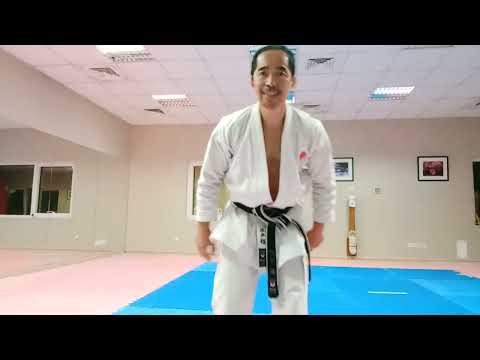
How to do side thrusting kick (yoko geri) like a pro
0
Thrusting Side Kick·Kapawen Kai Jka Karate
This is about a kicking maneauver that is strong and effective in dismantling an aggressor if done correctly with perfec…
横蹴込み(Yoko-geri Kekomi)
TraditionalTranslation: thrusting side kick
The Thrusting Side Kick subfamily covers side kicks executed with a powerful forward thrust that drives through the target, emphasising penetrating force over speed and retraction. [1] The thrusting side kick extends the leg fully and pushes the hip through the target, sending the opponent backward with substantial force, making it effective for stopping forward charges and creating distance. [1],[2] This variation generates more impact force than the snapping variant but takes longer to execute and leaves the kicker more committed to the technique. [2],[3]
The thrusting side kick (yoko geri kekomi) is a fundamental karate technique classified alongside the snapping variant in Shotokan's systematic kicking taxonomy. [1] Bruce Lee famously favoured the thrusting side kick as a primary weapon in Jeet Kune Do, using the lead-leg thrust kick as a stopping technique against advancing opponents. [2],[3]
The thrusting side kick drives the heel into the target with maximum penetrating force. [1]
From TKD and karate. [1]
Used in competition. [1]
No images yet for this technique.
Sign in to suggest an image.
This is about a kicking maneauver that is strong and effective in dismantling an aggressor if done correctly with perfec…
No instructional courses yet for this technique.
Sign in to suggest a course.
Risk of injury to the person this technique is applied to
Linear thrust kick; generates highest force among basic kicks
Skill level needed to execute this technique reliably
Whether this technique is allowed under major competition rule sets
Karate-Do Kyohan: The Master Text (Gichin Funakoshi, 1935)
Alias sources — [1] Karate-Do Kyohan (Funakoshi, 1935) [2] Kukkiwon Taekwondo Textbook (Kukkiwon, 2006) [3] Dynamic Karate (Nakayama, 1966)
Effectiveness sources — [1] Comprehensive Asian Fighting Arts (Draeger & Smith, 1969)
Official karate technique names (和語/漢語)
Established Japanese martial arts naming convention — native Japanese term (和語/漢語)
Alias sources — [1] Karate-Do Kyohan (Funakoshi, 1935) [2] Kukkiwon Taekwondo Textbook (Kukkiwon, 2006) [3] Dynamic Karate (Nakayama, 1966)
Effectiveness sources — [1] Comprehensive Asian Fighting Arts (Draeger & Smith, 1969)
hip abduction power, lateral hip flexibility, single-leg balance
flexible hips for high side kicks
gluteus medius, hip abductors, quadriceps, core
Avoid overstretching the groin area, as this can cause painful injury. Be mindful of your flexibility limits when executing the technique.
The Thrusting Side Kick subfamily covers side kicks executed with a powerful forward thrust that drives through the target, emphasising penetrating force over speed and retraction. The thrusting side kick extends the leg fully and pushes the hip through the target, sending the opponent backward with substantial force, making it effective for stopping forward charges and creating distance.
The thrusting side kick (yoko geri kekomi) is a fundamental karate technique classified alongside the snapping variant in Shotokan's systematic kicking taxonomy. Bruce Lee famously favoured the thrusting side kick as a primary weapon in Jeet Kune Do, using the lead-leg thrust kick as a stopping technique against advancing opponents.
Unified MMA: legal — Legal striking technique; WBC/Boxing: banned — All kicks prohibited in boxing; WKF: legal — Legal, chudan (body) kick scores 2 points, jodan (head) kick scores 3 points; Kyokushin: legal — Legal at full power to body and head; WT: legal — Legal, body kick 2 points, head kick 3 points, spinning body 4 points, spinni…; WAKO: legal — Legal in Full Contact and Low Kick formats; K: legal — 1/GLORY — Legal; IFMA: legal — Legal — kicks are a core Muay Thai technique
Danger rating 6/10. High — linear thrust kick; generates highest force among basic kicks
The standard setup chain: Stance and Range → Chamber the Leg → Execute the Kick → Recover.
Standard counters include: Check (Shin Block) — raise the shin to intercept the kick before it lands / Catch and Sweep — catch the kicking leg and sweep the standing leg / Step Inside — close distance inside the kick's effective range to smother it.
Common variants: Standard side kick (driving the heel or blade of the foot laterally with hip …); Checking side kick (low side kick targeting the knee to stop the opponent's a…); Spinning side kick (adding a spin for extra rotational power); Step-through side kick (stepping through for deeper penetration).
Used in competition.
Top errors to watch for: Not driving the hip through the kick — without the hip thrust, it becomes a weak leg push / Kicking upward instead of horizontally through the target — the thrust must be lateral / Over-leaning away from the kick, which disconnects bodyweight from the thrust / Not pivoting the support foot, which blocks the hip from extending fully.
The Thrusting Side Kick is also known as Yoko-geri Kekomi, Yoko Geri Kekomi, Yop Chagi, Side Thrust Kick.