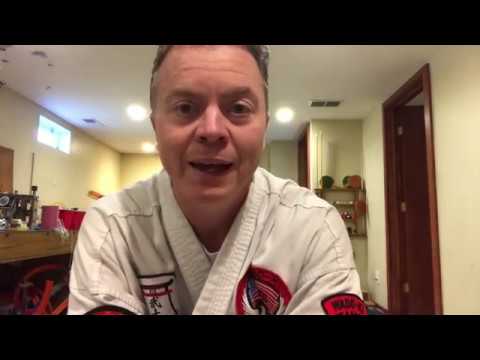
Wado Ki Karate Workout, Lesson 9 Side thrust kick
0
Standard Thrusting Side Kick·Ben Hillis·Added by Admin
In this video I will be demonstrating the side thrust kick. This kick is one of the most powerful kicks you will do in k…
Translation: standard thrusting side kick
The Standard Thrusting Side Kick is executed by chambering the knee, turning the hip over, and driving the heel into the target with a full linear thrust of the leg and hip, following through the target to maximise force transfer. [1] The kicker leans the upper body slightly away from the kick to counterbalance the force, and the standing foot pivots to allow maximum hip extension through the target. [1],[2] This technique is used in karate, taekwondo, and MMA as a powerful distance-managing weapon, effective against the opponent's midsection, hip, or knee. [2],[3]
The standard thrusting side kick (yoko geri kekomi) has been a core technique in karate since the art's systematisation in Japan. [1] It was elevated to iconic status by Bruce Lee's extensive use in his Jeet Kune Do system and films, where his explosive side kick became one of the most recognisable techniques in martial arts history. [2],[3]
The thrusting side kick generates substantial penetrating force by driving the heel laterally through the target using full hip extension, making it one of the most powerful kicks for stopping forward movement or pushing opponents away. [1] Biomechanical analysis has shown that the side kick can generate forces comparable to the roundhouse kick due to the linear thrust mechanism. [2]
The thrusting side kick (yoko geri kekomi) is a fundamental karate technique classified in Shotokan's kicking taxonomy. [1] Bruce Lee elevated the technique to iconic status in Jeet Kune Do, making the lead-leg side kick his primary kicking weapon and demonstrating its power in films and sparring. [2]
Bruce Lee's side kick demonstrations — including reportedly sending sparring partners flying backward several feet — made it the most famous application of the technique. [1] In MMA, Wonderboy Thompson has used the side kick effectively in UFC competition, applying his karate background to maintain distance. [2]
No images yet for this technique.
Sign in to suggest an image.
In this video I will be demonstrating the side thrust kick. This kick is one of the most powerful kicks you will do in k…
No instructional courses yet for this technique.
Sign in to suggest a course.
Risk of injury to the person this technique is applied to
Linear thrust kick; generates highest force among basic kicks
Skill level needed to execute this technique reliably
Whether this technique is allowed under major competition rule sets
Muay Thai: The Art of Fighting (Yod Ruerngsa, Khun Kao Charuad & James Cartmell, 2002)
Alias sources — [1] Karate-Do Kyohan (Funakoshi, 1935) [2] Kukkiwon Taekwondo Textbook (Kukkiwon, 2006) [3] Dynamic Karate (Nakayama, 1966)
Effectiveness sources — [1] Karate-Do Kyohan (Funakoshi, 1935) [2] Biomechanics of Striking Arts, in Martial Arts Medicine (Kordi et al., 2009)
Official karate technique names (和語/漢語)
Established Japanese martial arts naming convention — native Japanese term (和語/漢語)
Alias sources — [1] Karate-Do Kyohan (Funakoshi, 1935) [2] Kukkiwon Taekwondo Textbook (Kukkiwon, 2006) [3] Dynamic Karate (Nakayama, 1966)
Effectiveness sources — [1] Karate-Do Kyohan (Funakoshi, 1935) [2] Biomechanics of Striking Arts, in Martial Arts Medicine (Kordi et al., 2009)
hip abduction power, lateral hip flexibility, single-leg balance
flexible hips for high side kicks
gluteus medius, hip abductors, quadriceps, core
Raise your leg up and hold it at chamber position, just like in the front thrust kick, keeping your hands up for balance and protection.
Turn your non-kicking foot in the opposite direction and turn your back slightly toward the direction of the kick to generate proper power and alignment.
The Standard Thrusting Side Kick is executed by chambering the knee, turning the hip over, and driving the heel into the target with a full linear thrust of the leg and hip, following through the target to maximise force transfer. The kicker leans the upper body slightly away from the kick to counterbalance the force, and the standing foot pivots to allow maximum hip extension through the target.
The standard thrusting side kick (yoko geri kekomi) has been a core technique in karate since the art's systematisation in Japan. It was elevated to iconic status by Bruce Lee's extensive use in his Jeet Kune Do system and films, where his explosive side kick became one of the most recognisable techniques in martial arts history.
Unified MMA: legal — Legal striking technique; WBC/Boxing: banned — All kicks prohibited in boxing; WKF: legal — Legal, chudan (body) kick scores 2 points, jodan (head) kick scores 3 points; Kyokushin: legal — Legal at full power to body and head; WT: legal — Legal, body kick 2 points, head kick 3 points, spinning body 4 points, spinni…; WAKO: legal — Legal in Full Contact and Low Kick formats; K: legal — 1/GLORY — Legal; IFMA: legal — Legal — kicks are a core Muay Thai technique
Danger rating 6/10. High — linear thrust kick; generates highest force among basic kicks
The standard setup chain: Stance and Range → Chamber the Leg → Execute the Kick → Recover.
Standard counters include: Check (Shin Block) — raise the shin to intercept the kick before it lands / Catch and Sweep — catch the kicking leg and sweep the standing leg / Step Inside — close distance inside the kick's effective range to smother it.
Common variants: Standard side kick (driving the heel or blade of the foot laterally with hip …); Checking side kick (low side kick targeting the knee to stop the opponent's a…); Spinning side kick (adding a spin for extra rotational power); Step-through side kick (stepping through for deeper penetration).
Bruce Lee's side kick demonstrations — including reportedly sending sparring partners flying backward several feet — made it the most famous application of the technique. In MMA, Wonderboy Thompson has used the side kick effectively in UFC competition, applying his karate background to maintain distance.
Top errors to watch for: Pushing the bag without any snap at impact — even a thrusting kick should have an explosive moment at contact / Not turning sideways fully, which reduces reach and puts the knee at risk from lateral force / Locking the standing knee, which makes you rigid and easy to sweep / Driving with the toes instead of the heel — the heel is the hardest surface and safest for thrusting.
The Standard Thrusting Side Kick is also known as Yoko-geri Kekomi (Kihon-gata), Standard Yoko Geri Kekomi, Standard Yop Chagi, Side Thrust.