Introduction and Overview
The spinning hook kick is broken down into three fundamental components: turning, kicking, and observing proper technique. This tutorial provides a complete progression from basics to advanced execution, including specific drills and training methodologies.
Stance Foundation and Balance Setup
Proper stance requires feet positioned on the same linear line, with no lateral offset. Practitioners should use a wall, handrail, or heavy chair for balance support during initial learning, allowing focus on technique without proprioceptive demands.
Spinning Mechanics and Pivot Point
The spin must execute on the balls of the feet rather than the heels, maintaining a single point of contact throughout. Spinning on the heels creates instability and reduces control; staying on the toes ensures proper weight distribution and directional accuracy.
Hip Position and Core Engagement
The hip must remain directly under the supporting foot during the pivot. The motion initiates by leading with the backside or buttocks rather than the knee, creating a back-turn trajectory distinct from front-kick mechanics.
Foundational Back Kick Prerequisite
Understanding the back kick provides essential preparation for the spinning hook kick. The back kick involves a turn, knee lift, and extension; the spinning hook kick extends this motion by adding a rechamber and whip component.
Hip Flexor Power and Leg Extension
The hook kick incorporates a straight-leg extension phase where the hip flexors press across the target before the leg whips into the rechamber. This pressing motion, analogous to pedaling a bicycle, generates primary power and is often missed due to execution speed.
Training Progressions and Supplementary Drills
The pedal kick serves as a foundational drill to develop hip flexor engagement without the rechamber component. Practitioners should develop rear-leg hook proficiency before advancing to skip variations, using these drills as leg-strengthening exercises.
Execution Summary and Arm Integration
Complete execution requires proper heel orientation during rotation, knee drive toward the shoulder, leg whip, and balanced landing. Arm positioning mirrors figure-skating mechanics—extending outward at the start and pulling inward during rotation to accelerate spin velocity through centripetal force.
Spinning Hook Kick Tutorial
Key Takeaways
- •Introduction and Overview
- •Stance Foundation and Balance Setup
- •Spinning Mechanics and Pivot Point
- •Hip Position and Core Engagement
Master Messmer's Back Spinning Hook Kick Tutorial. for Dunes Camp Registration, go to www.risingstartaekwondo.com/dunes Thank You for Watching. Subscribe for More If you are interested the link here is for my two books that are currently on Amazon. My first book on the Pyschology of Teaching https://a.co/d/0b82BiQr My Second book on Structure and Alignment in Taekwondo https://a.co/d/02FY4wzc #taekwondomartialarts #forms #blockstrike #block #martialarts #karate #taekwondo #roundhousekick #spinkick #kata #poomsae #spinkick #spinningkick
Related Techniques
Frequently Asked Questions
What does this video teach about standard hook kick?
This video covers introduction and overview, stance foundation and balance setup, spinning mechanics and pivot point. It provides detailed instruction from Technical Taekwondo.
How long does it take to learn standard hook kick?
The basic mechanics can be understood in a single session, but developing reliable execution requires consistent drilling over weeks of practice. This 8-part breakdown helps structure your training by isolating each phase of the technique.
What are the key details for finishing standard hook kick?
The pedal kick serves as a foundational drill to develop hip flexor engagement without the rechamber component. Practitioners should develop rear-leg hook proficiency before advancing to skip variations, using these drills as leg-strengthening exercises.
Related videos
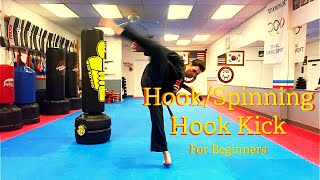
Hook/Spinning Hook Kick Tutorial
US National Taekwondo Academy NJ
![[HD] THE COMPLETE ROUNDHOUSE KICK TUTORIAL | INVINCIBLEWORLDWIDE](https://img.youtube.com/vi/0FqpYIvv9vc/mqdefault.jpg)
[HD] THE COMPLETE ROUNDHOUSE KICK TUTORIAL | INVINCIBLEWORLDWIDE
Invincible Worldwide
Taekwondo For Beginners: Basic Kicking Technique
World Taekwondo Academy
TAEKWONDO HOOK KICK TUTORIAL
Simon Scher
BEST Spinning Hook Kick Tutorial – Step-by-Step Guide!
BVO MASTER CHONG