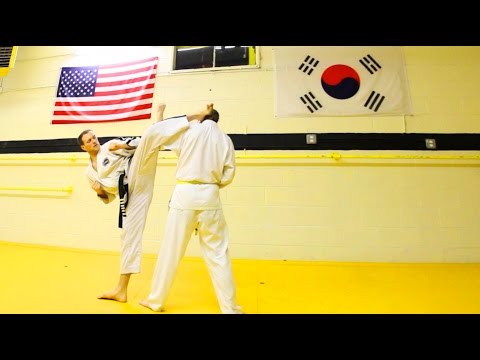
TAEKWONDO HOOK KICK TUTORIAL
0
Standard Hook Kick Technique·Simon Scher
In this tutorial you will learn how to perform and perfect a FULL RANGE OF MOTION hook kick. You will be surprised at th…
Translation: standard hook kick technique
The Standard Hook Kick Technique is executed by chambering the knee, extending the leg past the target as if delivering a side kick, then sharply bending the knee and pulling the heel back to contact the target — typically the temple or jaw — with the flat of the heel. [1] The hips remain turned over throughout the motion, and the hooking retraction is powered by the hamstrings and hip rotators. [1],[2] This technique is most effective when set up by feints or preceding kicks that make the opponent expect a linear attack. [2],[3]
The hook kick strikes with the heel in a hooking trajectory that comes around the opponent's guard from the outside, making it effective against fighters who defend against linear kicks but leave the sides of the head exposed. [1]
The hook kick is a commonly scored technique in World Taekwondo competition, where turning and spinning variants receive bonus points for technical difficulty. [1]
No images yet for this technique.
Sign in to suggest an image.
In this tutorial you will learn how to perform and perfect a FULL RANGE OF MOTION hook kick. You will be surprised at th…
Learn "The One Move That Can Save Your Life" plus get more free martial arts video training and tips at http://WorldTae…
Download this exclusive "Self Defense Kicks 101" Free here: https://scienceofskill.com/Kicking-Technique-Video This vid…
The standard hook kick is a powerful and deceptive striking technique that combines chambering, extension, and controlled retraction. Simon Scher emphasizes the full range-of-motion hook kick as foundational, distinguishing it from casual variations by stress on proper body mechanics and hip engagement. The technique begins with the standing foot pivoted, the kicking leg chambered fully at the chest with heel aimed at target, then extends diagonally forward before the knee bends to strike. Critically, the leg retracts back to chamber position post-strike, preventing the body from rotating fully and exposing the center to the opponent. Scher recommends progressive drills using balance props (cups with balls or water) to develop control, emphasizing that power derives from gluteal and hip muscles rather than arm counterbalance. The technique accommodates two striking methods: pointed-toe contact for controlled sparring and flexed-heel impact for maximum power in board-breaking. Scher also notes the hook kick's utility in combination sequences and its sneaky arcing trajectory from open stance, which allows the foot to strike targets even if the knee contacts an opponent's block. The technique can be performed from stationary, step, turn, spin, or jumping variations. While World Taekwondo Academy and Invincible Worldwide's transcripts focus on front snap and roundhouse kicks respectively, their emphasis on knee alignment, hip rotation, and chamber-based power generation aligns with Scher's foundational principles for controlled, repeatable kicking mechanics.
Synthesized from 3 instructors
No instructional courses yet for this technique.
Sign in to suggest a course.
Risk of injury to the person this technique is applied to
Whipping heel strike; high KO potential to temple
Skill level needed to execute this technique reliably
Whether this technique is allowed under major competition rule sets
Muay Thai: The Art of Fighting (Yod Ruerngsa, Khun Kao Charuad & James Cartmell, 2002)
Alias sources — [1] Dynamic Karate (Nakayama, 1966) [2] Kukkiwon Taekwondo Textbook (Kukkiwon, 2006) [3] Best Karate Vol. 5 (Nakayama, 1979)
Effectiveness sources — [1] Taekwondo: The State of the Art (Jun, 1989)
Official karate technique names (和語/漢語)
Established Japanese martial arts naming convention — native Japanese term (和語/漢語)
Alias sources — [1] Dynamic Karate (Nakayama, 1966) [2] Kukkiwon Taekwondo Textbook (Kukkiwon, 2006) [3] Best Karate Vol. 5 (Nakayama, 1979)
Effectiveness sources — [1] Taekwondo: The State of the Art (Jun, 1989)
hip rotation, horizontal arm acceleration, tight elbow angle
compact build for short-range hooks, strong core
obliques, hip rotators, pectorals, biceps, forearms
Start with a fully chambered leg, then extend it out to the front diagonal. A straight leg pulls through in line with the hip, then the knee bends to strike the target. Simon Scher emphasizes re-chambering at the end of the kick is essential, especially if you want to chain multiple kicks together.
Your hands should be separate from the kick and should not serve as a counterbalance. One hand can be placed by your face while the other stays at your side, but they should remain still when you're throwing the kick.
It depends on your purpose. When sparring and being courteous, point your foot and strike with your toes. When breaking a board, hitting a pad, or demonstrating real power, use the back of the heel with a flexed foot. Simon Scher recommends practicing both variations by alternating between them.
The pull-back keeps you from going full-facing and presenting your center to your opponent, making the technique safer and more effective in sparring.
The hook kick is a sneaky kick—if you throw it in close and your opponent blocks, your knee may hit their block but the foot will still come around and strike them.
The Standard Hook Kick Technique is executed by chambering the knee, extending the leg past the target as if delivering a side kick, then sharply bending the knee and pulling the heel back to contact the target — typically the temple or jaw — with the flat of the heel. The hips remain turned over throughout the motion, and the hooking retraction is powered by the hamstrings and hip rotators.
The standard hook kick technique has been practised in taekwondo and karate competition for decades, with its effectiveness demonstrated in numerous tournament settings. The technique remains a scoring and knockout weapon in World Taekwondo Olympic-format sparring.
Unified MMA: legal — Legal striking technique; WBC/Boxing: banned — All kicks prohibited in boxing; WKF: legal — Legal, chudan (body) kick scores 2 points, jodan (head) kick scores 3 points; Kyokushin: legal — Legal at full power to body and head; WT: legal — Legal, body kick 2 points, head kick 3 points, spinning body 4 points, spinni…; WAKO: legal — Legal in Full Contact and Low Kick formats; K: legal — 1/GLORY — Legal; IFMA: legal — Legal — kicks are a core Muay Thai technique
Danger rating 6/10. High — whipping heel strike; high KO potential to temple
The standard setup chain: Setup with Straight Punch → Pivot the Lead Foot → Arc the Arm → Follow Through.
Standard counters include: Check (Shin Block) — raise the shin to intercept the kick before it lands / Catch and Sweep — catch the kicking leg and sweep the standing leg / Step Inside — close distance inside the kick's effective range to smother it.
Common variants: Standard hook (horizontal-arc punch targeting the jaw or temple); Tight hook (compact, short-range hook for close-quarters fighting); Body hook (targeting the ribs or liver with a downward-angled hook); Check hook (pivoting on the lead foot while throwing the hook as a co…).
The hook kick is a commonly scored technique in World Taekwondo competition, where turning and spinning variants receive bonus points for technical difficulty.
Top errors to watch for: Rushing through the extension and starting the hook too early, before the leg passes the target / Not bending the knee sharply enough during the hook phase — a slight bend produces a weak sweep / Landing on the heel of the support foot, which locks the hip and prevents the pivot needed for the hook / Dropping the guard hand on the kicking side because the torso rotates during the extension.
The Standard Hook Kick Technique is also known as Kagi-geri (Kihon-gata), Standard Ura Mawashi Geri, Standard Huryeo Chagi, Heel Hook Kick.
![[HD] THE COMPLETE ROUNDHOUSE KICK TUTORIAL | INVINCIBLEWORLDWIDE](https://img.youtube.com/vi/0FqpYIvv9vc/hqdefault.jpg)