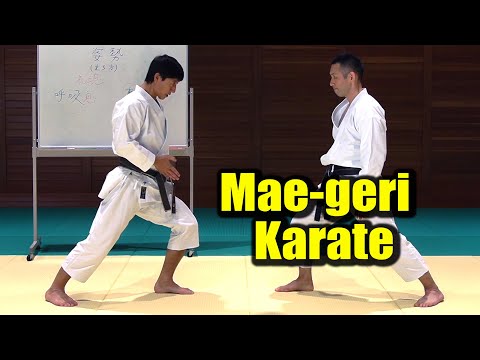
【Karate】How to hit "Mae-geri" (Front kick) from any distance【Tatsuya Naka】
0
Mae Geri Keage·kuro-obi world·Added by Admin
※ This AI voice is created from Naka sensei's own voice with his permission. It is the wish of Kuro-obi World that as ma…
Translation: front snap kick
Mae Geri Keage is the Japanese karate term for the snapping front kick, in which the leg is chambered by raising the knee and then snapped forward rapidly using the knee joint as a hinge, striking with the ball of the foot (koshi) before immediately retracting. [1] The 'keage' designation (meaning 'rising' or 'snapping upward') indicates that the kick follows a slightly upward trajectory at the end of extension, creating a flicking impact that is fast and sharp. [1],[2] Mae Geri Keage is one of the most fundamental kicks in Shotokan, Shito-Ryu, and Wado-Ryu karate, practised extensively in kihon (basics) and kata. [2],[3]
Mae Geri Keage was codified as a distinct technique within the framework of Japanese karate during the early 20th century, with Gichin Funakoshi's Shotokan system classifying front kicks into keage (snap) and kekomi (thrust) types. [1] The technique traces its lineage through Okinawan te to Chinese southern kung fu methods transmitted via trade routes between Fujian and Okinawa. [2],[3]
Lyoto Machida's front kick knockout of Randy Couture at UFC 129 (2011) — derived from his Shotokan karate background — demonstrated the technique's effectiveness in MMA and was trained specifically with Steven Seagal before the fight. [1]
No images yet for this technique.
Sign in to suggest an image.
※ This AI voice is created from Naka sensei's own voice with his permission. It is the wish of Kuro-obi World that as ma…
No instructional courses yet for this technique.
Sign in to suggest a course.
Risk of injury to the person this technique is applied to
Teep/push kick; primarily distance management, liver shot potential
Skill level needed to execute this technique reliably
Whether this technique is allowed under major competition rule sets
Muay Thai: The Art of Fighting (Yod Ruerngsa, Khun Kao Charuad & James Cartmell, 2002)
Alias sources — [1] Dynamic Karate (Nakayama, 1966) [2] Karate-Do Kyohan (Funakoshi, 1935) [3] Kukkiwon Taekwondo Textbook (Kukkiwon, 2006)
Effectiveness sources — [1] Karate-Do Kyohan (Funakoshi, 1935)
Official karate technique names (和語/漢語)
Established Japanese martial arts naming convention — native Japanese term (和語/漢語)
Alias sources — [1] Dynamic Karate (Nakayama, 1966) [2] Karate-Do Kyohan (Funakoshi, 1935) [3] Kukkiwon Taekwondo Textbook (Kukkiwon, 2006)
Effectiveness sources — [1] Karate-Do Kyohan (Funakoshi, 1935)
hip flexion power, knee extension speed, balance
long legs for range, hip flexibility
hip flexors, quadriceps, tibialis anterior, core
According to Tatsuya Naka, focus on transferring your center of gravity to your front leg and using your front hip joints well, rather than only thinking about the kicking leg itself. When you rely too much on the kicking leg alone, it becomes weak when pushed from the front or above.
Tatsuya Naka emphasizes raising your leg itself quickly by lifting your entire foot vertically off the ground, rather than pushing with your toes. Keep your back toes off the floor and use the inside of your body to generate power, which omits the obvious kicking action and makes the technique feel faster to your opponent.
Tatsuya Naka explains that depending on the angle of your ankle, knee, and hip joint, you can adjust your reach: for close distance, a basic kick works; for medium distance, move your ankle and knee forward; for far distance, take your ankle, knee, and hip joint forward even more to extend the kick further.
Mae Geri Keage is the Japanese karate term for the snapping front kick, in which the leg is chambered by raising the knee and then snapped forward rapidly using the knee joint as a hinge, striking with the ball of the foot (koshi) before immediately retracting. The 'keage' designation (meaning 'rising' or 'snapping upward') indicates that the kick follows a slightly upward trajectory at the end of extension, creating a flicking impact that is fast and sharp.
Mae Geri Keage was codified as a distinct technique within the framework of Japanese karate during the early 20th century, with Gichin Funakoshi's Shotokan system classifying front kicks into keage (snap) and kekomi (thrust) types. The technique traces its lineage through Okinawan te to Chinese southern kung fu methods transmitted via trade routes between Fujian and Okinawa.
Unified MMA: legal — Legal striking technique; WBC/Boxing: banned — All kicks prohibited in boxing; WKF: legal — Legal, chudan (body) kick scores 2 points, jodan (head) kick scores 3 points; Kyokushin: legal — Legal at full power to body and head; WT: legal — Legal, body kick 2 points, head kick 3 points, spinning body 4 points, spinni…; WAKO: legal — Legal in Full Contact and Low Kick formats; K: legal — 1/GLORY — Legal; IFMA: legal — Legal — kicks are a core Muay Thai technique
Danger rating 5/10. High — teep/push kick; primarily distance management, liver shot potential
The standard setup chain: Assume Fighting Stance → Generate Power → Execute Strike → Recover to Guard.
Standard counters include: Check (Shin Block) — raise the shin to intercept the kick before it lands / Catch and Sweep — catch the kicking leg and sweep the standing leg / Step Inside — close distance inside the kick's effective range to smother it.
Common variants: Push kick (teep) (pushing the opponent away with the ball of the foot); Snap front kick (snapping the foot to the target and quickly retracting); Side teep (angled teep pushing the opponent laterally); Body teep (driving into the solar plexus or chest for maximum push-back).
Lyoto Machida's front kick knockout of Randy Couture at UFC 129 (2011) — derived from his Shotokan karate background — demonstrated the technique's effectiveness in MMA and was trained specifically with Steven Seagal before the fight.
Top errors to watch for: Confusing keage (snapping) with kekomi (thrusting) — they have fundamentally different trajectories and purposes / Not pulling the toes back, resulting in toe contact instead of ball-of-foot contact / Swinging the leg from the hip instead of snapping from the knee — the hip is the stable platform, the knee is the hinge / Not retracting the kick immediately — keage must snap back as fast as it extends.
The Mae Geri Keage is also known as Mae-geri Keage, Snap Front Kick, Front Snap Kick, Ap Chagi.