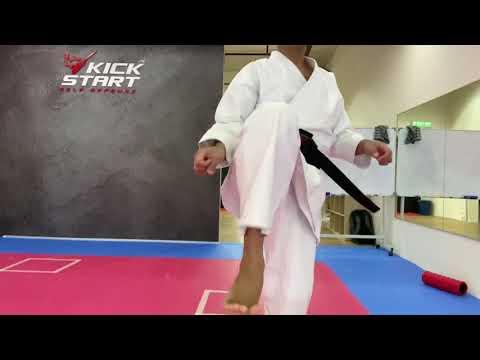
Chudan and Jodan Mae Geri Practice
0
Mae Geri Kekomi·Kick Start Self Defense·Added by Admin
Translation: front thrust kick
Mae Geri Kekomi is the Japanese karate term for the thrusting front kick, in which the leg is chambered and then driven forward in a straight penetrating line, striking with the heel or ball of the foot and pushing through the target with full hip extension. [1] The 'kekomi' designation (meaning 'thrusting' or 'pushing in') indicates a forceful, penetrating kick that prioritises power and displacement over speed and retraction. [1],[2] Mae Geri Kekomi functions similarly to the Muay Thai teep but is typically aimed higher, targeting the solar plexus or chest. [2],[3]
Mae Geri Kekomi was classified alongside Mae Geri Keage in the Shotokan karate system as the thrusting counterpart to the snapping front kick. [1] The distinction between keage and kekomi was an important pedagogical innovation in Japanese karate, teaching students to differentiate between speed-oriented and power-oriented applications of the same basic kick. [2],[3]
Mae geri kekomi (front thrust kick) is a standard karate kick used in kumite and kata competition. [1]
No images yet for this technique.
Sign in to suggest an image.
No instructional courses yet for this technique.
Sign in to suggest a course.
Risk of injury to the person this technique is applied to
Teep/push kick; primarily distance management, liver shot potential
Skill level needed to execute this technique reliably
Whether this technique is allowed under major competition rule sets
Muay Thai: The Art of Fighting (Yod Ruerngsa, Khun Kao Charuad & James Cartmell, 2002)
Alias sources — [1] Dynamic Karate (Nakayama, 1966) [2] Karate-Do Kyohan (Funakoshi, 1935) [3] Best Karate Vol. 4 (Nakayama, 1979)
Effectiveness sources — [1] Karate-Do Kyohan (Funakoshi, 1935)
Official karate technique names (和語/漢語)
Established Japanese martial arts naming convention — native Japanese term (和語/漢語)
Alias sources — [1] Dynamic Karate (Nakayama, 1966) [2] Karate-Do Kyohan (Funakoshi, 1935) [3] Best Karate Vol. 4 (Nakayama, 1979)
Effectiveness sources — [1] Karate-Do Kyohan (Funakoshi, 1935)
hip flexion power, knee extension speed, balance
long legs for range, hip flexibility
hip flexors, quadriceps, tibialis anterior, core
Chudan mae geri targets the opponent's mid-section (chest/torso level), while jodan mae geri targets the face level. Both follow the same fundamental principles but differ in their target height.
Start in your natural walking stance, then move into a Duchy stance with your back leg straight and front leg bent. Keep your back straight and use both hands in a double lower block position for balance.
Bring your knee above your Duchy (hip level) as you chamber the kick, then extend from the ball of your foot. This ensures proper height and power generation for the technique.
Mae Geri Kekomi is the Japanese karate term for the thrusting front kick, in which the leg is chambered and then driven forward in a straight penetrating line, striking with the heel or ball of the foot and pushing through the target with full hip extension. The 'kekomi' designation (meaning 'thrusting' or 'pushing in') indicates a forceful, penetrating kick that prioritises power and displacement over speed and retraction.
Mae Geri Kekomi was classified alongside Mae Geri Keage in the Shotokan karate system as the thrusting counterpart to the snapping front kick. The distinction between keage and kekomi was an important pedagogical innovation in Japanese karate, teaching students to differentiate between speed-oriented and power-oriented applications of the same basic kick.
Unified MMA: legal — Legal striking technique; WBC/Boxing: banned — All kicks prohibited in boxing; WKF: legal — Legal, chudan (body) kick scores 2 points, jodan (head) kick scores 3 points; Kyokushin: legal — Legal at full power to body and head; WT: legal — Legal, body kick 2 points, head kick 3 points, spinning body 4 points, spinni…; WAKO: legal — Legal in Full Contact and Low Kick formats; K: legal — 1/GLORY — Legal; IFMA: legal — Legal — kicks are a core Muay Thai technique
Danger rating 5/10. High — teep/push kick; primarily distance management, liver shot potential
The standard setup chain: Assume Fighting Stance → Generate Power → Execute Strike → Recover to Guard.
Standard counters include: Check (Shin Block) — raise the shin to intercept the kick before it lands / Catch and Sweep — catch the kicking leg and sweep the standing leg / Step Inside — close distance inside the kick's effective range to smother it.
Common variants: Push kick (teep) (pushing the opponent away with the ball of the foot); Snap front kick (snapping the foot to the target and quickly retracting); Side teep (angled teep pushing the opponent laterally); Body teep (driving into the solar plexus or chest for maximum push-back).
Mae geri kekomi (front thrust kick) is a standard karate kick used in kumite and kata competition.
Top errors to watch for: Not driving the hip forward on impact — the hip thrust is what separates kekomi from a simple leg extension / Confusing kekomi (thrusting) with keage (snapping) — kekomi drives through, keage snaps back / Leaning the upper body back too far, which disconnects the core from the kick / Thrusting with a bent knee at impact — the leg should be nearly fully extended at the moment of contact.
The Mae Geri Kekomi is also known as Mae-geri Kekomi, Thrust Front Kick, Front Thrust Kick, Pushing Mae Geri.