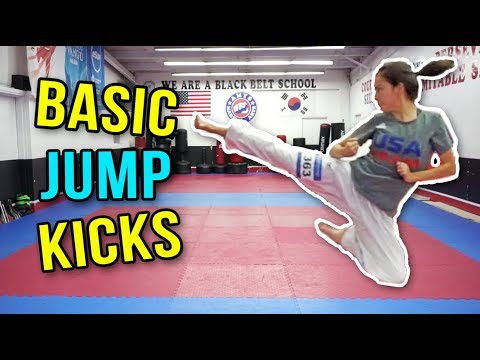
BASIC MARTIAL ARTS JUMP KICKS | Samery Moras Taekwondo
0
Standard Flying Front Kick·Black Belt Samery·Added by Admin
Taekwondo Tutorial on basic jump kicks: Jumping Front Snap Kick, Jump Side Kick, and Jump Splits Kick! 🔥 Join Live Mart…
Translation: standard flying front kick
The Standard Flying Front Kick is executed by leaping off the rear foot, driving the lead knee upward for height, and then extending the kicking leg in a linear front kick thrust at the apex of the jump, targeting the opponent's chin, chest, or solar plexus with the ball of the foot or heel. [1] The leap adds forward momentum that is transferred into the kick, and the kicker must aim to contact the target at the highest point of the jump for maximum effect. [1],[2] This technique is used in taekwondo breaking demonstrations, forms competition, and occasionally in full-contact fighting. [2],[3]
The standard flying front kick is a fundamental aerial technique in taekwondo and karate, practised in board-breaking demonstrations and forms (poomsae/kata) across these arts. [1] It became an iconic MMA technique after Lyoto Machida knocked out Randy Couture with a jumping front kick at UFC 129 in 2011. [2],[3]
The flying front kick adds airborne momentum and height to a front kick, allowing the striker to reach the head of even taller opponents and delivering significant impact through the combination of forward leap and thrust. [1]
Flying kicks are found across karate, taekwondo, and various kung fu styles, representing advanced aerial techniques developed for both combat and demonstration purposes. [1]
Anderson Silva's flying front kick knockout of Vitor Belfort at UFC 126 (2011) is one of the most celebrated finishes in MMA history and revived interest in front kick techniques. [1]
No images yet for this technique.
Sign in to suggest an image.
Taekwondo Tutorial on basic jump kicks: Jumping Front Snap Kick, Jump Side Kick, and Jump Splits Kick! 🔥 Join Live Mart…
No instructional courses yet for this technique.
Sign in to suggest a course.
Risk of injury to the person this technique is applied to
Airborne kicks maximize momentum; high injury risk to both fighters
Skill level needed to execute this technique reliably
Whether this technique is allowed under major competition rule sets
Muay Thai: The Art of Fighting (Yod Ruerngsa, Khun Kao Charuad & James Cartmell, 2002)
Alias sources — [1] Dynamic Karate (Nakayama, 1966) [2] Kukkiwon Taekwondo Textbook (Kukkiwon, 2006) [3] Best Karate Vol. 5 (Nakayama, 1979)
Effectiveness sources — [1] Karate-Do Kyohan (Funakoshi, 1935)
Official karate technique names (和語/漢語)
Established Japanese martial arts naming convention — native Japanese term (和語/漢語)
Alias sources — [1] Dynamic Karate (Nakayama, 1966) [2] Kukkiwon Taekwondo Textbook (Kukkiwon, 2006) [3] Best Karate Vol. 5 (Nakayama, 1979)
Effectiveness sources — [1] Karate-Do Kyohan (Funakoshi, 1935)
hip flexion power, knee extension speed, balance
long legs for range, hip flexibility
hip flexors, quadriceps, tibialis anterior, core
You must first be able to perform a standard front snap kick, as this is the prerequisite for learning the jump version. Black Belt Samery emphasizes starting from a proper fighting stance before progressing to the airborne technique.
Start in your fighting stance with hands up, bring your opposite (non-kicking) knee up first, then jump and bring the second knee up before extending the kick. Black Belt Samery stresses bringing your knees up first before extending them out to avoid a 'cheerleading style' jump.
Yes, Black Belt Samery recommends practicing on both legs so you can execute the technique every way.
The Standard Flying Front Kick is executed by leaping off the rear foot, driving the lead knee upward for height, and then extending the kicking leg in a linear front kick thrust at the apex of the jump, targeting the opponent's chin, chest, or solar plexus with the ball of the foot or heel. The leap adds forward momentum that is transferred into the kick, and the kicker must aim to contact the target at the highest point of the jump for maximum effect.
The standard flying front kick is a fundamental aerial technique in taekwondo and karate, practised in board-breaking demonstrations and forms (poomsae/kata) across these arts. It became an iconic MMA technique after Lyoto Machida knocked out Randy Couture with a jumping front kick at UFC 129 in 2011.
Unified MMA: legal — Legal striking technique; WBC/Boxing: banned — All kicks prohibited in boxing; WKF: legal — Legal, chudan (body) kick scores 2 points, jodan (head) kick scores 3 points; Kyokushin: legal — Legal at full power to body and head; WT: legal — Legal, body kick 2 points, head kick 3 points, spinning body 4 points, spinni…; WAKO: legal — Legal in Full Contact and Low Kick formats; K: legal — 1/GLORY — Legal; IFMA: legal — Legal — kicks are a core Muay Thai technique
Danger rating 7/10. Very High — airborne kicks maximize momentum; high injury risk to both fighters
The standard setup chain: Stance and Range → Chamber the Leg → Execute the Kick → Recover.
Standard counters include: Check (Shin Block) — raise the shin to intercept the kick before it lands / Catch and Sweep — catch the kicking leg and sweep the standing leg / Step Inside — close distance inside the kick's effective range to smother it.
Common variants: Push kick (teep) (pushing the opponent away with the ball of the foot); Snap front kick (snapping the foot to the target and quickly retracting); Side teep (angled teep pushing the opponent laterally); Body teep (driving into the solar plexus or chest for maximum push-back).
Anderson Silva's flying front kick knockout of Vitor Belfort at UFC 126 (2011) is one of the most celebrated finishes in MMA history and revived interest in front kick techniques.
Top errors to watch for: Taking too many preparatory steps, which telegraphs the flying kick / Not driving the non-kicking knee high enough to generate the leap / Extending the kick too early (still rising) and losing the forward trajectory / Landing flat on both feet after the kick, jarring the knees and preventing quick recovery.
The Standard Flying Front Kick is also known as Tobi Mae-geri (Kihon-gata), Standard Tobi Mae Geri, Standard Twi-eo Ap Chagi, Jumping Snap Kick.