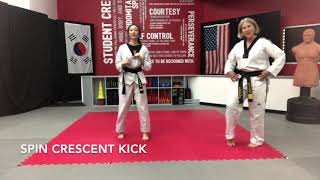
The Rubber Band Principle of Spinning Kicks
Spinning kicks derive their power from the unwinding motion, similar to releasing a twisted rubber band. The technique requires first winding the body, then explosively unwinding to generate force. This fundamental principle underlies all effective spinning kick mechanics.
Inside Crescent Kick Foundation
Students begin with the inside crescent kick in a right foot back fighting stance. Using an obstacle helps practitioners achieve proper leg height and positioning. The foot placement from this initial kick serves as the setup for the subsequent spinning motion.
The Wind-Unwind Transition
After executing the inside crescent kick, the practitioner pivots and performs a hand slap to initiate the spinning action. Critically, the movement should pass beyond the target rather than stop at it. This over-extension creates the necessary momentum for the automatic leg lift and spinning transition.
Hand Slap as a Teaching Tool
The hand slap serves exclusively as a temporary instructional device to establish proper spinning mechanics. Once students develop consistent rotation, the hand gesture is eliminated in favor of maintaining proper guard position. This progressive removal ensures techniques transition toward realistic combat application.
Contact Point and Foot Positioning
The spinning crescent kick makes contact using the side of the foot, not the toes. Practitioners must avoid rotating their toes inward, which would compromise both accuracy and power delivery. Proper foot alignment ensures effective target engagement throughout the technique.
Bent vs. Straight Leg Variations
Two primary approaches exist for executing the spinning crescent: a bent leg configuration for close-range encounters and a straight leg swing for extended distances. Both variations are equally effective depending on the practitioner's distance from the target. Distance assessment determines which variation to employ.
Standalone Spinning Crescent Execution
The spinning crescent kick performed independently requires pivoting the front foot and rotating the entire body before striking. The upper body initiates the movement, with the lower body following naturally through the rotation. Proper breathing coordination during extension enhances power release and control.
Heel Positioning and Directional Accuracy
The heel functions as a directional indicator, similar to a gun sight; wherever it points determines the trajectory. Pointing the heel past the intended impact point facilitates smoother execution and better power distribution. This anticipatory positioning makes the technique more efficient and controlled.
Left Side Execution and Stepping Pattern
The left-side spinning crescent requires stepping into the technique, mirroring the back kick setup methodology. This footwork ensures proper distance closure and body alignment before rotation. The stepping motion establishes the foundation for effective power generation on the non-dominant side.
Progressive Training Sequence
The complete training progression moves from inside crescent kick through spinning crescent toward mastery of the standalone spinning crescent kick. Alternating between right and left sides during practice ensures balanced development. This structured approach pre-frames students and prepares them for advanced spinning kick variations.
Inside Crescent to Spinning Crescent Kick
Key Takeaways
- •The Rubber Band Principle of Spinning Kicks
- •Inside Crescent Kick Foundation
- •The Wind-Unwind Transition
- •Hand Slap as a Teaching Tool
Related Techniques
Frequently Asked Questions
What does this video teach about spin-back outside crescent kick?
This video covers the rubber band principle of spinning kicks, inside crescent kick foundation, the wind-unwind transition. It provides detailed instruction from Fariborz Azhakh.
How long does it take to learn spin-back outside crescent kick?
The basic mechanics can be understood in a single session, but developing reliable execution requires consistent drilling over weeks of practice. This 10-part breakdown helps structure your training by isolating each phase of the technique.
What are the key details for finishing spin-back outside crescent kick?
The left-side spinning crescent requires stepping into the technique, mirroring the back kick setup methodology. This footwork ensures proper distance closure and body alignment before rotation. The stepping motion establishes the foundation for effective power generation on the non-dominant side.