Elbows & Hands. What’s a Crescent Kick for? Re-chamber your front kicks.
0
Standard Inside Axe Kick·Ramsey Dewey
Q&A with the coach Let’s talk technique
Translation: standard inside axe kick
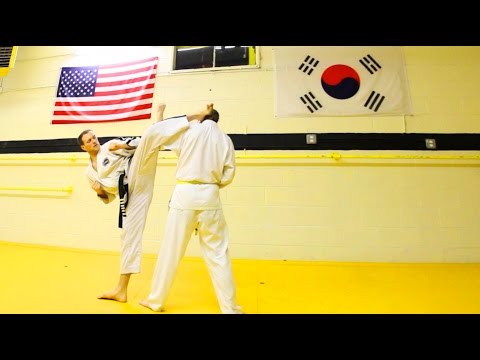
The Standard Inside Axe Kick is executed by swinging the kicking leg upward along the body's centreline, passing inside the opponent's guard, and then driving the heel straight down onto the opponent's collarbone, shoulder, or head. [1] The kicker uses hip flexion and adductor engagement to lift the leg along the medial path before gravity and active hip extension accelerate the downward strike. [1],[2] This variant is commonly used in taekwondo sparring as a scoring technique targeting the head. [2],[3]
Standard inside axe kick. [1]
A TKD/karate technique. [1]
Used in competition. [1]
No images yet for this technique.
Sign in to suggest an image.
Q&A with the coach Let’s talk technique
In this tutorial you will learn how to perform and perfect a FULL RANGE OF MOTION hook kick. You will be surprised at th…
Please Hit Like, Comment, Share and Subscribe to my Channel 👍 Sport (or sports) is all forms of usually competitive ph…
The standard inside axe kick does not receive direct instruction in the provided transcripts. Ramsey Dewey discusses crescent kicks as close-range head strikes executed from inside clinch distance, emphasizing their application in combinations and their use as fakes to set up secondary attacks like liver kicks. Simon Scher provides extensive technical instruction on the hook kick, covering chamber mechanics, hip and glute engagement, hand positioning, pivot footwork, target accuracy, striking surface variation (heel versus toe), and re-chambering for combination execution. While Scher's hook kick methodology—particularly chamber-extend-retract sequencing, hip drive engagement, and re-chambering discipline—shares biomechanical principles common to axe-kick variants, none of the instructors directly address the inside axe kick specifically. PJSPORTS TV VLOGS transcript contains only boxing fundamentals and is not applicable to kicking technique instruction.
Synthesized from 3 instructors
No instructional courses yet for this technique.
Sign in to suggest a course.
Risk of injury to the person this technique is applied to
Downward heel strike; collarbone/head impact risk
Skill level needed to execute this technique reliably
Whether this technique is allowed under major competition rule sets
Karate-Do Kyohan: The Master Text (Gichin Funakoshi, 1935)
Alias sources — [1] Kukkiwon Taekwondo Textbook (Kukkiwon, 2006) [2] Taekwondo: The State of the Art (Park, 1989) [3] Karate-Do Kyohan (Funakoshi, 1935)
Effectiveness sources — [1] Comprehensive Asian Fighting Arts (Draeger & Smith, 1969)
Mixed Japanese-Western terminology — combines traditional Japanese terms with katakana loanwords
Alias sources — [1] Kukkiwon Taekwondo Textbook (Kukkiwon, 2006) [2] Taekwondo: The State of the Art (Park, 1989) [3] Karate-Do Kyohan (Funakoshi, 1935)
Effectiveness sources — [1] Comprehensive Asian Fighting Arts (Draeger & Smith, 1969)
exceptional hip flexibility, hamstring length, leg raising speed
extremely flexible hips for raising the leg above head height
hip flexors, hamstrings (eccentric), quadriceps, core
According to Simon Scher, when sparring you point your foot and strike with your toes to be courteous and avoid excessive power, but when breaking boards or hitting pads to demonstrate real power, you use the back of the heel with a flexed foot.
Simon Scher emphasizes that re-chambering is essential because it keeps you from rotating fully and presenting your center to your opponent, and it's necessary for chaining multiple kicks together.
Simon Scher advises that your hands should remain separate from the kick and should not move or serve as a counterbalance when you're executing the technique.
Simon Scher notes that the hook kick is a sneaky kick because if you throw it in close range, your knee can make contact with your opponent's block and the foot will still curve around and strike the target.
The Standard Inside Axe Kick is executed by swinging the kicking leg upward along the body's centreline, passing inside the opponent's guard, and then driving the heel straight down onto the opponent's collarbone, shoulder, or head. The kicker uses hip flexion and adductor engagement to lift the leg along the medial path before gravity and active hip extension accelerate the downward strike.
The standard inside axe kick was developed within taekwondo sport competition as an effective way to score with a downward technique that could penetrate the opponent's guard from an unexpected inside angle. It has been a regular feature of World Taekwondo championship competition.
Unified MMA: legal — Legal striking technique; WBC/Boxing: banned — All kicks prohibited in boxing; WKF: legal — Legal, chudan (body) kick scores 2 points, jodan (head) kick scores 3 points; Kyokushin: legal — Legal at full power to body and head; WT: legal — Legal, body kick 2 points, head kick 3 points, spinning body 4 points, spinni…; WAKO: legal — Legal in Full Contact and Low Kick formats; K: legal — 1/GLORY — Legal; IFMA: legal — Legal — kicks are a core Muay Thai technique
Danger rating 6/10. High — downward heel strike; collarbone/head impact risk
The standard setup chain: Stance and Range → Chamber the Leg → Execute the Kick → Recover.
Standard counters include: Check (Shin Block) — raise the shin to intercept the kick before it lands / Catch and Sweep — catch the kicking leg and sweep the standing leg / Step Inside — close distance inside the kick's effective range to smother it.
Common variants: Outside axe kick (raising the leg outside and bringing the heel straight down); Inside axe kick (raising the leg inside in a crescent arc before chopping …); Spinning axe kick (adding a spin before the downward chop).
Used in competition.
Top errors to watch for: Not completing the full arc — the leg must go up and over, not just swing across at one height / Landing with the ankle or instep instead of the heel — the heel is the hardest surface and the correct impact point / Falling toward the opponent after the chop because of poor balance on the support leg / Not chopping aggressively enough — the downward motion must be forceful, not a gentle lowering.
The Standard Inside Axe Kick is also known as Sutandādo Uchi Kakato Otoshi, An Naeryeo Chagi, Standard Descending Heel Kick, Inside Kakato Otoshi.