Elbow Strikes: Open Hand vs. Closed Fist
When executing elbow strikes, an open hand provides superior biomechanical advantage over a closed fist. The closed fist creates unnecessary muscle tension in the forearm and rotator cuff, restricting efficient elbow extension and increasing shoulder injury risk. An open hand allows the striker to maintain loose, explosive musculature while the fingers remain safely positioned near the head, far from the point of contact.
Why Open-Handed Elbows Prove More Effective
Open-handed elbow techniques eliminate muscle padding around the striking surface, creating a harder, more concentrated point of impact compared to a closed fist. The additional muscle tension from closing the fist significantly reduces rotational efficiency, particularly in upward elbow strikes where finger placement naturally protects the back of the head. For practitioners in full-contact environments, this distinction translates to measurably superior striking power.
Crescent Kick Application and Range
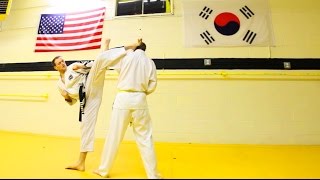
The crescent kick functions as a close-range head strike executed from clinch distance or arm's reach from an opponent. Rather than a standalone technique, it serves best as a combination strike or setup tool within combination sequences. Practitioners often underestimate the crescent kick's power due to insufficient practice at the appropriate range, typically reserving it for intermediate and advanced sparring.
Using Crescent Kicks as Feints and Combinations
Experienced fighters employ crescent kicks as powerful deceptive tools to manipulate opponent positioning. A high crescent kick directed at the head naturally forces the defender to raise their guard, creating openings for secondary strikes like liver kicks. Effective crescent kick utilization requires substantial drilling and confidence in close-range infighting, skills many beginners avoid due to the inherent contact risks of full-contact training.
Front Kick Recovery: Re-chambering vs. Dropping
When executing front kicks with forward momentum, practitioners must re-chamber the leg rather than allowing it to drop or extend fully. A fully extended front kick presents an immediate catching vulnerability, particularly against skilled catch wrestlers and traditional Chinese martial artists trained in leg capture techniques. Re-chambering maintains defensive integrity and prevents easily executed single-leg takedowns while still enabling forward pressure and range closure.
Front Kick Defense Against Capture Specialists
In sanda and similar full-contact striking sports, careless front kick extension invites experienced opponents to execute immediate leg catches followed by devastating single-leg takedowns. Proper re-chamber technique significantly reduces catch vulnerability while maintaining the kicker's ability to bridge distance gaps and transition into close-range striking combinations. This defensive consideration remains essential regardless of the practitioner's intention to advance forward after the kick.
Elbows & Hands. What’s a Crescent Kick for? Re-chamber your front kicks.
Key Takeaways
- •Elbow Strikes: Open Hand vs. Closed Fist
- •Why Open-Handed Elbows Prove More Effective
- •Crescent Kick Application and Range
- •Using Crescent Kicks as Feints and Combinations
Q&A with the coach Let’s talk technique
Frequently Asked Questions
What does this video teach about standard inside axe kick?
This video covers elbow strikes: open hand vs. closed fist, why open-handed elbows prove more effective, crescent kick application and range. It provides detailed instruction from Ramsey Dewey.
How long does it take to learn standard inside axe kick?
The basic mechanics can be understood in a single session, but developing reliable execution requires consistent drilling over weeks of practice. This 6-part breakdown helps structure your training by isolating each phase of the technique.
What are the key details for finishing standard inside axe kick?
When executing front kicks with forward momentum, practitioners must re-chamber the leg rather than allowing it to drop or extend fully. A fully extended front kick presents an immediate catching vulnerability, particularly against skilled catch wrestlers and traditional Chinese martial artists trained in leg capture techniques. Re-chambering maintains defensive integrity and prevents easily executed single-leg takedowns while still enabling forward pressure and range closure.