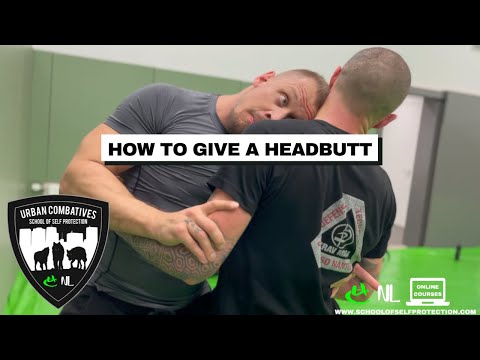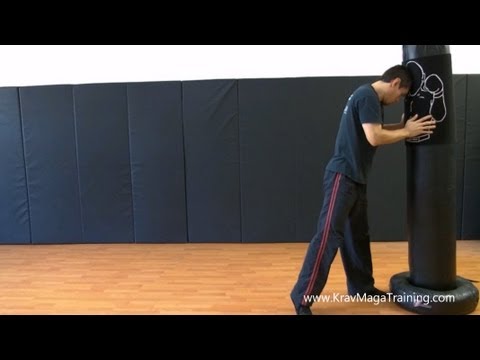
Krav Maga - Forward Headbutt (Tips to Improve Power)
0
Standard Forward Headbutt·Krav Maga Worldwide - Fort Lauderdale, Florida
This video shows the student how to develop more power and confidence in the Forward Headbutt (and all headbutts in gene…
Translation: standard forward headbutt
The Standard Forward Headbutt subfamily describes the conventional forward headbutt where the striker drives the forehead directly into the opponent's facial targets from a face-to-face position. [1] The technique involves a explosive extension of the neck, often augmented by a step or hip drive, to ram the frontal bone into the opponent's nose, mouth, or brow. [1],[2] Proper technique requires targeting with the area above the eyebrows and below the hairline, which is the thickest part of the frontal bone. [2],[3]
The standard forward headbutt has been documented in fighting contexts for millennia, from ancient pankration competitions where head strikes were legal to modern Lethwei bouts in Myanmar. [1] Self-defence instructors have taught this technique as a last-resort close-range weapon, and it features in the curricula of Krav Maga, Systema, and various military combatives programmes. [2],[3]
Standard forward headbutt. [1]
Traditional technique. [1]
Illegal in modern competition. [1]
No images yet for this technique.
Sign in to suggest an image.
This video shows the student how to develop more power and confidence in the Forward Headbutt (and all headbutts in gene…
ONLINE COURSES AND MORE INFO: www.schoolofselfprotection.com NEW COURSES ONLINE! https://schoolofselfprotection.thinki…
No instructional courses yet for this technique.
Sign in to suggest a course.
Risk of injury to the person this technique is applied to
Frontal bone impact; severe laceration and concussion risk to both
Skill level needed to execute this technique reliably
Whether this technique is allowed under major competition rule sets
Dirty Boxing for Mixed Martial Arts (Anderson Silva, 2012)
Alias sources — [1] The Noble Art of Self-Defence (Downey, 1967) [2] British boxing slang (Hazlitt, 1822) [3] Dirty Boxing (Hatmaker, 2006)
Effectiveness sources — [1] Comprehensive Asian Fighting Arts (Draeger & Smith, 1969)
Mixed Japanese-Western terminology — combines traditional Japanese terms with katakana loanwords
Alias sources — [1] The Noble Art of Self-Defence (Downey, 1967) [2] British boxing slang (Hazlitt, 1822) [3] Dirty Boxing (Hatmaker, 2006)
Effectiveness sources — [1] Comprehensive Asian Fighting Arts (Draeger & Smith, 1969)
strong neck stabilisation, explosive forward drive, short range comfort
thick frontal bone, strong neck muscles
neck flexors, trapezius, core, legs (for drive)
Every move, in any martial art, shares a few universal traits. Mix and match below to pinpoint the right tool — or compare equivalents across styles.
Bending your knees is crucial for both generating power and landing accurately with the crown of your head on the opponent's face rather than colliding heads or striking with your eyebrows or temple, which can cause damage to you. According to Krav Maga Worldwide, you should also look up at your opponent's face before delivering the technique to ensure clean contact with the soft tissues of their face.
Krav Maga Worldwide emphasizes focusing on a good leg drive when practicing on pads and targets, but eventually you need to spar with actual resistance and headgear to develop real proficiency. Simply drilling the motion without live practice won't translate to effective technique.
The headbutt doesn't require much space and is a very short move that generates substantial power because the head is large compared to the fists or other striking surfaces. According to Krav Maga Worldwide, opponents often don't see it coming due to its close-range nature.
According to Urban Combatives, you should not stabilize your head and then deliver a headbutt expecting not to get hurt or knock someone out—that is a critical mistake. You need to drive power through your entire body, starting with your back foot to initiate the kinetic chain.
The Standard Forward Headbutt subfamily describes the conventional forward headbutt where the striker drives the forehead directly into the opponent's facial targets from a face-to-face position. The technique involves a explosive extension of the neck, often augmented by a step or hip drive, to ram the frontal bone into the opponent's nose, mouth, or brow.
The standard forward headbutt has been documented in fighting contexts for millennia, from ancient pankration competitions where head strikes were legal to modern Lethwei bouts in Myanmar. Self-defence instructors have taught this technique as a last-resort close-range weapon, and it features in the curricula of Krav Maga, Systema, and various military combatives programmes.
Unified MMA: banned — Headbutts prohibited; WBC/Boxing: banned — Prohibited; WKF: banned — Prohibited; Kyokushin: banned — Prohibited; WT: banned — Prohibited; ITF: banned — Prohibited; WAKO: banned — Prohibited; K: banned — 1/GLORY — Prohibited; IFMA: banned — Prohibited; FIAS Combat Sambo: legal — Legal — headbutts permitted in combat sambo
Danger rating 8/10. Very High — frontal bone impact; severe laceration and concussion risk to both
The standard setup chain: Assume Fighting Stance → Generate Power → Execute Strike → Recover to Guard.
Standard counters include: Block — absorb the strike with a protective guard position / Evasion — move the target out of the strike's path / Counter-Attack — time an offensive response during the recovery phase of the strike.
Common variants: Standard variation (primary execution of the strike from the most common stance); Power variation (modified mechanics for maximum force generation); Speed variation (minimised telegraph for a faster, harder-to-read attack); Counter variation (timed to exploit the opponent's offensive commitment).
Illegal in modern competition.
Top errors to watch for: Craning the neck forward without driving from the legs — neck-only headbutts are weak and risk self-injury / Hitting the opponent's forehead with your own — equal force to both skulls / Not gripping the opponent to control the distance and angle / Closing the eyes during delivery — vision is essential for accuracy.
The Standard Forward Headbutt is also known as Sutandādo Mae Zutsuki, Glasgow Kiss, Nut, Liverpool Kiss.