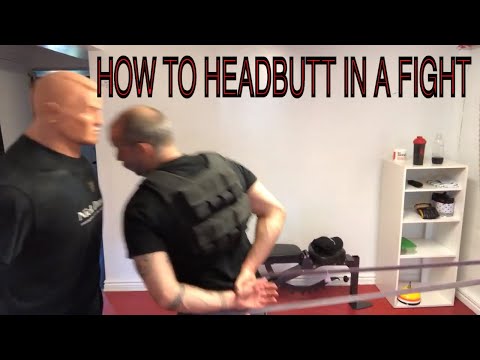
Krav Maga - How to Train a Headbutt
0
Forward Headbutt·Nick Drossos Defensive Tactics
LEARN REAL WORLD SELF DEFENSE : https://www.nickdrossos.com/membership/ 1 ON 1 COACHING: https://www.nickdrossos.com/p…
Translation: forward headbutt
The Forward Headbutt family covers headbutt strikes delivered in a forward direction, where the striker drives the frontal bone of the skull into the opponent's face, typically targeting the nose, brow ridge, or orbital area. [1] The forward headbutt is the most common and naturally instinctive headbutt technique, utilising a sharp forward thrust of the neck and upper torso to accelerate the hardest part of the skull into a vulnerable target. [1],[2] Effective execution requires the striker to tuck the chin slightly and strike with the hairline area of the forehead, which provides maximum bone density and minimises the risk of self-injury. [2],[3]
The forward headbutt is the most universally practised headbutt technique across all cultures with fighting traditions. [1] It appears in Lethwei competition as a standard offensive technique, in Krav Maga as a self-defence tool for close-quarters confrontation, and historically in bare-knuckle boxing and street fighting throughout Europe. [1],[2] The technique's simplicity and effectiveness ensured its persistence in combat traditions despite widespread prohibition in regulated sport. [2],[3]
The forward headbutt strikes with the forehead directly into the opponent's face. [1]
A traditional striking technique banned in modern combat sports. [1]
Illegal in modern MMA and boxing. [1]
No images yet for this technique.
Sign in to suggest an image.
LEARN REAL WORLD SELF DEFENSE : https://www.nickdrossos.com/membership/ 1 ON 1 COACHING: https://www.nickdrossos.com/p…
No instructional courses yet for this technique.
Sign in to suggest a course.
Risk of injury to the person this technique is applied to
Frontal bone impact; severe laceration and concussion risk to both
Skill level needed to execute this technique reliably
Whether this technique is allowed under major competition rule sets
Dirty Boxing for Mixed Martial Arts (Anderson Silva, 2012)
Alias sources — [1] Boxing Mastery (Hatmaker, 2004) [2] Boxing Mastery (Hatmaker, 2004)
Effectiveness sources — [1] Comprehensive Asian Fighting Arts (Draeger & Smith, 1969)
Official karate technique names (和語/漢語)
Established Japanese martial arts naming convention — native Japanese term (和語/漢語)
Alias sources — [1] Boxing Mastery (Hatmaker, 2004) [2] Boxing Mastery (Hatmaker, 2004)
Effectiveness sources — [1] Comprehensive Asian Fighting Arts (Draeger & Smith, 1969)
strong neck stabilisation, explosive forward drive, short range comfort
thick frontal bone, strong neck muscles
neck flexors, trapezius, core, legs (for drive)
Every move, in any martial art, shares a few universal traits. Mix and match below to pinpoint the right tool — or compare equivalents across styles.
Headbutts appear in 127 passages across 27 books. The forward headbutt uses the hard frontal bone of the skull — the hardest part of the body — against the opponent's soft facial bones. Banned in all modern sport combat (MMA, boxing, Muay Thai) but a standard self-defense technique. (27 books; military combatives manuals)
You should use the top of your head to strike the opponent's facial targets like the nose, chin, or jaw. According to Nick Drossos, the nose is the optimal target, as it will cause the most damage.
Nick Drossos emphasizes that you should move your whole body, not just your head—the motion is similar to the mechanics of sneezing, creating power through full-body coordination.
Use the headbutt when you're in close range or clinched with an opponent, where it works effectively alongside other close-quarter strikes like elbows and knees.
Nick Drossos recommends training headbutts on your knees while also practicing elbows and knees together, since all three are close-range strikes that work in combination during actual clinch fighting.
The Forward Headbutt family covers headbutt strikes delivered in a forward direction, where the striker drives the frontal bone of the skull into the opponent's face, typically targeting the nose, brow ridge, or orbital area. The forward headbutt is the most common and naturally instinctive headbutt technique, utilising a sharp forward thrust of the neck and upper torso to accelerate the hardest part of the skull into a vulnerable target.
The forward headbutt is the most universally practised headbutt technique across all cultures with fighting traditions. It appears in Lethwei competition as a standard offensive technique, in Krav Maga as a self-defence tool for close-quarters confrontation, and historically in bare-knuckle boxing and street fighting throughout Europe.
Unified MMA: banned — Headbutts prohibited; WBC/Boxing: banned — Prohibited; WKF: banned — Prohibited; Kyokushin: banned — Prohibited; WT: banned — Prohibited; ITF: banned — Prohibited; WAKO: banned — Prohibited; K: banned — 1/GLORY — Prohibited; IFMA: banned — Prohibited; FIAS Combat Sambo: legal — Legal — headbutts permitted in combat sambo
Danger rating 8/10. Very High — frontal bone impact; severe laceration and concussion risk to both
The standard setup chain: Assume Fighting Stance → Generate Power → Execute Strike → Recover to Guard.
Standard counters include: Block — absorb the strike with a protective guard position / Evasion — move the target out of the strike's path / Counter-Attack — time an offensive response during the recovery phase of the strike.
Common variants: Standard variation (primary execution of the strike from the most common stance); Power variation (modified mechanics for maximum force generation); Speed variation (minimised telegraph for a faster, harder-to-read attack); Counter variation (timed to exploit the opponent's offensive commitment).
Illegal in modern MMA and boxing.
Top errors to watch for: Using the top of the head instead of the forehead — high cervical spine injury risk / Headbutting forehead-to-forehead, which injures both fighters equally / Closing the eyes on impact — this causes you to miss the target and reduces accuracy / Relying on neck extension alone — the power must come from the legs and torso driving forward.
The Forward Headbutt is also known as Mae Zutsuki, Straight Headbutt, Front Head Strike.