Strike & defenceLocksClose rangeFighting multiple people
Distance
CloseMiddleLong
Body target
Upper bodyMiddle bodyLower body
Overview
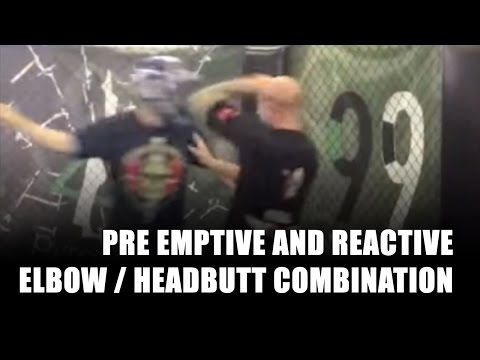
The Standard Forward Headbutt Technique is executed by tucking the chin to present the hard frontal bone, gripping the opponent's shoulders or head for control, and driving the forehead explosively into the opponent's nose or orbital area. [1] The neck muscles contract isometrically to create a rigid connection between the skull and torso, and the force is generated primarily through the legs and hips driving the body forward. [1],[2] This technique is trained in Lethwei, Krav Maga, and military combatives as a high-damage close-quarters weapon. [2],[3]
This fundamental headbutt technique has been used in combat throughout human history and remains a staple of Lethwei competition in Myanmar, where it is considered a legitimate and celebrated weapon. [1] Military self-defence manuals from the 20th century, including those by William Fairbairn and Rex Applegate, describe the forward headbutt as an essential close-combat tool. [2],[3]
Primary Action — Driving the hardest part of the skull (frontal bone) into a vulnerable target
Joints Involved — Cervical spine (stabilised for impact), hips and legs (forward drive), core (body weight transfer)
Force Vector — Short, explosive forward or upward thrust — minimal windup maximises surprise
Impact Mechanic — The frontal bone is the thickest cranial bone — targeting soft tissue (nose, orbital) with the hardest bone creates asymmetric damage
Position & Entry
From clinch range — In close quarters, drive the forehead (frontal bone) into the opponent's nose, orbital, or cheekbone
As surprise (from collar tie) — While controlling the head with a collar tie, snap the forehead forward into the face
Variants
Standard variation — primary execution of the strike from the most common stance
Power variation — modified mechanics for maximum force generation
Speed variation — minimised telegraph for a faster, harder-to-read attack
Counter variation — timed to exploit the opponent's offensive commitment
4OtherJapanese Martial Arts Standard Terminology (武道用語)
Established Japanese martial arts naming convention — native Japanese term (和語/漢語)
5CitationBoxing (Dempsey, 1950)
Alias sources — [1] Dirty Boxing (Hatmaker, 2006) [2] The Noble Art of Self-Defence (Downey, 1967) [3] Complete Krav Maga (Levine & Whitman, 2007)
6CitationMuay Thai: The Art of Fighting (Kraitus, 2002)
Effectiveness sources — [1] Comprehensive Asian Fighting Arts (Draeger & Smith, 1969)
Community
Athletics
Requires
strong neck stabilisation, explosive forward drive, short range comfort
Favours
thick frontal bone, strong neck muscles
Key muscles
neck flexors, trapezius, core, legs (for drive)
Frequently Asked Questions
How do I generate power in a forward headbutt?
According to Martial Arts Guardian, the key is driving your hip into the technique—it's not just an arm or head movement. You need to switch your hip and move straight through the target to generate real power rather than just a surface-level pop.
What's the most important thing to check before executing a headbutt?
Range is critical—you need to be within the correct distance to ensure you don't miss. Martial Arts Guardian emphasizes that knowing you're at the right range is the first and foremost priority before committing to the technique.
Where should the headbutt actually connect on the target?
Martial Arts Guardian stresses that you should connect with the hard part of your forehead, driving past the surface rather than striking flat or at an angle where only surface contact is made.
Should I pull back after a headbutt or press forward?
Instead of allowing your power to drive backward, Martial Arts Guardian recommends holding your position and driving through the target to ensure the opponent takes the full force of the technique.
How does the Standard Forward Headbutt Technique work?
The Standard Forward Headbutt Technique is executed by tucking the chin to present the hard frontal bone, gripping the opponent's shoulders or head for control, and driving the forehead explosively into the opponent's nose or orbital area. The neck muscles contract isometrically to create a rigid connection between the skull and torso, and the force is generated primarily through the legs and hips driving the body forward.
Where does the Standard Forward Headbutt Technique come from?
This fundamental headbutt technique has been used in combat throughout human history and remains a staple of Lethwei competition in Myanmar, where it is considered a legitimate and celebrated weapon. Military self-defence manuals from the 20th century, including those by William Fairbairn and Rex Applegate, describe the forward headbutt as an essential close-combat tool.
Is the Standard Forward Headbutt Technique legal in competition?
How dangerous is the Standard Forward Headbutt Technique?
Danger rating 8/10. Very High — frontal bone impact; severe laceration and concussion risk to both
How do I set up the Standard Forward Headbutt Technique?
The standard setup chain: Assume Fighting Stance → Generate Power → Execute Strike → Recover to Guard.
How do I defend against the Standard Forward Headbutt Technique?
Standard counters include: Block — absorb the strike with a protective guard position / Evasion — move the target out of the strike's path / Counter-Attack — time an offensive response during the recovery phase of the strike.
What are the variants of the Standard Forward Headbutt Technique?
Common variants: Standard variation (primary execution of the strike from the most common stance); Power variation (modified mechanics for maximum force generation); Speed variation (minimised telegraph for a faster, harder-to-read attack); Counter variation (timed to exploit the opponent's offensive commitment).
How effective is the Standard Forward Headbutt Technique in competition?
Illegal in modern competition.
What are common mistakes when doing the Standard Forward Headbutt Technique?
Top errors to watch for: Using the crown of the head, which risks compression injury to the cervical spine / Not pulling the opponent into the headbutt — the hand control is essential for impact / Closing the eyes — you must see the specific area of the face you are targeting / Driving from the neck instead of the hips and legs — all the power should come from below.
What are other names for the Standard Forward Headbutt Technique?
The Standard Forward Headbutt Technique is also known as Mae Zutsuki (Kihon-gata), Straight Headbutt, Forward Butt, Frontal Headbutt.