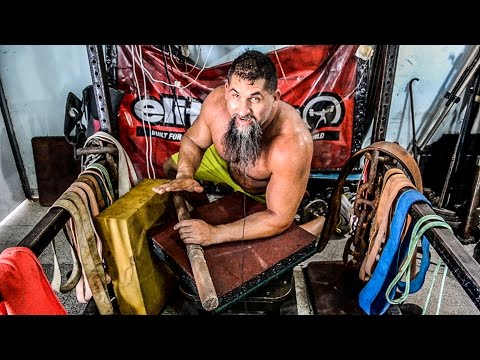
Tennis Elbow Smashing Therapy Part 1
0
Smashing Elbow·Clint Darden
A short clip for a friend about what I'm doing to assist my recovery from Tennis Elbow.
Translation: smashing elbow (Sok Pung)
The Smashing Elbow subfamily encompasses powerful downward elbow strikes characterised by maximal force generation, where the striker drops their full bodyweight behind the elbow to deliver a heavy, concussive blow. [1] The smashing elbow differs from the chopping elbow in its emphasis on blunt-force impact rather than cutting action, targeting the top of the skull, the back of the neck, or the shoulders with a hammering motion. [1],[2] Effective execution typically involves a slight jump or rise onto the toes before dropping the elbow, adding gravitational acceleration to the hip-driven torque. [2],[3]
Smashing elbow techniques are found in Muay Boran, where battlefield conditions favoured heavy, fight-ending strikes that could incapacitate an armoured or unarmoured opponent at close range. [1] Modern Muay Thai preserved these techniques in the competitive context, with the smashing elbow used opportunistically against bent-over or stunned opponents. [2],[3]
The smashing elbow strikes with maximum downward force. [1]
From Muay Thai's sok pung. [1]
Used in Muay Thai and MMA. [1]
No images yet for this technique.
Sign in to suggest an image.
A short clip for a friend about what I'm doing to assist my recovery from Tennis Elbow.
No instructional courses yet for this technique.
Sign in to suggest a course.
Risk of injury to the person this technique is applied to
12-6 elbow; extremely dangerous downward strike
Skill level needed to execute this technique reliably
Whether this technique is allowed under major competition rule sets
Muay Thai: The Art of Fighting (Yod Ruerngsa, Khun Kao Charuad & James Cartmell, 2002)
Alias sources — [1] Muay Thai: The Art of Fighting (Kraitus & Kraitus, 1988) [2] Muay Thai Unleashed (Delp, 2006) [3] WBC Muay Thai Rules (2014)
Effectiveness sources — [1] Muay Thai Unleashed (Delp, 2006)
Standard katakana transliteration of Western martial arts terminology (外来語) — used in Japanese MMA, boxing, and BJJ communities
Alias sources — [1] Muay Thai: The Art of Fighting (Kraitus & Kraitus, 1988) [2] Muay Thai Unleashed (Delp, 2006) [3] WBC Muay Thai Rules (2014)
Effectiveness sources — [1] Muay Thai Unleashed (Delp, 2006)
close-range proficiency, hip rotation, sharp elbow point
dense bone structure at the olecranon, strong rotational core
core rotators, deltoids, trapezius, biceps
Clint Darden emphasizes that tricep strength is where your torque comes from in techniques like the bench press and punching—if you want more power, focus on developing your triceps rather than just chest and shoulders.
According to Clint Darden, you can apply smashing (rolling) techniques on your training partner's neck, traps, low back, hamstrings, and inside of the calves—as long as you're flexible enough to reach the area.
The Smashing Elbow subfamily encompasses powerful downward elbow strikes characterised by maximal force generation, where the striker drops their full bodyweight behind the elbow to deliver a heavy, concussive blow. The smashing elbow differs from the chopping elbow in its emphasis on blunt-force impact rather than cutting action, targeting the top of the skull, the back of the neck, or the shoulders with a hammering motion.
Smashing elbow techniques are found in Muay Boran, where battlefield conditions favoured heavy, fight-ending strikes that could incapacitate an armoured or unarmoured opponent at close range. Modern Muay Thai preserved these techniques in the competitive context, with the smashing elbow used opportunistically against bent-over or stunned opponents.
Unified MMA: legal — Legal — all elbow strikes permitted; WBC/Boxing: banned — All elbow strikes prohibited in boxing; WKF: banned — Elbow strikes not a legal technique in sport karate; Kyokushin: banned — Elbow strikes prohibited; WT: banned — Prohibited; ITF: banned — Prohibited; WAKO: banned — Prohibited in all kickboxing formats; K: banned — 1/GLORY — Prohibited — key difference from Muay Thai; IFMA: legal — Legal — elbows are a core Muay Thai weapon (art of eight limbs)
Danger rating 8/10. Very High — 12-6 elbow; extremely dangerous downward strike
The standard setup chain: Close Distance → Hip Rotation → Strike with Elbow Point.
Standard counters include: Lean Back — pull the head out of elbow range to avoid the short-range strike / Clinch Tie-Up — close to body-to-body range to smother elbow strikes / Push Kick (Teep) — maintain distance to prevent elbow range from being established.
Common variants: Horizontal elbow (swinging the elbow horizontally at head level); Uppercut elbow (rising elbow from below targeting the chin); Downward elbow (chopping the elbow straight down (Muay Thai sok tat)); Spinning elbow (full rotation before driving the elbow into the target).
Used in Muay Thai and MMA.
Top errors to watch for: Not raising the elbow high enough — the smashing elbow needs maximum vertical distance for maximum force / Missing the target and smashing your own thigh or the opponent's back — control and accuracy are essential / Over-committing and falling forward over the opponent after the strike / Not controlling the opponent's posture — they must be bent forward for the vertical drop to land.
The Smashing Elbow is also known as Sōku Pun, Sok Pung, Dropping Elbow, Hammering Elbow.