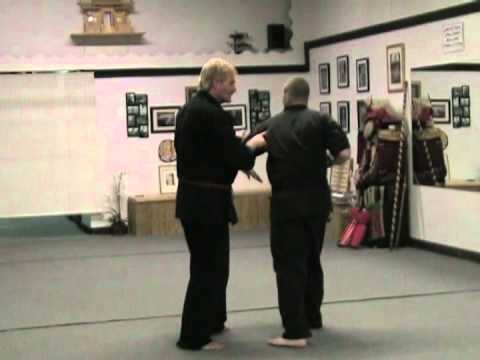
Cutting Elbow Tutorial
0
Chopping Elbow·senseijd7161
This video is about cutting over top and underneath the elbow for an in close range combat situation. Using this method…
Translation: chopping elbow (Sok Sap)
The Chopping Elbow subfamily covers downward elbow strikes delivered on a steep diagonal angle, resembling the motion of a hatchet or cleaver cutting downward and across. [1] Unlike a straight vertical drop, the chopping elbow follows a path roughly 45 degrees from vertical, allowing the striker to target the opponent's temple, orbital ridge, or the bridge of the nose with the sharp point of the elbow. [1],[2] The technique requires the striker to raise the elbow high, rotate the shoulder forward, and drive the elbow diagonally through the target using core rotation and gravity. [2],[3]
The chopping elbow is rooted in Muay Thai and Muay Boran, where diagonal downward elbows were among the standard techniques taught to fighters as part of the comprehensive elbow arsenal. [1] Thai trainers traditionally drilled the chopping motion using focus mitts and heavy bags, emphasising the diagonal cutting trajectory that distinguishes it from horizontal or vertical elbows. [2],[3]
The chopping elbow strikes downward onto the opponent's head or collarbone. [1]
From Muay Thai's sok sap technique. [1]
Used in Muay Thai and MMA. [1]
No images yet for this technique.
Sign in to suggest an image.
This video is about cutting over top and underneath the elbow for an in close range combat situation. Using this method…
No instructional courses yet for this technique.
Sign in to suggest a course.
Risk of injury to the person this technique is applied to
12-6 elbow; extremely dangerous downward strike
Skill level needed to execute this technique reliably
Whether this technique is allowed under major competition rule sets
Muay Thai: The Art of Fighting (Yod Ruerngsa, Khun Kao Charuad & James Cartmell, 2002)
Alias sources — [1] Muay Thai: The Art of Fighting (Kraitus & Kraitus, 1988) [2] Muay Thai Unleashed (Delp, 2006) [3] Championship Fighting (Dempsey, 1950)
Effectiveness sources — [1] Muay Thai Unleashed (Delp, 2006)
Standard katakana transliteration of Western martial arts terminology (外来語) — used in Japanese MMA, boxing, and BJJ communities
Alias sources — [1] Muay Thai: The Art of Fighting (Kraitus & Kraitus, 1988) [2] Muay Thai Unleashed (Delp, 2006) [3] Championship Fighting (Dempsey, 1950)
Effectiveness sources — [1] Muay Thai Unleashed (Delp, 2006)
hip rotation power, rear foot pivot, full kinetic chain coordination
reach advantage, strong hips for power transfer
glutes, obliques, pectorals, triceps, deltoids
Every move, in any martial art, shares a few universal traits. Mix and match below to pinpoint the right tool — or compare equivalents across styles.
Practice with a slow continuity drill: as your opponent throws a punch, shift your position, cut with your elbow, and bring it down. Repeat this cycle as they throw multiple punches, taking your time to build the movement slowly (senseijd7161 — "Cutting Elbow Tutorial").
Yes, the technique works whether you're on the inside or outside position relative to your opponent. The same cutting motion underneath applies regardless of your angle (senseijd7161 — "Cutting Elbow Tutorial").
After cutting, you have multiple options including total escape, manipulation, and applying a catch. You can slip inside as they rotate and bring the cut up to apply the catch (senseijd7161 — "Cutting Elbow Tutorial").
Use the checking technique along with the projection: when your opponent punches, cut with your elbow while keeping your triangles aligned, check their punch, hit, and then immediately roll into your tent position (senseijd7161 — "Cutting Elbow Tutorial").
The Chopping Elbow subfamily covers downward elbow strikes delivered on a steep diagonal angle, resembling the motion of a hatchet or cleaver cutting downward and across. Unlike a straight vertical drop, the chopping elbow follows a path roughly 45 degrees from vertical, allowing the striker to target the opponent's temple, orbital ridge, or the bridge of the nose with the sharp point of the elbow.
The chopping elbow is rooted in Muay Thai and Muay Boran, where diagonal downward elbows were among the standard techniques taught to fighters as part of the comprehensive elbow arsenal. Thai trainers traditionally drilled the chopping motion using focus mitts and heavy bags, emphasising the diagonal cutting trajectory that distinguishes it from horizontal or vertical elbows.
Unified MMA: legal — Legal — all elbow strikes permitted; WBC/Boxing: banned — All elbow strikes prohibited in boxing; WKF: banned — Elbow strikes not a legal technique in sport karate; Kyokushin: banned — Elbow strikes prohibited; WT: banned — Prohibited; ITF: banned — Prohibited; WAKO: banned — Prohibited in all kickboxing formats; K: banned — 1/GLORY — Prohibited — key difference from Muay Thai; IFMA: legal — Legal — elbows are a core Muay Thai weapon (art of eight limbs)
Danger rating 8/10. Very High — 12-6 elbow; extremely dangerous downward strike
The standard setup chain: Close Distance → Hip Rotation → Strike with Elbow Point.
Standard counters include: Lean Back — pull the head out of elbow range to avoid the short-range strike / Clinch Tie-Up — close to body-to-body range to smother elbow strikes / Push Kick (Teep) — maintain distance to prevent elbow range from being established.
Common variants: Standard cross (rear-hand straight punch with full hip rotation); Counter cross (pull counter) (leaning back to avoid the jab, firing the cross as a counter); Step-in cross (stepping forward with the punch for added reach and power); Body cross (targeting the solar plexus or liver with the straight rea…).
Used in Muay Thai and MMA.
Top errors to watch for: Chopping too wide and using the forearm instead of the elbow point — keep the arc tight / Not adding hip rotation to the chop, relying only on the arm and gravity / Aiming at the top of the skull where the bone is thickest — target the collarbone or temple area / Over-committing and losing balance on the follow-through.
The Chopping Elbow is also known as Sōku Sappu, Sok Sap, Diagonal Elbow, Hatchet Elbow.