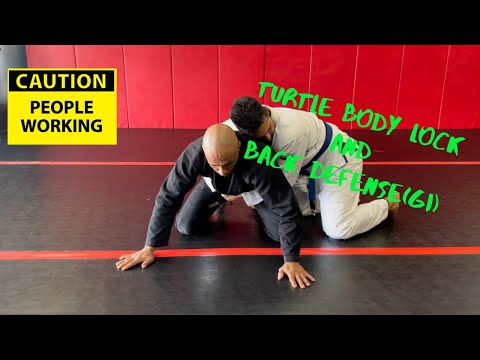
Turtle & Back Mount Defense Vol 1
0
Standard Defensive Turtle·Trillo Jiujitsu Academy·Added by Admin
Trillo Jiujitsu Academy 18400 NW 75 Place #122 Miami, Florida 33015 786-294-0447 trilloacademy.com https://www.facebo…
Translation: standard defensive turtle
The Standard Defensive Turtle establishes the basic defensive turtle with the fighter on hands and knees, elbows tight, chin tucked, and hips low, creating a compressed, protective ball that is difficult to attack. [1] The standard defensive turtle focuses on protecting the neck from chokes and the arms from locks while maintaining enough mobility to escape. [1],[2] The fighter monitors the opponent's position and weight distribution to time escape attempts. [2],[3]
The standard defensive turtle is the baseline tight-tucked turtle position. [1]
The fundamental defensive turtle in judo and BJJ. [1]
Used in judo and BJJ competition. [1]
No images yet for this technique.
Sign in to suggest an image.
Trillo Jiujitsu Academy 18400 NW 75 Place #122 Miami, Florida 33015 786-294-0447 trilloacademy.com https://www.facebo…
No instructional courses yet for this technique.
Sign in to suggest a course.
Risk of injury to the person this technique is applied to
Turtle is a defensive shell position; vulnerable to back takes and chokes
Skill level needed to execute this technique reliably
Whether this technique is allowed under major competition rule sets
Jiu-Jitsu University (Saulo Ribeiro, 2008)
Alias sources — [1] IBJJF Rules (2024) [2] Jiu-Jitsu University (Ribeiro, 2008) [3] Mastering Jujitsu (Gracie & Danaher, 2003)
Effectiveness sources — [1] Jiu-Jitsu University (Ribeiro, 2008)
Official Kodokan ground technique classification system
Mixed Japanese-Western terminology — combines traditional Japanese terms with katakana loanwords
Alias sources — [1] IBJJF Rules (2024) [2] Jiu-Jitsu University (Ribeiro, 2008) [3] Mastering Jujitsu (Gracie & Danaher, 2003)
Effectiveness sources — [1] Jiu-Jitsu University (Ribeiro, 2008)
core strength, tight elbow position, neck protection
compact build with strong core for stability
core stabilisers, shoulders, neck, hip flexors
First, pull yourself down to create leeway, then pop your arm over your shoulder and glue it there. Push your back to the ground and start moving yourself out—the hooks can then be easier to remove. Trillo Jiujitsu Academy emphasizes this as a fundamental escape sequence from back mount.
Trap your opponent's arm (easier in the gi), extend your inside leg completely straight, and sit while pulling them into your guard to roll them over. This leg trap and roll is an effective way to break their control from the turtle position.
Point your feet away and roll up onto your shoulders, which makes it very hard for your opponent to maintain back control because it pressures their face. This works as an alternative to the leg trap escape when your opponent has locked up your position.
The Standard Defensive Turtle establishes the basic defensive turtle with the fighter on hands and knees, elbows tight, chin tucked, and hips low, creating a compressed, protective ball that is difficult to attack. The standard defensive turtle focuses on protecting the neck from chokes and the arms from locks while maintaining enough mobility to escape.
The standard defensive turtle is the fundamental defensive turtle position taught across all grappling disciplines as the primary means of protecting oneself when flattened or turned over. It is a universal defensive position in grappling.
IBJJF: legal — Legal — common transitional position; IJF: restricted — Legal position but extended turtle without attacking penalized for non-combat…; ADCC: legal — Legal; Unified MMA: legal — Legal; UWW: legal — Legal — bottom position, opponent works to turn/pin; FIAS Sport Sambo: legal — Legal
Danger rating 3/10. Moderate — turtle is a defensive shell position; vulnerable to back takes and chokes
The standard setup chain: Achieve Position → Stabilize → Maintain → Attack.
Standard counters include: Posture Control — maintain strong posture to limit the opponent's offensive options / Escape to Neutral — work back to standing or a neutral position.
Common variants: Standard turtle (hands and knees with elbows tight, head protected); Flattened turtle (driven to the mat from turtle, attempting to re-turtle); Active turtle (using sit-outs or rolls from the turtle position).
Used in judo and BJJ competition.
Top errors to watch for: Turtling slowly — the transition to turtle must be explosive, and the escape must follow immediately / Not protecting the neck with the hands — the hands should be guarding the collar/chin area / Leaving the elbows open — any gap between the elbows and ribs allows arm entries / Staying in the turtle for a count of more than 3 — if you haven't escaped in 3 seconds, the opponent has established ….
The Standard Defensive Turtle is also known as Sutandādo Bōgyo Kame, Classic Turtle Defence, Basic Defensive Shell, Standard Bottom Turtle.