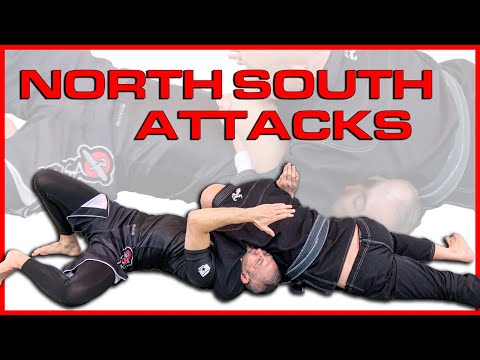
My 3 Favorite North South Submission Attacks
0
Attacking North-South·Stephan Kesting
There are many great attacks you can use from the North-South position in BJJ. Grab my free BJJ guide at https://www.gr…
Translation: attacking north-south
The Attacking North-South subfamily covers north-south configurations specifically set up for submission attacks, particularly the kimura and north-south choke. [1] Attacking north-south positions use specific grips that enable immediate submission threats while maintaining the north-south control. [1],[2] The kimura grip north-south is the most common attacking configuration, providing a powerful bent-armlock opportunity from the position. [2],[3]
Attacking north-south positions the attacker for kimura, north-south choke, or arm attacks. [1]
Attacking north-south was developed as an offensive variant in BJJ. [1]
Used in BJJ and MMA competition for submissions. [1]
No images yet for this technique.
Sign in to suggest an image.
There are many great attacks you can use from the North-South position in BJJ. Grab my free BJJ guide at https://www.gr…
This video one of my top students Richie Meister of Lion Heart MMA demonstrates a new reverse triangle attack that he ha…
No instructional courses yet for this technique.
Sign in to suggest a course.
Risk of injury to the person this technique is applied to
Top positions enable pressure and striking; rib compression risk under heavy pressure
Skill level needed to execute this technique reliably
Whether this technique is allowed under major competition rule sets
Mastering Jujitsu (Renzo Gracie & John Danaher, 2003)
Alias sources — [1] Jiu-Jitsu University (Ribeiro, 2008) [2] Mastering Jujitsu (Gracie & Danaher, 2003)
Effectiveness sources — [1] Jiu-Jitsu University (Ribeiro, 2008)
Mixed Japanese-Western terminology — combines traditional Japanese terms with katakana loanwords
Alias sources — [1] Jiu-Jitsu University (Ribeiro, 2008) [2] Mastering Jujitsu (Gracie & Danaher, 2003)
Effectiveness sources — [1] Jiu-Jitsu University (Ribeiro, 2008)
body awareness, stability, control of weight distribution
athletic build with good proprioception
core, hips, legs for base stability
Every move, in any martial art, shares a few universal traits. Mix and match below to pinpoint the right tool — or compare equivalents across styles.
Coach Brian emphasizes bringing your wrist bone up into the opponent's armpit while applying heavy hip pressure to keep them pinned on their side, similar to a ghost escape but with added downward force.
Coach Brian notes that you can transition to an armbar option by hiding your grip high and then repositioning—if your opponent reacts to defend, you can shift back into the armbar setup by controlling their elbow.
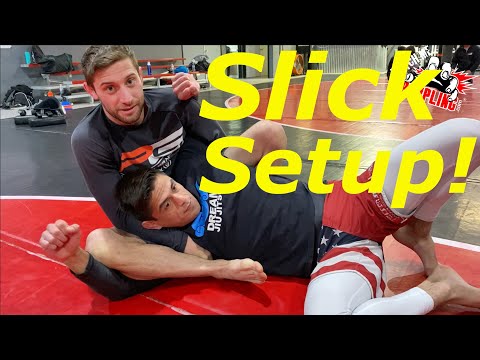
Stephan Kesting explains that starting from a double-under position (both hands under the opponent's arms while sprawled back) gives you multiple submission options and creates angles to attack the neck.
Stephan Kesting describes that when an opponent tucks their upper body to hide their arms, this actually gives you a route around the neck for submissions like the Kimura or other neck attacks.
The Attacking North-South subfamily covers north-south configurations specifically set up for submission attacks, particularly the kimura and north-south choke. Attacking north-south positions use specific grips that enable immediate submission threats while maintaining the north-south control.
Attacking north-south positions developed in BJJ as the art's submission-focused approach applied to the traditional pinning position inherited from judo. The north-south choke and kimura from north-south became signature techniques of fighters like Marcelo Garcia and Jeff Monson.
IBJJF: legal — Legal, mount scores 4 points — highest-scoring position; IJF: legal — Legal, osaekomi (pin) — 10-19 seconds scores waza-ari, 20 seconds scores ippon; ADCC: legal — Legal, mount scores 2 points; Unified MMA: legal — Legal dominant position; UWW: legal — Legal, back exposure scores points, pin ends match by fall; FIAS Sport Sambo: legal — Legal, pin scores points
Danger rating 3/10. Moderate — top positions enable pressure and striking; rib compression risk under heavy pressure
The standard setup chain: Achieve Position → Stabilize → Maintain → Attack.
Standard counters include: Bridge (Upa) — explosive hip elevation to off-balance the top player / Elbow-Knee Escape (Shrimp) — create space by driving elbow to knee and hip-escaping / Frame — establish forearm frames to prevent the top player from settling weight.
Common variants: Standard variation (primary positioning for control and attack); Offensive variation (configured for submission or striking opportunities); Transitional variation (positioned for quick movement to the next position); Defensive variation (prioritising stability and control over attack).
Used in BJJ and MMA competition for submissions.
Top errors to watch for: Attempting attacks without first establishing north-south control — the control must precede the attack / Committing to one attack without chaining — the choke and kimura must be alternated based on the opponent's defence / Transitioning to attack mode too slowly — the shift from control to attack should be sudden / Not maintaining chest pressure while attacking — the pressure must continue even as the arms reconfigure.
The Attacking North-South is also known as Kōgeki-gata Nanboku, Offensive North-South, Active North-South.