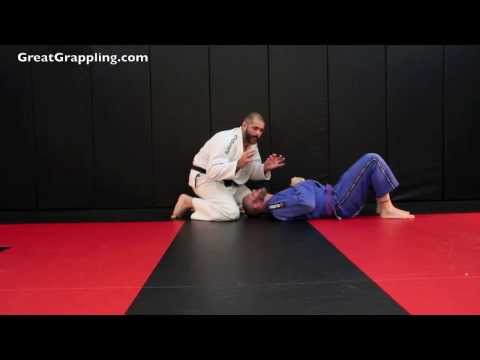
North South Submission North South Choke
0
North-South·Great Grappling
In this video I show a very basic but important choke, the North/South Choke. There are many different theories on the …
Translation: north-south
The North-South family covers the top control position where the controlling fighter lies chest-to-chest with the opponent but in opposite direction — head-to-feet — creating a 180-degree orientation. [1] North-south provides strong pinning pressure and is frequently used as a transitional position between side control and other positions, as well as a platform for kimura and north-south choke attacks. [1],[2] The position's chest-to-chest compression makes it very difficult for the bottom fighter to create space or bridge effectively. [2],[3]
North-south is a top control position in BJJ and MMA where the attacker lies chest-to-chest facing the opposite direction from the opponent. [1]
North-south is used as a control and submission position in BJJ and MMA competition. [1]
No images yet for this technique.
Sign in to suggest an image.
In this video I show a very basic but important choke, the North/South Choke. There are many different theories on the …
No instructional courses yet for this technique.
Sign in to suggest a course.
Risk of injury to the person this technique is applied to
Top positions enable pressure and striking; rib compression risk under heavy pressure
Skill level needed to execute this technique reliably
Whether this technique is allowed under major competition rule sets
Brazilian Jiu-Jitsu: Theory and Technique (Renzo Gracie & Royler Gracie, 2001)
Alias sources — [1] IBJJF Rules and Regulations [2] Kodokan Judo (Kano, 1986) [3] Jiu-Jitsu University (Ribeiro, 2008)
Effectiveness sources — [1] Jiu-Jitsu University (Ribeiro, 2008) [2] Mastering Jujitsu (Gracie & Danaher, 2003)
Standard Japanese martial arts terminology (kanji/hiragana)
Established Japanese martial arts naming convention — native Japanese term (和語/漢語)
Alias sources — [1] IBJJF Rules and Regulations [2] Kodokan Judo (Kano, 1986) [3] Jiu-Jitsu University (Ribeiro, 2008)
Effectiveness sources — [1] Jiu-Jitsu University (Ribeiro, 2008) [2] Mastering Jujitsu (Gracie & Danaher, 2003)
chest-to-chest pressure, hip positioning, crossface control
broad chest and shoulders for heavy top pressure
pectorals, deltoids, core, hip extensors
Every move, in any martial art, shares a few universal traits. Mix and match below to pinpoint the right tool — or compare equivalents across styles.
The Attacking North-South subfamily covers north-south configurations specifically set up for submission attacks, particularly the kimura and north-south choke. [1] Attacking north-south positions use specific grips that enable immediate submission threats while maintaining the north-south control. [1,2] The kimura grip north-south is the most common attacking configuration, providing a powerful bent-armlock opportunity from the position. [2,3]
The Standard North-South subfamily covers the basic north-south control position where the top fighter lies chest-to-chest in opposite orientation, using bodyweight and arm control to pin the opponent. [1] Standard north-south is primarily a controlling and transitional position, used to maintain dominance while setting up attacks or transitions to other positions. [1,2] The standard north-south uses underhook control on both sides to prevent the bottom fighter from creating frames or turning. [2,3]
North-south (kami-shiho-gatame in judo) is a controlling position where the attacker's chest covers the opponent's face. It does not score points in IBJJF but is a strong submission setup position. (Ribeiro, Jiu-Jitsu University)
Turning your opponent's face away with your ribcage is the single most important element. Great Grappling emphasizes that if you turn their face away and dominate their head, when they bridge they won't be able to move you because you'll be positioned on their head, not their body.
When you scoop the head with a head lasso, your fingertips need to be pushing into the floor—if you don't, you risk getting reversed. Great Grappling recommends starting the North-South choke from side control with a head lasso, then bringing your arm over the top of the head and coming back underneath.
If you execute the technique correctly, you should only need one hand in practice; in tournament, both hands will squeeze together. The key is that the initial setup and lasso mechanics do most of the work, so excessive squeezing is not the primary mechanism.
Great Grappling uses a straw analogy: when you pull both ends of a straw tightly apart, it doesn't cut off blood flow in the middle but creates an irregular stretched pattern that restricts it. The cutoff comes from squeezing, but pulling the head lasso away also contributes to restricting blood flow without requiring extra power.
The North-South family covers the top control position where the controlling fighter lies chest-to-chest with the opponent but in opposite direction — head-to-feet — creating a 180-degree orientation. North-south provides strong pinning pressure and is frequently used as a transitional position between side control and other positions, as well as a platform for kimura and north-south choke attacks.
North-south control has roots in judo's kami-shiho-gatame (upper four-corner hold) and was further developed in BJJ as both a controlling position and a submission platform, particularly for the north-south choke and kimura. It is a standard position in both judo and BJJ.
IBJJF: legal — Legal, mount scores 4 points — highest-scoring position; IJF: legal — Legal, osaekomi (pin) — 10-19 seconds scores waza-ari, 20 seconds scores ippon; ADCC: legal — Legal, mount scores 2 points; Unified MMA: legal — Legal dominant position; UWW: legal — Legal, back exposure scores points, pin ends match by fall; FIAS Sport Sambo: legal — Legal, pin scores points
Danger rating 3/10. Moderate — top positions enable pressure and striking; rib compression risk under heavy pressure
The standard setup chain: Pass the Guard → Settle Weight → Control Arms → Threaten Submissions.
Standard counters include: Bridge (Upa) — explosive hip elevation to off-balance the top player / Elbow-Knee Escape (Shrimp) — create space by driving elbow to knee and hip-escaping / Frame — establish forearm frames to prevent the top player from settling weight.
Common variants: Standard side control (crossface and underhook, chest on chest); Kesa gatame (head control with arm trapped, hip facing the opponent); Reverse kesa gatame (facing the opponent's legs with arm control); Modified side control (arm under the head, leg-side arm controlling the hip).
North-south is used as a control and submission position in BJJ and MMA competition.
Top errors to watch for: Not driving chest pressure into the opponent — the chest must be heavy and actively pressing down / Allowing space between the chest and the opponent — eliminate all space for maximum control / Not controlling the arms — the opponent's arms must be pinned or overhook'd to prevent frames / Staying in north-south without attacking the choke — the north-south choke should always be threatened.
The North-South is also known as Nanboku, North-South Position, Kami Shiho Gatame, 69 Position.