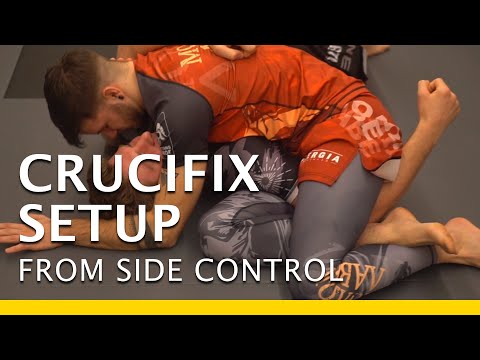
Crucifix from sidecontrol
0
Standard Mounted Crucifix·Energia Martial Arts·Added by Admin
Crucifix from sidecontrol Let's check out the crucifix position from side control! A vicious position to strike your opp…
Translation: standard mounted crucifix
The Standard Mounted Crucifix traps one of the opponent's arms under the top fighter's leg while the other arm is controlled by both hands, spreading the arms apart while maintaining the mounted position. [1] The combination of mount weight and arm trapping creates total immobilisation — the bottom fighter cannot bridge, frame, or defend against attacks. [1],[2] From standard mounted crucifix, the top fighter can deliver undefended strikes or transition to various submission finishes. [2],[3]
The standard mounted crucifix is the baseline version of this dominant position. [1]
Developed in modern BJJ and MMA. [1]
Used in MMA competition. [1]
No images yet for this technique.
Sign in to suggest an image.
Crucifix from sidecontrol Let's check out the crucifix position from side control! A vicious position to strike your opp…
No instructional courses yet for this technique.
Sign in to suggest a course.
Risk of injury to the person this technique is applied to
Top positions enable pressure and striking; rib compression risk under heavy pressure
Skill level needed to execute this technique reliably
Whether this technique is allowed under major competition rule sets
Mastering Jujitsu (Renzo Gracie & John Danaher, 2003)
Alias sources — [1] Jiu-Jitsu University (Ribeiro, 2008) [2] Mastering Jujitsu (Gracie & Danaher, 2003)
Effectiveness sources — [1] Mastering Jujitsu (Gracie & Danaher, 2003)
Standard katakana transliteration of Western martial arts terminology (外来語) — used in Japanese MMA, boxing, and BJJ communities
Alias sources — [1] Jiu-Jitsu University (Ribeiro, 2008) [2] Mastering Jujitsu (Gracie & Danaher, 2003)
Effectiveness sources — [1] Mastering Jujitsu (Gracie & Danaher, 2003)
base stability, heavy hips, ride ability
heavier build with strong hips for pressure
hip adductors, core, glutes, quadriceps
From a tight side control, cup your opponent's armpit and pull them in with shoulder pressure. Use your knee to separate their arm by placing it on top of their chest and shoulder, similar to a reverse knee on belly. Close a Gable grip and use a fast leg-switching motion (like a windshield wiper) to collect their forearm and secure the position.
Keep a good posture with your underhook in place, maintain tight knee pressure by squeezing your knees together, and never let go of your opponent's arm—if they pull it free, you lose the position. Stay very close and tight; if you feel them slipping, cup their shoulder and slide through to re-secure.
If your opponent tries to push you backward or reverse you, use a cross-face to control their neck and bend it, which makes the escape very difficult. Post your arm if they try to build you forward, and keep your legs positioned so they cannot roll you to the side.
The Americana is a high-percentage finish from this position. Push their hand down with your head, grab the wrist with your underhook hand, and slowly bring their elbow toward their body while maintaining leg pressure. Use a reverse wrist rotation to prevent them from escaping the submission.
The Standard Mounted Crucifix traps one of the opponent's arms under the top fighter's leg while the other arm is controlled by both hands, spreading the arms apart while maintaining the mounted position. The combination of mount weight and arm trapping creates total immobilisation — the bottom fighter cannot bridge, frame, or defend against attacks.
The standard mounted crucifix is the primary version of this ultra-dominant position, used in BJJ and MMA as the ultimate expression of positional dominance from the mount. It represents the combination of two of the most dominant positional concepts in grappling.
IBJJF: legal — Legal, mount scores 4 points — highest-scoring position; IJF: legal — Legal, osaekomi (pin) — 10-19 seconds scores waza-ari, 20 seconds scores ippon; ADCC: legal — Legal, mount scores 2 points; Unified MMA: legal — Legal dominant position; UWW: legal — Legal, back exposure scores points, pin ends match by fall; FIAS Sport Sambo: legal — Legal, pin scores points
Danger rating 3/10. Moderate — top positions enable pressure and striking; rib compression risk under heavy pressure
The standard setup chain: Pass the Guard → Settle Weight → Control Arms → Threaten Submissions.
Standard counters include: Bridge (Upa) — explosive hip elevation to off-balance the top player / Elbow-Knee Escape (Shrimp) — create space by driving elbow to knee and hip-escaping / Frame — establish forearm frames to prevent the top player from settling weight.
Common variants: Low mount (hips heavy on the opponent's belly, grapevines in for sta…); High mount (knees under the armpits, arms isolated for submissions); S-mount (one knee high under the armpit, other leg across for arm …); Technical mount (one leg hooked, one knee posted, modified for back-take t…).
Used in MMA competition.
Top errors to watch for: Not squeezing the thighs on the trapped arm — the leg trap must be tight to prevent extraction / Trapping the arm too close to the elbow — trap near the wrist/forearm for maximum control / Losing mount balance while setting up the crucifix — maintain stable mount throughout the transition / Not controlling the second arm firmly — if the second arm escapes, the position degrades.
The Standard Mounted Crucifix is also known as Sutandādo Maunto Kurushifikkusu, Classic Mounted Crucifix, Full Mounted Crucifix.