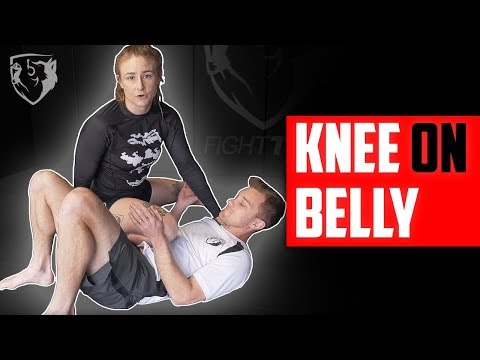
Knee-on-Belly: How to Dominate in this Position
0
Near Side Knee On Belly·fightTIPS·Added by Admin
In today's tutorial, BJJ black belt Erin Herle teaches how to properly transition into and keep a dominant 'Knee-On-Bell…
Translation: near side knee on belly
The Near Side Knee On Belly positions the knee on the opponent's near side (closest to the controlling fighter) with the posted foot on the far side, creating the most common and mechanically stable knee-on-belly configuration. [1] The near-side placement provides optimal weight distribution for pressure, excellent access to cross-choke and armbar attacks, and easy transitions to mount by stepping over. [1],[2] It is the default knee-on-belly configuration taught in most BJJ academies. [2],[3]
Near side knee on belly places the knee closest to the opponent's head, a standard variation. [1]
A standard knee on belly variant in BJJ. [1]
Used in BJJ competition. [1]
No images yet for this technique.
Sign in to suggest an image.
In today's tutorial, BJJ black belt Erin Herle teaches how to properly transition into and keep a dominant 'Knee-On-Bell…
No instructional courses yet for this technique.
Sign in to suggest a course.
Risk of injury to the person this technique is applied to
Top positions enable pressure and striking; rib compression risk under heavy pressure
Skill level needed to execute this technique reliably
Whether this technique is allowed under major competition rule sets
Mastering Jujitsu (Renzo Gracie & John Danaher, 2003)
Alias sources — [1] IBJJF Rules (2024) [2] Jiu-Jitsu University (Ribeiro, 2008) [3] Mastering Jujitsu (Gracie & Danaher, 2003)
Effectiveness sources — [1] Jiu-Jitsu University (Ribeiro, 2008)
Standard katakana transliteration of Western martial arts terminology (外来語) — used in Japanese MMA, boxing, and BJJ communities
Alias sources — [1] IBJJF Rules (2024) [2] Jiu-Jitsu University (Ribeiro, 2008) [3] Mastering Jujitsu (Gracie & Danaher, 2003)
Effectiveness sources — [1] Jiu-Jitsu University (Ribeiro, 2008)
base stability, heavy hips, ride ability
heavier build with strong hips for pressure
hip adductors, core, glutes, quadriceps
Many practitioners believe knee on belly is unstable, but according to fightTIPS, the position is actually very safe and advantageous as long as you're not rigid and you understand your weight distribution properly.
fightTIPS recommends thinking of it like surfing—use subtle, continuous movements to follow your opponent's hips rather than staying stationary. Cup their hip with your forearm and maintain control without being rigid, adjusting your foot position to allow fluid weight distribution.
Create cause and effect by striking or moving to provoke a reaction, then capitalize on it. For example, if your opponent turns away from strikes, you can transition to their back for a rear control position.
Understand your own base and master your weight distribution through your foot. fightTIPS emphasizes that you should only move when your opponent moves—this keeps you stable and dominant in the position.
The Near Side Knee On Belly positions the knee on the opponent's near side (closest to the controlling fighter) with the posted foot on the far side, creating the most common and mechanically stable knee-on-belly configuration. The near-side placement provides optimal weight distribution for pressure, excellent access to cross-choke and armbar attacks, and easy transitions to mount by stepping over.
Near side knee-on-belly is the standard knee-on-belly configuration taught as the primary version of this position in BJJ. It represents the most mechanically sound and widely used knee-on-belly placement.
IBJJF: legal — Legal, knee on belly scores 2 points; IJF: legal — Legal, osaekomi (pin) — 10-19 seconds scores waza-ari, 20 seconds scores ippon; ADCC: legal — Legal, knee on belly scores 2 points; Unified MMA: legal — Legal dominant position; UWW: legal — Legal, back exposure scores points, pin ends match by fall; FIAS Sport Sambo: legal — Legal, pin scores points
Danger rating 3/10. Moderate — top positions enable pressure and striking; rib compression risk under heavy pressure
The standard setup chain: Pass the Guard → Settle Weight → Control Arms → Threaten Submissions.
Standard counters include: Bridge (Upa) — explosive hip elevation to off-balance the top player / Elbow-Knee Escape (Shrimp) — create space by driving elbow to knee and hip-escaping / Frame — establish forearm frames to prevent the top player from settling weight.
Common variants: Low mount (hips heavy on the opponent's belly, grapevines in for sta…); High mount (knees under the armpits, arms isolated for submissions); S-mount (one knee high under the armpit, other leg across for arm …); Technical mount (one leg hooked, one knee posted, modified for back-take t…).
Used in BJJ competition.
Top errors to watch for: Placing the knee on the side of the ribs instead of the abdomen — the abdomen provides more control and pressure / Not controlling the collar or head with the near hand — this grip anchors the position / Posting the far foot behind the opponent's body — the posting foot should be forward and wide for mobility / Not attacking the near-side armbar when they push the knee — this is the highest-percentage counter to their escape.
The Near Side Knee On Belly is also known as Nia Saido Nī On Berī, Near Side KOB, Near Side Knee Ride, Inside Knee on Belly.