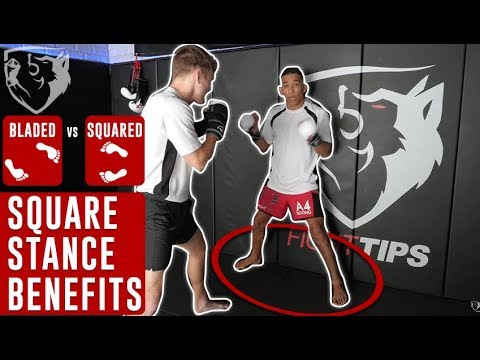
WHEN TO STAND IN A SQUARED STANCE IN A FIGHT
0
Standard Square Stance·fightTIPS·Added by Admin
Today we talk about the benefits of squaring your stance when against the cage, to increase mobility and create a safe e…
Translation: standard square stance
The Standard Square Stance positions both feet even, shoulder-width apart, with the body facing forward, knees slightly bent, and hands up guarding the head. [1] The standard square stance provides a balanced, symmetrical fighting platform that allows the fighter to attack with any limb without needing to switch stances. [1],[2] It is the default stance in Muay Thai, where fighters need to check low kicks, throw roundhouse kicks, and clinch from either side. [2],[3]
The standard square stance is the baseline parallel-feet fighting position. [1]
Common in Muay Thai and wrestling. [1]
Used in Muay Thai and MMA competition. [1]
No images yet for this technique.
Sign in to suggest an image.
Today we talk about the benefits of squaring your stance when against the cage, to increase mobility and create a safe e…
No instructional courses yet for this technique.
Sign in to suggest a course.
Risk of injury to the person this technique is applied to
Standing positions are pre-engagement stances; minimal direct risk
Skill level needed to execute this technique reliably
Whether this technique is allowed under major competition rule sets
Jiu-Jitsu University (Saulo Ribeiro, 2008)
Alias sources — [1] Kodokan Judo (Kano, 1986) [2] UWW Wrestling Rules [3] Championship Fighting (Dempsey, 1950)
Effectiveness sources — [1] Muay Thai Unleashed (Delp, 2006)
Mixed Japanese-Western terminology — combines traditional Japanese terms with katakana loanwords
Alias sources — [1] Kodokan Judo (Kano, 1986) [2] UWW Wrestling Rules [3] Championship Fighting (Dempsey, 1950)
Effectiveness sources — [1] Muay Thai Unleashed (Delp, 2006)
hip flexibility, active legs, grip management
long legs for distance control and guard retention
hip flexors, adductors, quadriceps, core, grip
Square up when your back is against the wall or cage, as it opens up a full 180 degrees of space to move and defend. In open space, a bladed stance is preferable because you can generate more striking force and won't get off-balance as easily.
A square stance gives you maximum lateral mobility to dart off to the side quickly, throw straight punches while stepping away, and defend against takedowns when cornered. It also allows you to use the full width of space available when your back is against an obstacle.
You can't generate much striking force from a square stance compared to a bladed stance, making it weaker for generating power in your punches.
Drill with a partner and set a timer for five minutes, going back and forth practicing how to move quickly off the wall from a square stance. Make it realistic by having your partner apply pressure like an aggressive opponent would.
The Standard Square Stance positions both feet even, shoulder-width apart, with the body facing forward, knees slightly bent, and hands up guarding the head. The standard square stance provides a balanced, symmetrical fighting platform that allows the fighter to attack with any limb without needing to switch stances.
The standard square stance is the traditional Muay Thai fighting position, developed for the art's unique requirements of kicking, kneeing, elbowing, and clinching from both sides. It remains the primary stance in Muay Thai competition.
Unified MMA: legal — Legal; IBJJF: legal — Legal; IJF: legal — Legal; WBC/Boxing: legal — Legal — stance and footwork are fundamental; WKF: legal — Legal; UWW: legal — Legal
Danger rating 2/10. Low — standing positions are pre-engagement stances; minimal direct risk
The standard setup chain: Achieve Guard Contact → Control Grips → Manage Distance → Threaten Submissions/Sweeps.
Standard counters include: Guard Pass — systematically work to clear the legs and establish a dominant position / Leg Pin — control one or both legs to neutralize guard retention / Pressure Passing — use heavy chest pressure to flatten and immobilize the guard player.
Common variants: Standard guard (primary leg and grip configuration for control and attack…); Offensive guard (configured for sweeps and submissions); Defensive guard (prioritising distance management and preventing passes); Transition guard (moving between guard types to adjust to the opponent's pa…).
Used in Muay Thai and MMA competition.
Top errors to watch for: Standing too wide — shoulder-width is the maximum; wider stances reduce mobility / Standing too narrow — feet too close together sacrifices stability / Keeping the weight on one leg — the 50/50 distribution is what makes the square stance work / Not protecting the centre line — the square stance exposes the centre; both hands must guard it.
The Standard Square Stance is also known as Sutandādo Shōmen Kamae, Basic Square Stance, Standard Parallel Stance, Shizen-Hontai (自然本体).