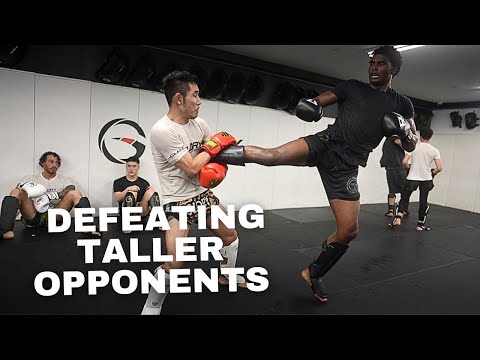
The BEST Video You'll Watch on How to Fight Taller Opponents
0
Standard Long Range·Jeff Chan MMAShredded ·Added by Admin
0:00 - Start 0:20 - Tactic 1: Catch kicks to get inside 1:42 - Tactic 2: Use head movement to get inside 3:37 - Tactic 3…
Translation: standard long range
The Standard Long Range position places fighters at a distance where kicks and fully extended punches are the only techniques that can reach. [1] At standard long range, the primary tools are front kicks, roundhouse kicks, side kicks, and the jab delivered with full extension and forward step. [1],[2] Fighters at long range focus on footwork and angle changes to create entries to mid range or to maintain distance if they prefer to fight at range. [2],[3]
Standard long range is the baseline kicking and long punching distance. [1]
Defined in striking arts range theory. [1]
A fundamental distance in combat sports. [1]
No images yet for this technique.
Sign in to suggest an image.
0:00 - Start 0:20 - Tactic 1: Catch kicks to get inside 1:42 - Tactic 2: Use head movement to get inside 3:37 - Tactic 3…
No instructional courses yet for this technique.
Sign in to suggest a course.
Risk of injury to the person this technique is applied to
Standing positions are pre-engagement stances; minimal direct risk
Skill level needed to execute this technique reliably
Whether this technique is allowed under major competition rule sets
Brazilian Jiu-Jitsu: Theory and Technique (Renzo Gracie & Royler Gracie, 2001)
Alias sources — [1] Mastering Jujitsu (Gracie & Danaher, 2003) [2] Championship Fighting (Dempsey, 1950)
Effectiveness sources — [1] Mastering Jujitsu (Gracie & Danaher, 2003)
Mixed Japanese-Western terminology — combines traditional Japanese terms with katakana loanwords
Alias sources — [1] Mastering Jujitsu (Gracie & Danaher, 2003) [2] Championship Fighting (Dempsey, 1950)
Effectiveness sources — [1] Mastering Jujitsu (Gracie & Danaher, 2003)
balance, lower body stability, quick directional change
well-proportioned build with strong base
calves, quadriceps, core, hip stabilisers
At middle range, your taller opponent can reach you with their longer limbs while you cannot reach them effectively. Jeff Chan MMAShredded emphasizes you want to be either all the way on the outside or all the way on the inside—never in the middle.
Jeff Chan MMAShredded recommends catching or brushing kicks to close the distance, then throw the leg off to the side and move into body-to-head combinations. For straight kicks, scoop underneath the heel with your lead arm into a punch-kick combination while using head movement to close the distance.
Jeff Chan MMAShredded explains that hitting the body first causes your taller opponent to shell up and lower their head, which opens them up for head strikes. This creates opportunities for combinations like body shots followed by hooks or overhands.
No—while staying in the pocket works in boxing, in MMA or Muay Thai your taller opponent can clinch you and throw knees, so you should exit after striking rather than continuing to work short range.
The Standard Long Range position places fighters at a distance where kicks and fully extended punches are the only techniques that can reach. At standard long range, the primary tools are front kicks, roundhouse kicks, side kicks, and the jab delivered with full extension and forward step.
Standard long range is a fundamental fighting distance studied across all striking martial arts, representing the outermost zone where offensive engagement is possible. It is the preferred fighting distance for counter-strikers and fighters with reach advantages.
Unified MMA: legal — Legal; IBJJF: legal — Legal; IJF: legal — Legal; WBC/Boxing: legal — Legal — stance and footwork are fundamental; WKF: legal — Legal; UWW: legal — Legal
Danger rating 2/10. Low — standing positions are pre-engagement stances; minimal direct risk
The standard setup chain: Achieve Position → Stabilize → Maintain → Attack.
Standard counters include: Posture Control — maintain strong posture to limit the opponent's offensive options / Escape to Neutral — work back to standing or a neutral position.
Common variants: Standard variation (primary positioning for control and attack); Offensive variation (configured for submission or striking opportunities); Transitional variation (positioned for quick movement to the next position); Defensive variation (prioritising stability and control over attack).
A fundamental distance in combat sports.
Top errors to watch for: Standing at long range without working — long range requires constant probing with jabs and feints / Maintaining distance by only moving backward — circle and angle to maintain range while repositioning / Throwing power punches from long range — the cross and hooks fall short; use the jab and front kick / Not adjusting the stance for long range — a slightly more bladed stance presents a smaller target.
The Standard Long Range is also known as Sutandādo Enkyori, Basic Out-Fighting Distance, Standard Kicking Range.