Initial Position Setup
When unable to turn toward the opponent, the instructor establishes half guard and executes a shrimp in the opposite direction. The practitioner pushes the opponent's arm out and brings the knee inside, securing this fundamental position before proceeding to the next phase.
Arm Control and Wrist Security
To prevent the opponent from extracting their arm, the instructor secures the wrist control by gripping underneath. This grip is significantly more effective than standard control and makes it substantially harder for the opponent to escape.
Bicep Slicer Setup
From the secured wrist position, the instructor grabs the opponent's wrist and prepares the bicep slicer submission. The grip is established by pulling down on both the wrist and arm simultaneously to create the proper angle.
Creating Space with Double Knee Insertion
The goal is to thread both knees through the opponent's guard to create separation and lift their upper body. Successfully inserting both knees automatically forces the opponent to work harder to maintain upper body control.
Guard Transition Options
After creating sufficient space, the practitioner can return to full guard or transition to spider guard position. These guard variations provide continued control and set up follow-up submissions or positional advantages.
Finishing Positions
The instructor can manipulate the opponent's arm over or under their leg to set up final submission details. This positional work creates multiple finishing angles for the cocoon guard technique.
The Cocoon Guard
Key Takeaways
- •Initial Position Setup
- •Arm Control and Wrist Security
- •Bicep Slicer Setup
- •Creating Space with Double Knee Insertion
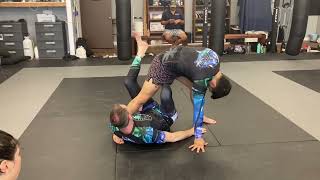
Hedgehogey demonstrates the cocoon guard with Munacra at the April ATX SparBQ.
Frequently Asked Questions
What does this video teach about cocoon?
This video covers initial position setup, arm control and wrist security, bicep slicer setup. It provides detailed instruction from Joe Cheavens.
How long does it take to learn cocoon?
The basic mechanics can be understood in a single session, but developing reliable execution requires consistent drilling over weeks of practice. This 6-part breakdown helps structure your training by isolating each phase of the technique.
What are the key details for finishing cocoon?
After creating sufficient space, the practitioner can return to full guard or transition to spider guard position. These guard variations provide continued control and set up follow-up submissions or positional advantages.
Related videos
Cocoon Guard - Trouble Shooting Part I
Joe Cheavens
Use The Cocoon To Protect Your Guard!
The Grappling Academy
Mounted Rubber Guard - 10th Planet Jiu Jitsu
Brandon Mccaghren
10th Planet Fundamentals Half Guard Stomp & Super Stomp 2 of 2 Heather
10th Planet Denver Jiu Jitsu
Ways to use Mini Stomp, 10th Planet Orange Park Jiu Jitsu
10th Planet Orange Park