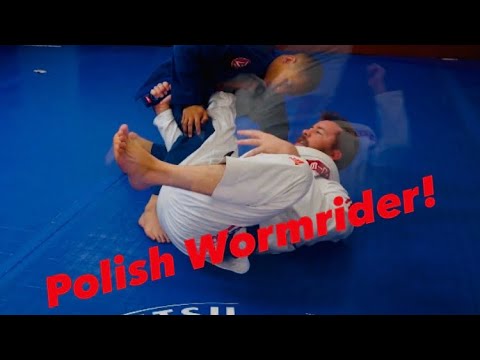
Learn this Guard! The Polish Worm Rider
0
Lapel Worm Guard·Rollin with Bowlin Jiu Jitsu
Part of the Lapel Guard / Worm Guard system. Great position to attack from. https://youtu.be/AdFKCkVs80s
Translation: lapel worm guard
The Lapel Worm Guard is the core worm guard technique where the opponent's extracted lapel is threaded between the legs, gripped with the far hand, and combined with DLR or reverse DLR hooks to create a comprehensive control system. [1] The lapel grip acts as a fifth point of control beyond the standard four limbs, providing the guard player with extraordinary leverage for sweeping and off-balancing. [1],[2] The lapel worm guard's unique control mechanics make it one of the most difficult guards to deal with for opponents unfamiliar with the system. [2],[3]
The lapel worm guard feeds the opponent's own lapel around their leg and grips it, creating unique control, sweep, and back-take opportunities. [1]
The worm guard was invented by Keenan Cornelius in the 2010s, representing a new paradigm in gi guard play. [1]
Worm guard has been used at the highest levels of IBJJF competition by Keenan Cornelius and others. [1]
No images yet for this technique.
Sign in to suggest an image.
Part of the Lapel Guard / Worm Guard system. Great position to attack from. https://youtu.be/AdFKCkVs80s
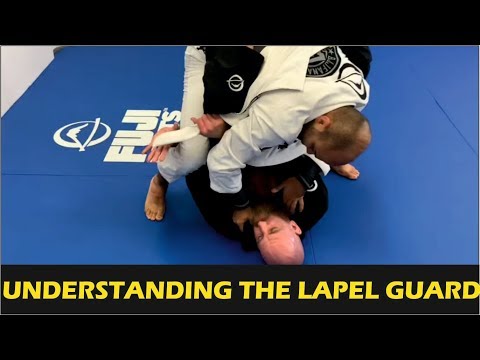
Understanding The Lapel Guard by Alex Huddleston - For The Best BJJ Instructional Videos, Check Out: https://bjjfanatics…
The lapel worm guard, also called the Polish wormrider, is a control position that combines lapel grips with leg weaving to create multiple offensive pathways including sweeps, submissions, and back takes. Both Rollin with Bowlin Jiu Jitsu and Bernardo Faria BJJ Fanatics emphasize that the position is accessible to grapplers of all flexibility levels and body types, not reserved for younger or more athletic practitioners. Entry mechanics differ slightly between instructors: Bolin begins with both hands on the lapel and feet on shoulders, transitioning through a lapel lasso grip before weaving the leg deep into the ribcage with a hip switch, then inverting slightly to thread an arm through the opponent's legs and establishing a grip around the hip. Huddleston's approach emphasizes the lapel grip as a foundational control that allows movement into multiple guard variations from both standing and seated positions, using it as a handle to maintain weight distribution and create lifting mechanics. Both instructors agree on the core attacking options: clearing the knee to create a shelving position before snaking the leg through for back takes, or threading through the legs to attack the arm with armbars and triangles. Bolin stresses the importance of getting the weaving leg deep to prevent escape, while Huddleston highlights how the lapel grip functions as a mechanical advantage that compensates for lack of flexibility. The position is presented as deceptive and difficult to defend once established, with multiple contingent responses available based on opponent reactions.
Synthesized from 2 instructors
No instructional courses yet for this technique.
Sign in to suggest a course.
Risk of injury to the person this technique is applied to
Guard positions are defensive; injury risk comes from transitions, not the position itself
Skill level needed to execute this technique reliably
Whether this technique is allowed under major competition rule sets
Advanced Brazilian Jiu-Jitsu Techniques (Marcelo Garcia, 2011)
Alias sources — [1] IBJJF Rules (2024) [2] Jiu-Jitsu University (Ribeiro, 2008) [3] The Guard (Moreira & Beneville, 2003)
Effectiveness sources — [1] IBJJF competition analysis; Keenan Cornelius instructionals
Standard katakana transliteration of Western martial arts terminology (外来語) — used in Japanese MMA, boxing, and BJJ communities
Alias sources — [1] IBJJF Rules (2024) [2] Jiu-Jitsu University (Ribeiro, 2008) [3] The Guard (Moreira & Beneville, 2003)
Effectiveness sources — [1] IBJJF competition analysis; Keenan Cornelius instructionals
hip flexibility, active legs, grip management
long legs for distance control and guard retention
hip flexors, adductors, quadriceps, core, grip
Keep the lapel grip right on your opponent's chest—this allows you to push into their shoulder and makes it very hard for them to shoot or come in close. According to Alex Huddleston (Bernardo Faria BJJ Fanatics), this chest-level grip control is key to shutting down takedown attempts.
No. Alex Huddleston emphasizes that lapels work for everyone—this technique doesn't require athleticism or flexibility, and you can develop it as deep as you want without doing anything special.
According to Rollin with Bowlin Jiu Jitsu, you want to pass the lapel around the hip area rather than by the knee, as this makes it difficult for your opponent to grab and allows you to lock in your position with multiple follow-up options.
Rollin with Bowlin Jiu Jitsu recommends faking high (toward the collar) to get your opponent's hands up, then grabbing low on the lapel and pulling with both hands—this misdirection makes the grip harder to defend.
The Lapel Worm Guard is the core worm guard technique where the opponent's extracted lapel is threaded between the legs, gripped with the far hand, and combined with DLR or reverse DLR hooks to create a comprehensive control system. The lapel grip acts as a fifth point of control beyond the standard four limbs, providing the guard player with extraordinary leverage for sweeping and off-balancing.
The lapel worm guard is Keenan Cornelius's signature technique, the original worm guard that launched the lapel guard era in competitive BJJ. Cornelius's innovations with the worm guard fundamentally changed gi competition strategy and guard play.
IBJJF: legal — Legal — guard is fundamental to BJJ, sweeps from guard score 2 points; IJF: restricted — Guard pulling penalized as non-combativity — groundwork from guard permitted …; ADCC: legal — Legal, guard pull penalized -1 point in points portion; Unified MMA: legal — Legal — no penalty for playing guard; FIAS Sport Sambo: legal — Legal
Danger rating 2/10. Low — guard positions are defensive; injury risk comes from transitions, not the position itself
The standard setup chain: Achieve Guard Contact → Control Grips → Manage Distance → Threaten Submissions/Sweeps.
Standard counters include: Guard Pass — systematically work to clear the legs and establish a dominant position / Leg Pin — control one or both legs to neutralize guard retention / Pressure Passing — use heavy chest pressure to flatten and immobilize the guard player.
Common variants: Standard guard (primary leg and grip configuration for control and attack…); Offensive guard (configured for sweeps and submissions); Defensive guard (prioritising distance management and preventing passes); Transition guard (moving between guard types to adjust to the opponent's pa…).
Worm guard has been used at the highest levels of IBJJF competition by Keenan Cornelius and others.
Top errors to watch for: Attempting the deep version without mastering standard worm guard — the additional wraps require advanced skill / Spending too long on the setup — the opponent will defend the lapel threading if given time / Not using the DLR hook during the deep wrap — the hook maintains control while the lapel is being threaded / Wrapping the lapel without purpose — each wrap should add to the control and sweep angle.
The Lapel Worm Guard is also known as Raperu Wāmu Gādo, Full Worm Guard, Lapel Thread Guard, Cornelius Guard.