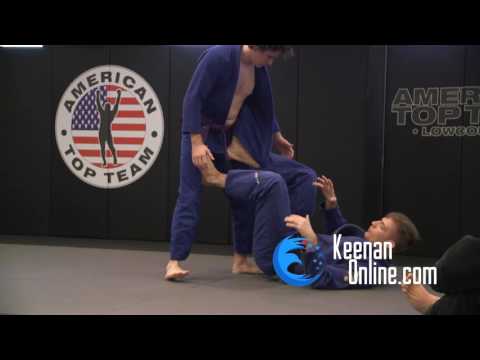
Worm Guard 101 - Keenanonline.com
0
Worm Guard·Keenan Cornelius
Make sure to go sign up and subscribe at http://keenanonline.com/ to learn more great techniques and take your control o…
Translation: worm guard
The Worm Guard family covers the guard position that uses the opponent's own gi lapel as a controlling tool, threading it around the leg and using it as a grip to control distance and set up sweeps. [1] The worm guard was a revolutionary innovation in gi BJJ because it introduced lapel-based guards that created entirely new control mechanics not possible with traditional grips. [1],[2] The lapel wrap provides a persistent, difficult-to-break connection that gives the guard player exceptional control over the opponent's movement and base. [2],[3]
The worm guard provides exceptional control by threading the opponent's lapel around their leg and gripping it from underneath, creating a connection that is extremely difficult to break and generates powerful sweeping angles. [1]
Keenan Cornelius used the worm guard to win multiple IBJJF titles and compete at the highest levels of gi grappling, proving the position viable against elite-level opponents. [1]
No images yet for this technique.
Sign in to suggest an image.
Make sure to go sign up and subscribe at http://keenanonline.com/ to learn more great techniques and take your control o…
No instructional courses yet for this technique.
Sign in to suggest a course.
Risk of injury to the person this technique is applied to
Guard positions are defensive; injury risk comes from transitions, not the position itself
Skill level needed to execute this technique reliably
Whether this technique is allowed under major competition rule sets
Advanced Brazilian Jiu-Jitsu Techniques (Marcelo Garcia, 2011)
Alias sources — [1] IBJJF Rules and Regulations [2] IBJJF Rules and Regulations [3] IBJJF Rules and Regulations
Effectiveness sources — [1] IBJJF official records
Standard katakana transliteration of Western martial arts terminology (外来語) — used in Japanese MMA, boxing, and BJJ communities
Alias sources — [1] IBJJF Rules and Regulations [2] IBJJF Rules and Regulations [3] IBJJF Rules and Regulations
Effectiveness sources — [1] IBJJF official records
hip flexibility, active legs, grip management
long legs for distance control and guard retention
hip flexors, adductors, quadriceps, core, grip
Every move, in any martial art, shares a few universal traits. Mix and match below to pinpoint the right tool — or compare equivalents across styles.
The worm guard was invented by Keenan Cornelius around 2014 — it uses the opponent's own lapel threaded around their leg as a control handle. One of the most innovative modern gi guard developments. (Cornelius, instructional series)
According to Keenan Cornelius, the goal is to open up your opponent and create opportunities for attacks like triangles and arm bars by pulling their arms away from them, which leaves them more exposed.
Keenan Cornelius explains that most people prefer to pass to the same side repeatedly, so controlling their facing direction forces them to pass to an uncomfortable side, making them awkward and uncomfortable with their pass attempts.
According to Keenan Cornelius, you can set up the Worm Guard from virtually any guard position except closed guard.
Keenan Cornelius emphasizes gripping the lapel, keeping your arm in position to defend against leg attacks, then sitting down and placing your foot on the hip to pull your opponent into you at a safe distance.
The Worm Guard family covers the guard position that uses the opponent's own gi lapel as a controlling tool, threading it around the leg and using it as a grip to control distance and set up sweeps. The worm guard was a revolutionary innovation in gi BJJ because it introduced lapel-based guards that created entirely new control mechanics not possible with traditional grips.
The worm guard was invented by Keenan Cornelius, who developed and refined it through competition in the early-to-mid 2010s. Cornelius's worm guard innovation sparked an entire category of lapel-based guards (squid guard, mantis guard) that transformed gi BJJ.
IBJJF: legal — Legal — guard is fundamental to BJJ, sweeps from guard score 2 points; IJF: restricted — Guard pulling penalized as non-combativity — groundwork from guard permitted …; ADCC: legal — Legal, guard pull penalized -1 point in points portion; Unified MMA: legal — Legal — no penalty for playing guard; FIAS Sport Sambo: legal — Legal
Danger rating 2/10. Low — guard positions are defensive; injury risk comes from transitions, not the position itself
The standard setup chain: Achieve Guard Contact → Control Grips → Manage Distance → Threaten Submissions/Sweeps.
Standard counters include: Guard Pass — systematically work to clear the legs and establish a dominant position / Leg Pin — control one or both legs to neutralize guard retention / Pressure Passing — use heavy chest pressure to flatten and immobilize the guard player.
Common variants: Standard guard (primary leg and grip configuration for control and attack…); Offensive guard (configured for sweeps and submissions); Defensive guard (prioritising distance management and preventing passes); Transition guard (moving between guard types to adjust to the opponent's pa…).
Keenan Cornelius used the worm guard to win multiple IBJJF titles and compete at the highest levels of gi grappling, proving the position viable against elite-level opponents.
Top errors to watch for: Attempting worm guard in no-gi — it is exclusively a gi technique / Not threading the lapel deeply enough — the lapel must wrap fully around the leg for the control to work / Holding worm guard without attacking — the lapel control creates a window; use it before the opponent strips the grip / Not extracting the lapel efficiently — the lapel pull must be quick and committed.
The Worm Guard is also known as Wāmu Gādo, Lapel Guard, Keenan Guard, Cornelius Guard.