Standard Chill Dog

Genus

スタンダードチルドッグ(Sutandādo Chiru Doggu)

Transliteration

Translation: standard chill dog

Overview

The Standard Chill Dog establishes the intermediate rubber guard position with the shin pulled over the opponent's shoulder, the arm threaded through the leg triangle, and the guard player controlling the position while setting up gogoplata, omoplata, or triangle transitions. [1] The standard chill dog builds on Mission Control by adding arm threading that creates a tighter control and more direct submission pathways. [1],[2] It requires the guard player to maintain the flexible leg position while executing the arm thread. [2],[3]

Also known as
Basic Chill Dog[1]Classic Chill Dog[2]

History & Origin

The standard chill dog is the base version of the chill dog position in the 10th Planet rubber guard system, developed by Eddie Bravo as part of his systematic approach to no-gi guard play. [1] It is taught as an intermediate position in the rubber guard curriculum. [2],[3]

Effectiveness

The standard chill dog is the fundamental version of this 10th Planet position. [1]

Lineage

Developed by Eddie Bravo. [1]

Competition Record

Used in no-gi competition. [1]

Images

No images yet for this technique.

Sign in to suggest an image.

Biomechanical Mechanism

Primary ActionUsing the legs and hips to control the opponent from the bottom — maintaining distance management and attack angles
Joints InvolvedHips (primary engine for sweeps and attacks), knees (framing and hooking), ankles (secondary hooks)
Force VectorPulling, framing, and hip-escaping — creating angles for attacks while preventing passing
Positional MechanicThe guard is an active offensive position — leg control compensates for bottom positioning by threatening sweeps and submissions

Position & Entry

From closed guardBreak the opponent's posture, secure mission control (overhook the head with the leg), establish rubber guard configuration
From high guardClimb the legs high, flex the hip to bring the foot to the shoulder, lock the rubber guard position

Variants

Standard guardprimary leg and grip configuration for control and attacks from bottom
Offensive guardconfigured for sweeps and submissions
Defensive guardprioritising distance management and preventing passes
Transition guardmoving between guard types to adjust to the opponent's passing style

Videos

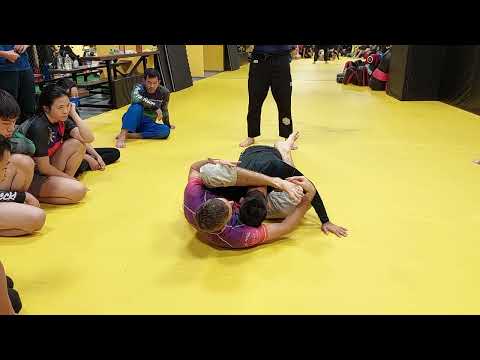
4. Rubber Guard- Marshall Stamper. Kung Fu Move to Chill Dog to GoGo Clinch

0
Standard Chill Dog·The Bear's Den BJJ & MMA 熊派巴西柔術及MMA學院·Added by Admin

On Saturday, December 10th, 10th Planet Brown Belt Marshall Stamper gave a Rubber Guard Workshop at The Bear's Den BJJ &

1 video

Learn This Technique

No instructional courses yet for this technique.

Sign in to suggest a course.

Ratings

Danger Rating

Risk of injury to the person this technique is applied to

2
Low2/10

Guard positions are defensive; injury risk comes from transitions, not the position itself

Difficulty

Skill level needed to execute this technique reliably

Intermediate
Competition Legality

Whether this technique is allowed under major competition rule sets

Restricted
IJF — Guard pulling penalized as non-combativity — ground...
IJF Sport and Organisation Rules 2025, Article 27PDF
Legal
IBJJF — Legal — guard is fundamental to BJJ, sweeps from ...
IBJJF Rules Book v6.0, June 2024PDF
ADCC — Legal, guard pull penalized -1 point in points por...
ADCC Rules Update, April 2025PDF
Unified MMA — Legal — no penalty for playing guard
Unified Rules of MMA, August 2025PDF
FIAS Sport Sambo — Legal
FIAS International Sambo Competition RulesPDF

Training Notes

Standard chill dog execution: from mission control (shin across opponent's neck with same-side hand holding the ankle), release the ankle hand, reach across the opponent's back to grip their far wrist, and pull the arm across their body to isolate it (Eddie Bravo, Mastering the Rubber Guard, 2006)
Step 1: establish mission control — shin across the back of the neck, same-side hand holds the ankle or shin
Step 2: release the hand holding the ankle — the leg must maintain its position through flexibility alone
Step 3: reach across the opponent's back with the freed hand
Step 4: grip the opponent's far wrist and pull it across their body toward you
Step 5: the opponent is now trapped: shin controls the neck, hand controls the far arm — this is chill dog
Step 6: from here, choose: gogoplata (thread the shin under the chin), omoplata (spin under the arm), or new york (advanced setup)
The transition from mission control to chill dog must be smooth — any gap allows the opponent to posture
Drill: from closed guard, flow through mission control to chill dog — 5 reps per side
Common Mistakes

!Releasing the ankle hand before the shin is secure — the leg must be stable enough to maintain position without hand assistance
!Reaching for the far arm too aggressively — maintain posture control throughout the reach
!Not pulling the arm fully across — the arm must be completely isolated on your side
!Losing the shin position while reaching — if the shin slips, return to mission control before trying again
!Not immediately choosing a submission after establishing chill dog — the position deteriorates if held passively
!Using excessive force on the neck — the shin should control posture, not apply damaging pressure
!Not practising the transition speed — the mission control to chill dog transition must be fluid

Related Techniques

Counter Techniques

Setup Chain

1Achieve Guard Contactestablish leg control around or against the opponent
2Control Gripssecure sleeve, collar, or wrist control for manipulation
3Manage Distanceuse legs and grips to control the range and prevent passing
4Threaten Submissions/Sweepscreate offensive threats to keep the opponent reactive

Sources & References

Primary Source

Advanced Brazilian Jiu-Jitsu Techniques (Marcelo Garcia, 2011)

1BookThe Guard (Moreira & Beneville, 2008)

Alias sources — [1] Advanced Rubber Guard (Bravo, 2006) [2] Advanced Rubber Guard (Bravo, 2006)

2BookJiu-Jitsu University (Ribeiro, 2008)

Effectiveness sources — [1] Mastering the Rubber Guard (Bravo, 2006)

3OtherJapanese Combat Sports Katakana Convention

Standard katakana transliteration of Western martial arts terminology (外来語) — used in Japanese MMA, boxing, and BJJ communities

4CitationThe Guard (Moreira & Beneville, 2008)

Alias sources — [1] Advanced Rubber Guard (Bravo, 2006) [2] Advanced Rubber Guard (Bravo, 2006)

5CitationJiu-Jitsu University (Ribeiro, 2008)

Effectiveness sources — [1] Mastering the Rubber Guard (Bravo, 2006)

Community

Athletics

Requires

hip flexibility, active legs, grip management

Favours

long legs for distance control and guard retention

Key muscles

hip flexors, adductors, quadriceps, core, grip

Frequently Asked Questions

What's the key to controlling someone in the Chill Dog position?

The knee pinch and keeping your knees in tight is the most important part—if you do this strongly and repeatedly, there's not much your opponent can do. Marshall Stamper emphasizes constantly attacking the hands, pinching, and pulling while sitting up.

How do I transition into the Chill Dog from the rubber guard?

Start with your knee up and across, then use the kung fu move to get your hand to the other side: slice your wrist on your toenails, push your opponent's face, and come under your ankle. Readjust back on your hip and pinch your knees to secure the position.

What should I avoid when setting up the Chill Dog?

Don't let your opponent sit in a relaxed position, as this creates trouble and gives them more movement options to pass your leg. Keep constant pressure with your knees and control.

How does the Standard Chill Dog work?

The Standard Chill Dog establishes the intermediate rubber guard position with the shin pulled over the opponent's shoulder, the arm threaded through the leg triangle, and the guard player controlling the position while setting up gogoplata, omoplata, or triangle transitions. The standard chill dog builds on Mission Control by adding arm threading that creates a tighter control and more direct submission pathways.

Where does the Standard Chill Dog come from?

The standard chill dog is the base version of the chill dog position in the 10th Planet rubber guard system, developed by Eddie Bravo as part of his systematic approach to no-gi guard play. It is taught as an intermediate position in the rubber guard curriculum.

Is the Standard Chill Dog legal in competition?

IBJJF: legal — Legal — guard is fundamental to BJJ, sweeps from guard score 2 points; IJF: restricted — Guard pulling penalized as non-combativity — groundwork from guard permitted …; ADCC: legal — Legal, guard pull penalized -1 point in points portion; Unified MMA: legal — Legal — no penalty for playing guard; FIAS Sport Sambo: legal — Legal

How dangerous is the Standard Chill Dog?

Danger rating 2/10. Low — guard positions are defensive; injury risk comes from transitions, not the position itself

How do I set up the Standard Chill Dog?

The standard setup chain: Achieve Guard Contact → Control Grips → Manage Distance → Threaten Submissions/Sweeps.

How do I defend against the Standard Chill Dog?

Standard counters include: Guard Pass — systematically work to clear the legs and establish a dominant position / Leg Pin — control one or both legs to neutralize guard retention / Pressure Passing — use heavy chest pressure to flatten and immobilize the guard player.

What are the variants of the Standard Chill Dog?

Common variants: Standard guard (primary leg and grip configuration for control and attack…); Offensive guard (configured for sweeps and submissions); Defensive guard (prioritising distance management and preventing passes); Transition guard (moving between guard types to adjust to the opponent's pa…).

How effective is the Standard Chill Dog in competition?

Used in no-gi competition.

What are common mistakes when doing the Standard Chill Dog?

Top errors to watch for: Releasing the ankle hand before the shin is secure — the leg must be stable enough to maintain position without hand … / Reaching for the far arm too aggressively — maintain posture control throughout the reach / Not pulling the arm fully across — the arm must be completely isolated on your side / Losing the shin position while reaching — if the shin slips, return to mission control before trying again.

What are other names for the Standard Chill Dog?

The Standard Chill Dog is also known as Sutandādo Chiru Doggu, Basic Chill Dog, Classic Chill Dog.