Lasso Guard Sweep & Arm Drag Combo
0
Double Lasso Guard·MMA Leech·Added by Admin
Click Here To Subscribe So You Never Miss A Video ➤ https://bit.ly/2CxCEvi Professor Gustavo Gasperin teaches the first …
Translation: double lasso guard
The Double Lasso Guard uses the lasso wrap on both sides — both legs threaded over and through the opponent's arms — creating a symmetrical control that severely restricts the opponent's ability to use their arms. [1] The double lasso is extremely controlling but limits the guard player's own mobility, making it primarily a stalling or submission-setup position. [1],[2] From double lasso, the guard player can attack with sweep combinations and triangle chokes. [2],[3]
Double lasso guard wraps both shins around the opponent's arms, providing maximum control of both sides. [1]
Double lasso is an advanced lasso guard variant developed in gi competition. [1]
Double lasso guard is used in gi BJJ competition. [1]
No images yet for this technique.
Sign in to suggest an image.
Click Here To Subscribe So You Never Miss A Video ➤ https://bit.ly/2CxCEvi Professor Gustavo Gasperin teaches the first …
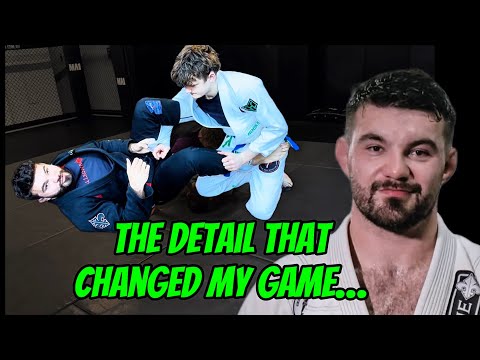
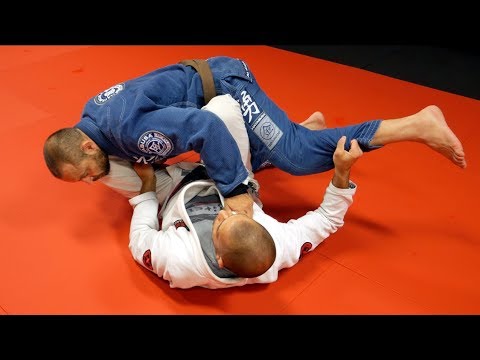
One of the strongest guards in the sport, Lasso Guard can take you all the way from white to black belt! In this video …
The double lasso guard, also called the lasso guard, is an open-guard position where the bottom player threads one leg around the opponent's arm and controls the same-side leg with a grip on the wrist or cuff, typically establishing a hook across the torso. Both MMA Leech and Precision MMA emphasize the critical importance of hand positioning and grip structure. MMA Leech stresses aligning the knee close to the opponent's shoulder to maximize control—if the knee disconnects from the shoulder, sweeping power diminishes significantly. Precision MMA highlights using a hook grip with the palm facing the ceiling rather than a closed fist, which preserves grip endurance during longer exchanges. Both instructors teach foundational sweeps: MMA Leech describes the shin-across-stomach sweep where lifting the opponent's leg while opening the knee toward the mat generates momentum for top position. Precision MMA presents multiple sweep variations including the knee lever, reverse de la Riva hook, and modified tripod sweep, each triggered by different opponent base positions and weight distributions. Where MMA Leech focuses on a single primary sweep with an arm-drag follow-up combo, Precision MMA delivers extensive positional variations—shallow versus full lasso, transitions to half-guard and X-guard structures, spider lasso combinations, and leg-reaping attacks. Both agree that the lasso guard functions effectively from half-guard as well. Precision MMA additionally covers defensive counters, particularly addressing the opponent's knee-scrape and elbow-flare pass attempts by transitioning to shallow lasso or open guard recovery.
Synthesized from 2 instructors
No instructional courses yet for this technique.
Sign in to suggest a course.
Risk of injury to the person this technique is applied to
Guard positions are defensive; injury risk comes from transitions, not the position itself
Skill level needed to execute this technique reliably
Whether this technique is allowed under major competition rule sets
Jiu-Jitsu University (Saulo Ribeiro, 2008)
Alias sources — [1] Jiu-Jitsu University (Ribeiro, 2008) [2] The Guard (Moreira & Beneville, 2003) [3] The Guard (Moreira & Beneville, 2003)
Effectiveness sources — [1] Jiu-Jitsu University (Ribeiro, 2008)
Standard katakana transliteration of Western martial arts terminology (外来語) — used in Japanese MMA, boxing, and BJJ communities
Alias sources — [1] Jiu-Jitsu University (Ribeiro, 2008) [2] The Guard (Moreira & Beneville, 2003) [3] The Guard (Moreira & Beneville, 2003)
Effectiveness sources — [1] Jiu-Jitsu University (Ribeiro, 2008)
hip flexibility, active legs, grip management
long legs for distance control and guard retention
hip flexors, adductors, quadriceps, core, grip
Hand positioning is critical—if your hand is turned down, your opponent can easily loop their hand out and grab your thigh to break the grip. According to Precision MMA, you should position your hand specifically to prevent this escape, which is the foundational detail that unlocks the position.
When your opponent tries to walk in that direction and flare their elbow to push your foot off their shoulder, close your thigh down to catch their hip and prevent the guard pass, as emphasized by Precision MMA.
According to MMA Leech, you need to align your knee as close as possible to your opponent's shoulder—when your knee is connected to their shoulder, opening your knee creates immediate movement; if your leg is positioned too far to the side, the sweep won't be effective.
Precision MMA recommends learning shallow lasso as a valuable structure when starting out with lasso guard, as it teaches fundamental concepts before progressing to more complex variations.
The Double Lasso Guard uses the lasso wrap on both sides — both legs threaded over and through the opponent's arms — creating a symmetrical control that severely restricts the opponent's ability to use their arms. The double lasso is extremely controlling but limits the guard player's own mobility, making it primarily a stalling or submission-setup position.
The double lasso guard developed as an extension of the single lasso, used by competitors who sought maximum arm control from the guard. It is less commonly used than single lasso due to its mobility limitations but is effective in specific competitive scenarios.
IBJJF: legal — Legal — guard is fundamental to BJJ, sweeps from guard score 2 points; IJF: restricted — Guard pulling penalized as non-combativity — groundwork from guard permitted …; ADCC: legal — Legal, guard pull penalized -1 point in points portion; Unified MMA: legal — Legal — no penalty for playing guard; FIAS Sport Sambo: legal — Legal
Danger rating 2/10. Low — guard positions are defensive; injury risk comes from transitions, not the position itself
The standard setup chain: Achieve Guard Contact → Control Grips → Manage Distance → Threaten Submissions/Sweeps.
Standard counters include: Guard Pass — systematically work to clear the legs and establish a dominant position / Leg Pin — control one or both legs to neutralize guard retention / Pressure Passing — use heavy chest pressure to flatten and immobilize the guard player.
Common variants: Spider guard (gripping both sleeves with feet on the biceps for distanc…); De la Riva guard (one hook behind the opponent's lead leg with opposite foo…); Lasso guard (lasso grip wrapping the leg around the opponent's arm); Collar-sleeve guard (controlling collar with one hand and sleeve with the othe…).
Double lasso guard is used in gi BJJ competition.
Top errors to watch for: Maintaining double lasso without sweeping — the position is controlling but must lead to a sweep / Using double lasso against a retreating opponent — the opponent must be close and engaged for double lasso to work / Not maintaining both sleeve grips — if either grip breaks, the double lasso collapses / Holding double lasso as a stalling position — referees will penalize inactivity; sweep immediately.
The Double Lasso Guard is also known as Daburu Rassō Gādo, Double Lasso, Two-Lasso Guard, Dual Spiral Guard.