Closed Guard Position Overview
The closed guard occurs when the bottom player has their legs locked around the top player's torso. Although the top player has a positional advantage, they remain in danger from submissions such as armbars and triangle chokes. The primary objective for the top player is to open the guard and pass, rather than attempt submissions from this position.
Maintaining Posture and Staying Square
Proper posture is critical for safety in the closed guard. The top player should remain upright and square to their opponent, as a broken posture allows the bottom player to isolate limbs and attack. When the bottom player gains an angle by moving their hips to the side, they can more effectively isolate a single arm, making defense more difficult.
Arm Positioning and Defense
The top player should keep both arms ready in front to block submissions rather than reaching underneath the legs. This positioning allows one arm to protect the other. Reaching an arm through exposes it to isolation and attack from the bottom player.
Initial Posture Control
The top player begins by swimming both arms to the opponent's armpits and straightening the arms completely. Straight arms provide structural strength that resists the bottom player's attempts to break posture by pulling downward. Bent arms are vulnerable to being folded, making the position dependent on muscular strength rather than leverage.
High and Low Hand Placement
The top player establishes one hand high on the shoulder and one hand low on the hip. The high hand prevents posture from being broken, while the low hand prevents the bottom player from raising their hips to isolate a single arm. This configuration requires the top player to lift their hips forward to maintain straight arms.
Standing and Creating Pressure
The top player stands up by stepping back with their feet while leaning away to maintain straight arms. Standing increases pressure on the bottom player's legs and distributes their opponent's weight through the locked leg structure. This positioning makes it significantly easier to open the guard.
Mechanics of Opening the Guard
To open the closed guard, the top player applies downward pressure through the hip control while pushing just below the shin along the length of the thigh. The crossed feet structure requires maximum tension to separate, which occurs at the foot connection point. Once the legs open, the top player places their knee over the opponent's leg to prevent re-closure.
Common Mistakes
Keeping both hands high without controlling the hip fails to create sufficient pressure on the legs. Conversely, placing both hands on the hips without high control allows posture to be broken. Additionally, attempting to open the guard while seated rather than standing eliminates the structural pressure needed to unlock the crossed feet.
Opening The Closed Guard
Key Takeaways
- •Closed Guard Position Overview
- •Maintaining Posture and Staying Square
- •Arm Positioning and Defense
- •Initial Posture Control
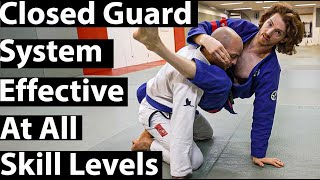
Full Course Playlist → https://youtube.com/playlist?list=PLDrQXekZsfYZfV1QZ4T5UkxLwFwQ12EbP Find the Introduction course here → https://submeta.io/@lachlangiles/courses/introduction Once we escape the mount finish in our opponents closed guard. When we are in closed guard we must seek to open the guard before we can proceed to improve our position and search for the submission. The closed guard is a position where we must take great care not to give our opponent the opportunity to sweep (to put us down and come on top) or to submit. In this video, we cover the dos and don’t of this position as well as detail one basic way to open the guard. More from Lachlan https://www.submeta.io/@lachlangiles Subscribe to watch a huge range of courses all designed to plan, personalize and optimize your game. Follow SUBMETA https://www.instagram.com/submeta.io https://www.facebook.com/submeta.io
Related Techniques
Frequently Asked Questions
What does this video teach about standard closed guard?
This video covers closed guard position overview, maintaining posture and staying square, arm positioning and defense. It provides detailed instruction from Absolute MMA St Kilda - Melbourne.
How long does it take to learn standard closed guard?
The basic mechanics can be understood in a single session, but developing reliable execution requires consistent drilling over weeks of practice. This 8-part breakdown helps structure your training by isolating each phase of the technique.
What are the key details for finishing standard closed guard?
To open the closed guard, the top player applies downward pressure through the hip control while pushing just below the shin along the length of the thigh. The crossed feet structure requires maximum tension to separate, which occurs at the foot connection point. Once the legs open, the top player places their knee over the opponent's leg to prevent re-closure.
Related videos
John Danaher Explains Closed Guard Fundamentals
Bernardo Faria BJJ Fanatics
Roger Gracie's Closed Guard is Extremely Complex - BJJ Study
Deep Dive JJ
Kimura From Closed Guard For White Belts (Small Details To Improve Success)
Chewjitsu
Elevated Basics: The Ultimate No-Gi Closed Guard Guide
IsakIvanovicjj
Easy to Use Entire Closed Guard System
JonThomasBJJ