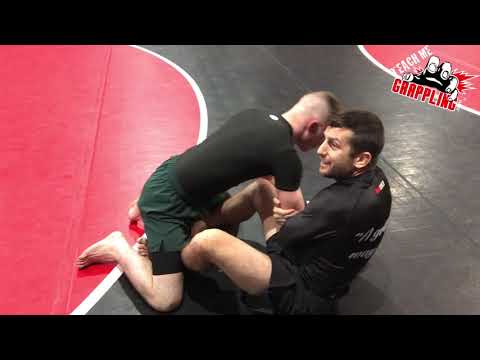
UTILIZE your Butterfly GUARD! Then ARMDRAG!
0
Standard Seated Butterfly·TeachMeGrappling Coach Brian·Added by Admin
PLEASE Click this link to SUPPORT the TeachMeGrappling Channel!!! https://www.patreon.com/TeachMeGrappling or https:/…
Translation: standard seated butterfly
The Standard Seated Butterfly establishes the fundamental butterfly guard with the guard player sitting upright, both hooks inserted inside the opponent's thighs, hands controlling the upper body via collar/sleeve grips (gi) or underhooks/overhooks (no-gi). [1] This is the base butterfly guard position from which all butterfly guard attacks originate — hook sweeps, arm drags, guillotines, and transitions to X-guard and single leg X. [1],[2] The standard seated butterfly is characterised by an active, mobile seated posture with constant adjustment of hooks and grips. [2],[3]
The standard seated butterfly is the prototypical butterfly guard, representing the fundamental position of the guard system that Marcelo Garcia used to win multiple ADCC and World Championship titles. [1] It is one of the most effective and widely used guard positions in both gi and no-gi competition. [2],[3]
The standard seated butterfly is the fundamental seated butterfly guard position. [1]
A core no-gi guard position popularised by Marcelo Garcia. [1]
Widely used in ADCC and no-gi competition. [1]
No images yet for this technique.
Sign in to suggest an image.
PLEASE Click this link to SUPPORT the TeachMeGrappling Channel!!! https://www.patreon.com/TeachMeGrappling or https:/…
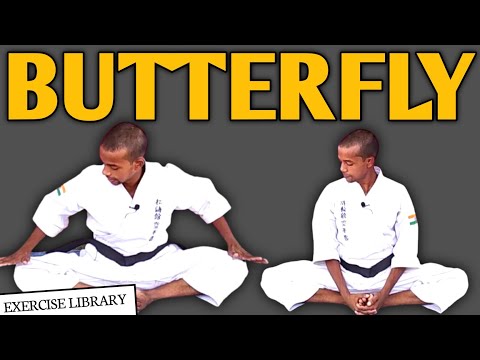
HOW TO DO BUTTERFLY EXERCISE | BEST STRETCHING EXERCISE | BUTTERFLY STRETCH | EXERCISE LIBRARY #virtualkarateclub #sen…
The standard seated butterfly guard is a foundational grappling position executed from the bottom, characterized by the practitioner sitting upright with both legs bent and feet planted close to the hips, using the inside of the thighs and lower legs—the butterfly hooks—to control an opponent's base and hips. TeachMeGrappling Coach Brian emphasizes that proper positioning requires the top player to have knees wide and base engaged, while the bottom player maintains active leg hooks rather than passive ones. The position functions as a launching point for multiple offensive techniques, particularly the arm drag, which constitutes a core attack from this guard. Brian's instructional approach highlights several critical mechanical details: the importance of getting under the opponent's center of gravity by scooting the hips in deeply, using flared elbows for frame control, and maintaining connection through underhooks to prevent the opponent from establishing top control. The rocking chair drill—in which the bottom player uses butterfly hooks to lift and control the top player's base—serves as the foundational drilling exercise. From seated butterfly, the arm drag attack involves isolating a wrist, feeding it into the armpit while controlling the triceps, then using leg manipulation to rotate toward the back control position. Brian notes that keeping butterfly hooks engaged during the initial drag phase maintains positional security. The position remains effective against larger opponents due to the mechanical advantage provided by the hooks and the proximity gained through hip advancement.
Synthesized from 2 instructors
No instructional courses yet for this technique.
Sign in to suggest a course.
Risk of injury to the person this technique is applied to
Guard positions are defensive; injury risk comes from transitions, not the position itself
Skill level needed to execute this technique reliably
Whether this technique is allowed under major competition rule sets
Advanced Brazilian Jiu-Jitsu Techniques (Marcelo Garcia, 2011)
Alias sources — [1] The Guard (Moreira & Beneville, 2003) [2] Marcelo Garcia: Advanced BJJ Techniques (2011)
Effectiveness sources — [1] Mastering Jujitsu (Gracie & Danaher, 2003)
Mixed Japanese-Western terminology — combines traditional Japanese terms with katakana loanwords
Alias sources — [1] The Guard (Moreira & Beneville, 2003) [2] Marcelo Garcia: Advanced BJJ Techniques (2011)
Effectiveness sources — [1] Mastering Jujitsu (Gracie & Danaher, 2003)
hip flexibility, active legs, grip management
long legs for distance control and guard retention
hip flexors, adductors, quadriceps, core, grip
Coach Brian recommends using either an S-grip or palm-to-palm grip, and emphasizes keeping your elbows in to prevent your opponent from getting underhooks while maintaining head position.
Coach Brian prefers being higher because it gives a better grip, though being lower provides more leverage—the choice depends on your preference, but a higher position keeps more offensive options available.
Coach Brian advises against trying to wrap your leg around immediately, as this forces you to put your hand on the mat. Instead, base on your elbow, grab the lat, lift your hips with a big step, then place your hooks in with your foot on the mat.
Keep your butterfly hooks active and maintain a chest-to-back connection; if your opponent tries to defend or escape, you can scoot to maintain the hooks and control.
The Standard Seated Butterfly establishes the fundamental butterfly guard with the guard player sitting upright, both hooks inserted inside the opponent's thighs, hands controlling the upper body via collar/sleeve grips (gi) or underhooks/overhooks (no-gi). This is the base butterfly guard position from which all butterfly guard attacks originate — hook sweeps, arm drags, guillotines, and transitions to X-guard and single leg X.
The standard seated butterfly is the prototypical butterfly guard, representing the fundamental position of the guard system that Marcelo Garcia used to win multiple ADCC and World Championship titles. It is one of the most effective and widely used guard positions in both gi and no-gi competition.
IBJJF: legal — Legal — guard is fundamental to BJJ, sweeps from guard score 2 points; IJF: restricted — Guard pulling penalized as non-combativity — groundwork from guard permitted …; ADCC: legal — Legal, guard pull penalized -1 point in points portion; Unified MMA: legal — Legal — no penalty for playing guard; FIAS Sport Sambo: legal — Legal
Danger rating 2/10. Low — guard positions are defensive; injury risk comes from transitions, not the position itself
The standard setup chain: Achieve Guard Contact → Control Grips → Manage Distance → Threaten Submissions/Sweeps.
Standard counters include: Guard Pass — systematically work to clear the legs and establish a dominant position / Leg Pin — control one or both legs to neutralize guard retention / Pressure Passing — use heavy chest pressure to flatten and immobilize the guard player.
Common variants: Standard butterfly guard (both feet hooked inside the opponent's thighs); Single butterfly hook (one hook in while the other leg posts or controls); Butterfly with overhook (combining the hooks with an overhook for sweep setups).
Widely used in ADCC and no-gi competition.
Top errors to watch for: Not fighting for the underhook — the underhook is the most important grip; prioritize it above all else / Sitting passively without threatening — constant sweep threats keep the opponent defensive / Allowing the opponent to get double underhooks — immediately pummel or switch to a different guard / Keeping hooks loose — active hooks with upward pressure are essential.
The Standard Seated Butterfly is also known as Sutandādo Suwari Batafurai, Classic Butterfly Guard, Standard Butterfly.