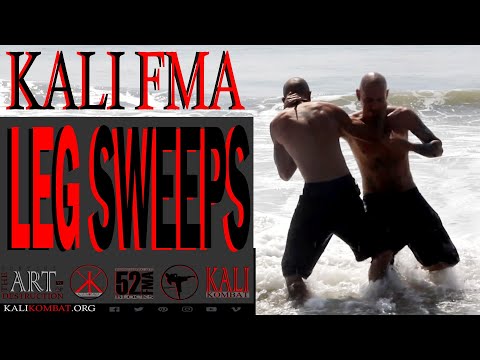
KALI FMA Leg Sweeps / takedowns pt1 Tutorial
0
Leg Drag Execution·Kali Kombat·Added by Admin
SoloMinati demonstrates in full detail how to execute kali fma leg sweep takedowns!! KALI KOMBAT Full Digi Courses, vi…
Translation: leg drag pass
The leg drag pass controls one of the opponent's legs and drags it across the passer's own centerline to the opposite hip, pinning the knee to the mat while the chest presses the opponent's thigh flat, eliminating hip mobility on one side and creating a direct passing lane to side control or the back. [1] The technique appeared in rudimentary form in the 1990s through Fernando 'Terere' Augusto, Leo Vieira, and Vitor 'Shaolin' Ribeiro. It was revolutionized by Rafael and Guilherme Mendes in the early 2010s, who used it as both a passing position and a back-take platform to win multiple IBJJF World Championships. [2]
One of the most important modern guard passes. Rafael Mendes used the leg drag to back take sequence to win multiple IBJJF World Championships. The technique works against all guard variations and provides direct access to both side control and back takes. [1]
Terere, Leo Vieira, Shaolin (1990s-2000s) → Mendes brothers revolution (2010s) → Modern standard pass.
Rafael Mendes: multiple IBJJF World Championship titles using leg drag to back take. Guilherme Mendes: IBJJF World Champion. Mikey Musumeci, Gianni Grippo also use extensively.
No images yet for this technique.
Sign in to suggest an image.
SoloMinati demonstrates in full detail how to execute kali fma leg sweep takedowns!! KALI KOMBAT Full Digi Courses, vi…
No instructional courses yet for this technique.
Sign in to suggest a course.
Risk of injury to the person this technique is applied to
Controlled lateral pressure on the hip with no joint manipulation
Skill level needed to execute this technique reliably
Whether this technique is allowed under major competition rule sets
BJJ Heroes — Leg Drag Guard Pass History
[2] Art of Jiu-Jitsu — Mendes brothers competition footage and system
BJJ Heroes — Leg Drag Guard Pass History (bjjheroes.com) || Art of Jiu-Jitsu — Rafael Mendes competition system || BJJ Fanatics — Leg Drag instructional content
Standard katakana transliteration of Western martial arts terminology (外来語) — used in Japanese MMA, boxing, and BJJ communities
[1] BJJ Heroes — leg drag history documenting Terere, Vieira, Shaolin, Mendes lineage
[2] Art of Jiu-Jitsu — Mendes brothers competition footage and system
precise grip placement, hip positioning, lateral movement
adductors, obliques, grip flexors
The fundamental concept is sweeping the feet in the opposite direction of the head, in any direction. Kali Kombat emphasizes that while there are hundreds of ways to sweep a person, they all return to this one core principle.
You need to establish proper footwork to get into sweeping position, using techniques like the triangle step, v-step from the outside, and cross step (where your left foot goes to the outside of your opponent's foot). Kali Kombat teaches using a push and pull concept to move your opponent's foot and knee in one direction while pulling their body another way.
Push on one side of your opponent's body and pull on the other, which can be applied to any joint or the whole body during a sweep. This simultaneous push-pull action is what creates the effective takedown.
The leg drag pass controls one of the opponent's legs and drags it across the passer's own centerline to the opposite hip, pinning the knee to the mat while the chest presses the opponent's thigh flat, eliminating hip mobility on one side and creating a direct passing lane to side control or the back. The technique appeared in rudimentary form in the 1990s through Fernando 'Terere' Augusto, Leo Vieira, and Vitor 'Shaolin' Ribeiro.
Appeared in rudimentary form in the 1990s-2000s through Terere, Leo Vieira, and Shaolin. Revolutionized by Rafael and Guilherme Mendes in the early 2010s at Art of Jiu-Jitsu.
IBJJF: legal — Legal, guard pass scores 3 points; IJF: legal — Legal — transitioning past opponent's legs is part of newaza; ADCC: legal — Legal, guard pass scores 3 points; Unified MMA: legal — Legal; FIAS Sport Sambo: legal — Legal
Danger rating 2/10. Low — controlled lateral pressure on the hip with no joint manipulation
The standard setup chain: Establish standing position → Grip opponent's ankle or pant leg → Step laterally and drag the leg across your centerline → Pin knee to mat → Press chest into opponent's thigh → Advance to side control or continue to back take.
Standard counters include: Granby roll / inversion — invert before the pin is established / Pummel legs free — retract the dragged leg before it is pinned / Underhook the far leg — prevent the passer from advancing / Berimbolo counter-attack — use the passer's lateral position against them.
Common variants: Leg drag to back take (Mendes brothers signature, continue the drag to expose th…); Leg drag from standing (initiated from standing position); Leg drag from De La Riva counter (strip the hook and drag); Reverse leg drag (drag in the opposite direction); Leg drag as a pinning position (maintain the drag control without advancing, using it as …).
Rafael Mendes: multiple IBJJF World Championship titles using leg drag to back take. Guilherme Mendes: IBJJF World Champion.
Top errors to watch for: Not pinning the knee firmly to the mat — the drag must immobilize the leg / Releasing the grip too early — maintain control until side control is established / Not pressing chest into the thigh — the chest pressure is what prevents reguarding / Not transitioning quickly to side control or back — the leg drag is a transitional position.
The Leg Drag Execution is also known as Reggu Doraggu Pasu, Standard Leg Drag Pass, Leg Drag Pass, Leg Drag, Drags Pass.