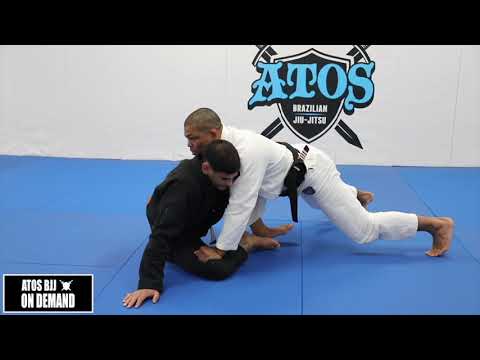
The Easy Leg Drag Pass - Andre Galvao
0
Standard Leg Drag Pass·Atos Jiu-Jitsu HQ | World's Best BJJ Academy - Home Page
DIGITAL COURSE AVAILABLE FOR IMMEDIATE VIEWING ONLINE OR OFFLINE AFTER PURCHASE. Featuring 33 individual lessons, consis…
Not yet documented
The Standard Leg Drag Pass is the classic execution of the leg drag — gripping one pant leg at the knee, pulling it across the opponent's body, pinning it at the far hip with the dropping hip, and advancing to side control or back angle. [1] The Mendes brothers perfected this standard version, using pure lateral speed and hip-dropping pressure. [1],[2]
Developed within the modern BJJ competition passing evolution. [1]
Used at IBJJF and ADCC competition. [1]
No images yet for this technique.
Sign in to suggest an image.
DIGITAL COURSE AVAILABLE FOR IMMEDIATE VIEWING ONLINE OR OFFLINE AFTER PURCHASE. Featuring 33 individual lessons, consis…
No instructional courses yet for this technique.
Sign in to suggest a course.
Risk of injury to the person this technique is applied to
Guard passes carry minimal injury risk for both fighters under normal conditions
Skill level needed to execute this technique reliably
Whether this technique is allowed under major competition rule sets
Jiu-Jitsu University (Saulo Ribeiro, 2008)
Description sources — [1] Modern BJJ passing methodology [2] Competition passing analysis
Standard katakana transliteration of Western martial arts terminology (外来語) — used in Japanese MMA, boxing, and BJJ communities
Description sources — [1] Modern BJJ passing methodology [2] Competition passing analysis
hip mobility, grip strength, timing
athletic ability, good reflexes
core, quadriceps, forearms
Every move, in any martial art, shares a few universal traits. Mix and match below to pinpoint the right tool — or compare equivalents across styles.
The leg drag controls one of the opponent's legs by pulling it across their body, exposing the back and creating a passing lane. Popularized by the Mendes Brothers and Miyao Brothers in the early 2010s. (BJJ competition records)
Andre Galvao emphasizes that your opponent will use the bottom leg to sweep you, not the top leg, so controlling it is essential to preventing the sweep and maintaining control during the pass.
Andre Galvao recommends passing toward the side of the opponent's back, typically away from the direction they are trying to sweep you, or toward the side where you can get underhooks or overhooks.
Andre Galvao stresses that you cannot let your opponent escape their hips, as this creates space to recover guard; follow their hips if they move and don't change your grip too quickly—only transition to underhooing the arm once they stop moving.
Andre Galvao emphasizes keeping your head low on the opponent's belly rather than high on their chest, as a high head position can allow them to reverse and catch your head.
The Standard Leg Drag Pass is the classic execution of the leg drag — gripping one pant leg at the knee, pulling it across the opponent's body, pinning it at the far hip with the dropping hip, and advancing to side control or back angle. The Mendes brothers perfected this standard version, using pure lateral speed and hip-dropping pressure.
This passing technique is part of the modern BJJ guard passing curriculum, refined through competition at IBJJF and ADCC.
IBJJF: legal — Legal, guard pass scores 3 points; IJF: legal — Legal — transitioning past opponent's legs is part of newaza; ADCC: legal — Legal, guard pass scores 3 points; Unified MMA: legal — Legal; FIAS Sport Sambo: legal — Legal
Danger rating 2/10. Low — guard passes carry minimal injury risk for both fighters under normal conditions
The standard setup chain: Establish Position → Strip Grips → Initiate Pass → Navigate Legs → Consolidate Side Control.
Standard counters include: Guard retention / Frame and shrimp / Sweep timing / Re-guarding.
Common variants: Standard execution (the fundamental version of this pass); Modified version (adapted for specific guard types); Chain variant (transitioning to this pass from another pass that was def…).
Used at IBJJF and ADCC competition.
Top errors to watch for: Not establishing grips before initiating / Not consolidating with crossface after passing / Only passing to one side / Rushing without reading the guard player's position.
The Standard Leg Drag Pass is also known as Basic Leg Drag, Standard Traction Pass.