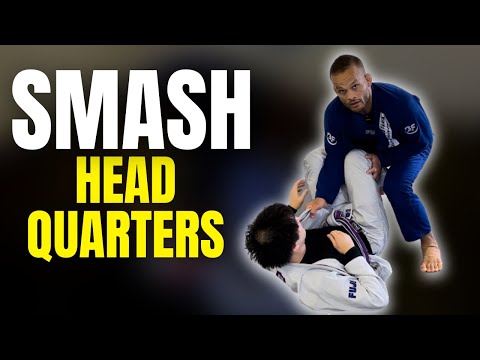
Do This to Pass Headquarters EVERY Time!
0
Standard Headquarters Pass·BIG OSS Jiu-Jitsu Channel
IF YOU HAVE A HARD TIME PASS THE HEADQUATERS POSITIONS THIS VIDEO IS FOR YOU! ON this video i show how to smash and pas…
Not yet documented
The Standard Headquarters Pass covers the fundamental passing technique from the headquarters stance — one knee up, one knee down between the opponent's legs — using the raised knee to initiate a knee cut while simultaneously establishing crossface control. [1] This standard execution represents the default passing action from headquarters, with the raised knee becoming the cutting knee. [1],[2]
Developed within the modern BJJ competition passing evolution. [1]
Used at IBJJF and ADCC competition. [1]
No images yet for this technique.
Sign in to suggest an image.
IF YOU HAVE A HARD TIME PASS THE HEADQUATERS POSITIONS THIS VIDEO IS FOR YOU! ON this video i show how to smash and pas…
No instructional courses yet for this technique.
Sign in to suggest a course.
Risk of injury to the person this technique is applied to
Guard passes carry minimal injury risk for both fighters under normal conditions
Skill level needed to execute this technique reliably
Whether this technique is allowed under major competition rule sets
Jiu-Jitsu University (Saulo Ribeiro, 2008)
Description sources — [1] Modern BJJ passing methodology [2] Competition passing analysis
Standard katakana transliteration of Western martial arts terminology (外来語) — used in Japanese MMA, boxing, and BJJ communities
Description sources — [1] Modern BJJ passing methodology [2] Competition passing analysis
hip mobility, grip strength, timing
athletic ability, good reflexes
core, quadriceps, forearms
Every move, in any martial art, shares a few universal traits. Mix and match below to pinpoint the right tool — or compare equivalents across styles.
Headquarters (HQ) is a combat base position between the opponent's legs with one knee up and one knee down. It serves as a neutral passing position from which multiple passes can be launched. (Danaher, Guard Passing instructionals)
Start by holding one ankle with your grip on the knee of the leg you want to trap, then pinch your knees together to prevent your opponent from pulling and pushing you away.
Keep your hips low and down with your weight rather than above your opponent's hips—position yourself in a squatting stance with your legs forming a V shape so that when your opponent pulls, your weight stays on your hip.
Don't go directly into mount position after controlling the arm and knee on the mat; instead, transition through quarter mount and bring your knee in to trap your opponent's leg so they cannot hook you, then bring your knee all the way down into mount.
Keep your chest on top of their hip with good weight distribution—if they elevate, wrap around the back of their knee and drive them back rather than driving forward, which prevents them from escaping with momentum.
The Standard Headquarters Pass covers the fundamental passing technique from the headquarters stance — one knee up, one knee down between the opponent's legs — using the raised knee to initiate a knee cut while simultaneously establishing crossface control. This standard execution represents the default passing action from headquarters, with the raised knee becoming the cutting knee.
This passing technique is part of the modern BJJ guard passing curriculum, refined through competition at IBJJF and ADCC.
IBJJF: legal — Legal, guard pass scores 3 points; IJF: legal — Legal — transitioning past opponent's legs is part of newaza; ADCC: legal — Legal, guard pass scores 3 points; Unified MMA: legal — Legal; FIAS Sport Sambo: legal — Legal
Danger rating 2/10. Low — guard passes carry minimal injury risk for both fighters under normal conditions
The standard setup chain: Establish Position → Strip Grips → Initiate Pass → Navigate Legs → Consolidate Side Control.
Standard counters include: Guard retention / Frame and shrimp / Sweep timing / Re-guarding.
Common variants: Standard execution (the fundamental version of this pass); Modified version (adapted for specific guard types); Chain variant (transitioning to this pass from another pass that was def…).
Used at IBJJF and ADCC competition.
Top errors to watch for: Not establishing grips before initiating / Not consolidating with crossface after passing / Only passing to one side / Rushing without reading the guard player's position.
The Standard Headquarters Pass is also known as Standard HQ Pass, Basic Headquarters.