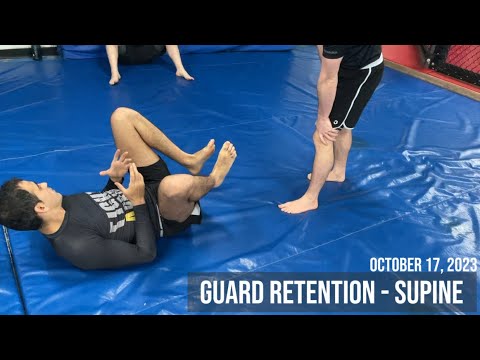
Guard Retention - Supine
0
Standard Supine Rear Mount·Bjj_saad·Added by Admin
0:00 Intro to supine guard 1:56 How to deal with grips 4:25 How to prevent the grips 5:42 How to defend against side ste…
Translation: standard supine rear mount
The Standard Supine Rear Mount has the controlling fighter lying on their back with the opponent face-up on top, hooks or body triangle locked in, and seatbelt grip secured. [1] From this position, the controlling fighter attacks primarily with the rear naked choke, using the seatbelt to manage the opponent's hand fighting while the hooks or body triangle prevent the opponent from sliding down to escape. [1],[2] The standard supine rear mount is the most frequently seen back control position in both BJJ competition and MMA fights. [2],[3]
The standard supine rear mount is the fundamental back control position with hooks in. [1]
The classical BJJ and judo rear control position. [1]
The most common back control finishing position in MMA. [1]
No images yet for this technique.
Sign in to suggest an image.
0:00 Intro to supine guard 1:56 How to deal with grips 4:25 How to prevent the grips 5:42 How to defend against side ste…
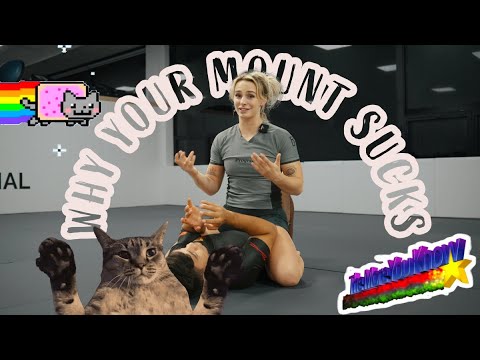
When you first start Jiu Jitsu, you're gonna be getting stuck in the bottom of mount. A lot. Even by people who aren't v…
Here are a few of my favourite tips on controlling from the mount position, and why you may be struggling in this positi…
The Standard Supine Rear Mount represents a position where a grappler controls an opponent from behind while both fighters are on their backs. Bjj_saad emphasizes the foundational importance of establishing and maintaining connection through controlled grip work on the ankles and wrists, stressing that proper positioning prevents the bottom player from escaping via lateral movement. The instructor advocates for specific hook placement above rather than below the knee to prevent paddle escapes, and describes defensive mechanics against both side-step and cross-step passing attempts by the top player. Bjj_saad's teaching focuses on minimizing the opponent's options through active leg positioning and preventing them from advancing past the hip line. Brandon Mccaghren addresses escape methodology from mounted positions, detailing three primary escapes—bridge and roll, knee-elbow escape, and kipping escape—that bottom players can employ from the supine rear mount position. Ffion Davies contributes control principles for the mounted position, including head control via cross-face, elbow elevation to prevent bridge mechanics, hip positioning slightly above the opponent's hips, and knee spacing relative to opponent arm position. Davies also emphasizes bailing out of unsustainable positions rather than clutching desperately. The three instructors collectively present a comprehensive view of the position: Bjj_saad on top-player control and connection, Mccaghren on bottom-player escapes, and Davies on positional refinement and weight distribution.
Synthesized from 3 instructors
No instructional courses yet for this technique.
Sign in to suggest a course.
Risk of injury to the person this technique is applied to
Back control is dominant position; enables rear chokes (Danaher 2021)
Skill level needed to execute this technique reliably
Whether this technique is allowed under major competition rule sets
Mastering Jujitsu (Renzo Gracie & John Danaher, 2003)
Alias sources — [1] Jiu-Jitsu University (Ribeiro, 2008) [2] Mastering Jujitsu (Gracie & Danaher, 2003)
Effectiveness sources — [1] Mastering Jujitsu (Gracie & Danaher, 2003)
Mixed Japanese-Western terminology — combines traditional Japanese terms with katakana loanwords
Alias sources — [1] Jiu-Jitsu University (Ribeiro, 2008) [2] Mastering Jujitsu (Gracie & Danaher, 2003)
Effectiveness sources — [1] Mastering Jujitsu (Gracie & Danaher, 2003)
base stability, heavy hips, ride ability
heavier build with strong hips for pressure
hip adductors, core, glutes, quadriceps
Control your opponent's head by turning it in a specific direction and using your chest to drive their face—this forces them to bridge in only one direction rather than letting them decide left or right. Ffion Davies emphasizes that if your opponent can look square or control their head freely, they have options for where to bridge.
Keeping your hips slightly above your opponent's hips prevents them from throwing your weight when they bridge, since your heaviest point won't be directly on top of their strongest point. Ffion Davies notes that positioning hips in line with theirs makes it much easier for them to escape.
Use a 'blanketing motion' by opening your arms wide rather than bunching up tight, which makes you feel much heavier and harder to move. Ffion Davies explains that when you ball up, it's significantly easier for your opponent to turn you, so staying open creates better control.
It's easier to control the position if you establish mount from side control by collecting the elbows in front (disconnecting them from the mat) before transitioning up. Ffion Davies explains that when elbows are already tight and blocking you, the resulting position is much harder to control compared to when they're already separated.
The Standard Supine Rear Mount has the controlling fighter lying on their back with the opponent face-up on top, hooks or body triangle locked in, and seatbelt grip secured. From this position, the controlling fighter attacks primarily with the rear naked choke, using the seatbelt to manage the opponent's hand fighting while the hooks or body triangle prevent the opponent from sliding down to escape.
The standard supine rear mount is the single most common finishing position for rear naked chokes in both BJJ and MMA competition. Its prevalence reflects the natural dynamics of back control exchanges, where the controlling fighter frequently ends up on their back.
IBJJF: legal — Legal, mount scores 4 points — highest-scoring position; IJF: legal — Legal, osaekomi (pin) — 10-19 seconds scores waza-ari, 20 seconds scores ippon; ADCC: legal — Legal, mount scores 2 points; Unified MMA: legal — Legal dominant position; UWW: legal — Legal, back exposure scores points, pin ends match by fall; FIAS Sport Sambo: legal — Legal, pin scores points
Danger rating 4/10. Moderate — back control is dominant position; enables rear chokes (Danaher 2021)
The standard setup chain: Pass the Guard → Settle Weight → Control Arms → Threaten Submissions.
Standard counters include: Bridge (Upa) — explosive hip elevation to off-balance the top player / Elbow-Knee Escape (Shrimp) — create space by driving elbow to knee and hip-escaping / Frame — establish forearm frames to prevent the top player from settling weight.
Common variants: Low mount (hips heavy on the opponent's belly, grapevines in for sta…); High mount (knees under the armpits, arms isolated for submissions); S-mount (one knee high under the armpit, other leg across for arm …); Technical mount (one leg hooked, one knee posted, modified for back-take t…).
The most common back control finishing position in MMA.
Top errors to watch for: Head on the wrong side — the head should be on the strong (choking) side / Hips too far from the opponent's lower back — close the gap for maximum control / Not maintaining active hooks — the hooks prevent the opponent from sliding down to escape / Attacking the RNC before the position is fully secured — establish all control elements first.
The Standard Supine Rear Mount is also known as Sutandādo Aomuke Ushiro Kijōi, Flat Rear Mount, Back Pack Position.