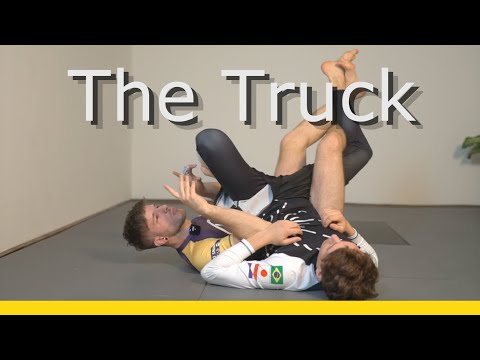
Truck entries and submissions
0
Truck Position·Energia Martial Arts
Truck entries and submissions Let's dive into a very cool position; the truck! With great credit to 10th planet master E…
Not yet documented
The Truck Position is a 10th Planet Jiu-Jitsu back-body entanglement where the attacker controls the opponent from behind with a calf hook (leg threaded between the opponent's legs hooking the calf), a seatbelt grip, and far-side leg control — creating a platform for the Twister (spinal crank), Banana Split (leg split), and calf crank submissions. [1] The Truck is a transitional back control position that provides access to submissions unavailable from standard hooks-in back control. [1],[2]
Developed within the modern BJJ competition framework. [1]
Used in IBJJF, ADCC, and/or EBI competition. [1]
No images yet for this technique.
Sign in to suggest an image.
Truck entries and submissions Let's dive into a very cool position; the truck! With great credit to 10th planet master E…
No instructional courses yet for this technique.
Sign in to suggest a course.
Risk of injury to the person this technique is applied to
Varies based on the submissions accessible from this position
Skill level needed to execute this technique reliably
Whether this technique is allowed under major competition rule sets
Jiu-Jitsu University (Saulo Ribeiro, 2008)
Description sources — [1] Modern BJJ positional development [2] Competition evolution
Standard katakana transliteration of Western martial arts terminology (外来語) — used in Japanese MMA, boxing, and BJJ communities
Description sources — [1] Modern BJJ positional development [2] Competition evolution
positional awareness, body control, specific attribute for this position
core, hip flexors, legs
Every move, in any martial art, shares a few universal traits. Mix and match below to pinpoint the right tool — or compare equivalents across styles.
The truck position originated in wrestling's leg ride system and was adapted by Eddie Bravo for BJJ as the entry to the Twister spinal lock and calf slicer. The name comes from 10th Planet Jiu-Jitsu's distinctive naming system. (Bravo, Mastering the Rubber Guard, 2006)
Start from turtle position and work to secure at least one hook. If you can't hook behind the knee on the calf, drop your leg under and extend to create space, especially if your opponent leans forward (Energia Martial Arts).
Getting your double hooks in is essential for maintaining back control—if you don't secure both hooks, you lose the position. Keep one foot rotated to the side and maintain your weight on top of the opponent's back (Energia Martial Arts).
If your opponent fears rolling backwards and keeps their weight forward, roll forward instead to end up in truck position (Energia Martial Arts).
Grab underneath the shin or just above the foot with a 'taco grip' to maintain control, and wait for your opponent to escape before reacting—their movements will naturally help you transition to submissions like a figure four grip or armpit control (Energia Martial Arts).
The Truck Position is a 10th Planet Jiu-Jitsu back-body entanglement where the attacker controls the opponent from behind with a calf hook (leg threaded between the opponent's legs hooking the calf), a seatbelt grip, and far-side leg control — creating a platform for the Twister (spinal crank), Banana Split (leg split), and calf crank submissions. The Truck is a transitional back control position that provides access to submissions unavailable from standard hooks-in back control.
This position developed within the modern BJJ/grappling positional framework as the art evolved.
IBJJF: legal — Legal, back control with hooks or body triangle scores 4 points; IJF: legal — Legal — back control leads to pin or submission opportunities; ADCC: legal — Legal, back mount scores 3 points (4 from sweep); Unified MMA: legal — Legal — dominant position for ground-and-pound and rear naked choke; UWW: legal — Legal — back exposure is the primary scoring mechanism in wrestling; FIAS Sport Sambo: legal — Legal
Danger rating 5/10. Moderate — varies based on the submissions accessible from this position
The standard setup chain: Establish Entry Position → Transition to This Position → Consolidate Control → Attack or Transition → Maintain or Advance.
Standard counters include: Positional escape / Prevention (not allowing the position to be established) / Transition to a more advantageous position.
Common variants: Standard execution (the fundamental version); Modified variation (adapted for specific scenarios); Transitional version (used as a waypoint between positions).
Used in IBJJF, ADCC, and/or EBI competition.
Top errors to watch for: Entering without proper control / Not understanding the position's purpose / Staying too long without attacking / Not chaining with transitions to other positions.
The Truck Position is also known as The Truck, Twister Control, Banana Split Position.