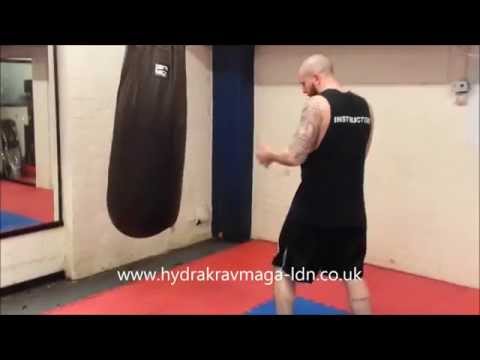
How To Hit Like A Truck
0
Standard Truck·HYDRAKRAVIST·Added by Admin
www.hydrakravmaga-ldn.co.uk Hydra shows you the way to develop the power to devestate
Translation: truck
The truck is a back-control position developed by Eddie Bravo in the early 2000s as part of his 10th Planet Jiu-Jitsu system, where the attacker uses a figure-four leg configuration to pin one of the opponent's legs while lying on their back atop the opponent. [1] Bravo adapted the wrestling leg ride — a technique used to break an opponent's defense and expose the back — into a submission-focused position for no-gi BJJ. From the truck, the attacker can execute the twister (spinal lock), calf slicer, banana split, or transition to back control. [2] The position has been further developed by berimbolo and crab ride practitioners including Rafael Mendes, the Miyao brothers, and Mikey Musumeci.
The truck was developed by Eddie Bravo in the early 2000s as part of his 10th Planet Jiu-Jitsu system. Bravo adapted the wrestling leg ride into a submission-focused position for no-gi BJJ. [1] His book 'Mastering the Twister' (2007) is the primary published reference. The position was further developed by berimbolo practitioners including Leonardo Vieira, Ryan Hall, Andre Galvao, Rafael Mendes, and the Miyao brothers, who incorporated truck entries through crab ride techniques. [2]
The truck is a highly effective attacking position in no-gi grappling, providing access to the twister (spinal lock), calf slicer, banana split, and back takes. In competitions that allow spinal locks (ADCC, EBI), it is one of the most dangerous positions to be caught in. Geo Martinez (10th Planet) has demonstrated its effectiveness repeatedly in EBI competition. [1]
Adapted by Eddie Bravo from wrestling leg ride to BJJ-focused position (early 2000s). Further developed by 10th Planet practitioners (Geo Martinez) and berimbolo competitors (Rafael Mendes, Miyao brothers, Mikey Musumeci) who added crab ride entries.
Geo Martinez: multiple EBI titles using truck and twister attacks. Rafael Mendes: 2x IBJJF World Champion, used truck entries via berimbolo. The Miyao brothers: multiple IBJJF medals with crab ride to truck sequences. Chan Sung Jung ('Korean Zombie'): first twister finish in UFC history (vs Leonard Garcia, 2011).
No images yet for this technique.
Sign in to suggest an image.
www.hydrakravmaga-ldn.co.uk Hydra shows you the way to develop the power to devestate
No instructional courses yet for this technique.
Sign in to suggest a course.
Risk of injury to the person this technique is applied to
High danger — the twister (primary attack) creates extreme rotational force on the cervical and thoracic spine; the calf slicer can cause ligament damage; the banana split can tear groin muscles and ligaments
Skill level needed to execute this technique reliably
Whether this technique is allowed under major competition rule sets
Mastering the Twister (Bravo, 2007) — The Truck position and all attacks
Primary source — [1] Mastering the Twister: Jiu Jitsu for Mixed Martial Arts Competition (Bravo, 2007, Victory Belt Publishing, ISBN 9780977731558) — 1,200+ color photos, foreword by Joe Rogan
[2] Mastering the Rubber Guard (Bravo, 2006) — broader 10th Planet system including truck transitions
Standard katakana transliteration of Western martial arts terminology (外来語) — used in Japanese MMA, boxing, and BJJ communities
Primary source — [1] Mastering the Twister: Jiu Jitsu for Mixed Martial Arts Competition (Bravo, 2007, Victory Belt Publishing, ISBN 9780977731558) — 1,200+ color photos, foreword by Joe Rogan
[2] Mastering the Rubber Guard (Bravo, 2006) — broader 10th Planet system including truck transitions
hip flexibility for figure-four configuration, understanding of wrestling leg ride concepts
flexible hips and strong legs
hip adductors, hamstrings, core stabilizers, grip strength
The truck is a back-control position developed by Eddie Bravo in the early 2000s as part of his 10th Planet Jiu-Jitsu system, where the attacker uses a figure-four leg configuration to pin one of the opponent's legs while lying on their back atop the opponent. Bravo adapted the wrestling leg ride — a technique used to break an opponent's defense and expose the back — into a submission-focused position for no-gi BJJ.
The truck was developed by Eddie Bravo in the early 2000s as part of his 10th Planet Jiu-Jitsu system. Bravo adapted the wrestling leg ride into a submission-focused position for no-gi BJJ.
IBJJF: legal — Legal, back control with hooks or body triangle scores 4 points; IJF: legal — Legal — back control leads to pin or submission opportunities; ADCC: legal — Legal, back mount scores 3 points (4 from sweep); Unified MMA: legal — Legal — dominant position for ground-and-pound and rear naked choke; UWW: legal — Legal — back exposure is the primary scoring mechanism in wrestling; FIAS Sport Sambo: legal — Legal
Danger rating 8/10. High danger — the twister (primary attack) creates extreme rotational force on the cervical and thoracic spine; the calf slicer can cause ligament damage; the banana split can tear groin muscles and ligaments
The standard setup chain: Access the Back or Turtle → Thread the Hook Inside → Establish Figure-Four → Secure Hip Control → Choose Attack Path.
Standard counters include: Straighten the Trapped Leg Immediately — prevents the deep knee bend required for calf slicer / Maintain Upward Flexed Foot — makes it difficult for attacker to fold the leg and secure grips / Hand-Fight Actively — pry at attacker's grips and leg entanglements / Hip Extension — forcefully extending hips breaks the wedge and relieves pressure.
Common variants: Standard truck (classical Eddie Bravo configuration from turtle or back e…); Reverse truck (entered from different angles, often from top side control); Crab ride to truck (used by berimbolo-style competitors (Mendes brothers, Miy…); Twister side control (related control position that feeds into truck entries).
Geo Martinez: multiple EBI titles using truck and twister attacks. Rafael Mendes: 2x IBJJF World Champion, used truck entries via berimbolo.
Top errors to watch for: Not fully establishing the figure-four — gaps in the leg ride allow the opponent to extract their leg / Attempting submissions before position is secure — the figure-four must be locked before attacking / Not controlling the opponent's upper body — for twister attacks, both the arm and head must be controlled / Allowing the opponent to flatten their hips — the truck requires the opponent to remain on their side.
The Standard Truck is also known as Torakku, Truck, Truck Position, 10th Planet Truck, Wrestling Leg Ride (BJJ adaptation).