Strike & defenceLocksClose rangeFighting multiple people
Distance
CloseMiddleLong
Body target
Upper bodyMiddle bodyLower body
Overview
The Under Body Triangle positions the locking leg underneath the opponent's body, typically threading beneath the hip and locking on the far side. [1] The under configuration provides a different control angle than the over body triangle and can be more effective when the opponent attempts to escape by turning into the controlling fighter. [1],[2] The under body triangle is sometimes used situationally when the over position is defended or when the angle of engagement favours the under-lock. [2],[3]
Also known as
Bottom Lock Body Triangle[1]Under-Lock Body Triangle[2]
The under body triangle developed as an alternative to the over body triangle, used situationally when the standard over-lock is difficult to establish or when the opponent's escape attempts create a better angle for the under-lock. [1] It is less commonly taught but recognised as a valuable alternative. [2],[3]
Country of origin· shown in random order
🇧🇷BrazilBJJ, MMA, Submission Grappling
🇯🇵JapanBJJ, Submission Grappling
🇺🇸USAMMA, Submission Grappling
Effectiveness
The under body triangle (legs under the bottom hip) provides a different angle of control, restricting the opponent's ability to slide down and escape. [1]
Lineage
The under body triangle is an alternative body triangle configuration developed in competitive BJJ. [1]
Competition Record
Both body triangle variants are used in high-level BJJ and MMA competition. [1]
Images
No images yet for this technique.
Sign in to suggest an image.
Biomechanical Mechanism
Primary Action — Perpendicular chest-to-chest control — pinning the opponent's upper body while maintaining mobility
Joints Involved — Attacker's chest (primary contact), hips (sprawled or driving), opponent's near shoulder and hip (controlled)
Force Vector — Downward and lateral — chest pressure pins the opponent while hip positioning prevents escape
Positional Mechanic — Crossface and underhook combination controls the opponent's head and near arm, preventing bridging or turning
Position & Entry
From arm drag or duck under — Create an angle behind the opponent, secure seatbelt grip, insert hooks to establish back control
From turtle (opponent turtles) — When the opponent turtles to avoid guard pass, take the back by inserting hooks and securing the seatbelt
From sweep (taking the back during the sweep) — During a sweep, circle behind and establish back control instead of ending on top
Variants
Back control with hooks — both feet hooked inside the opponent's thighs
Body triangle back control — legs locked in a figure-four around the torso
Rear mount — mounted on the back with both hooks, opponent face-down
Chair sit back control — sitting behind the opponent with hooks, upright position
Body Triangle Concepts - Code "BLACKFRIDAY" 25% OFF
0
Under Body Triangle·RVV BJJ
Here Rob and I talk about Body Triangle concepts from Back Control. This is a video from one of our Pedagogy membership…
1 / 2
3 videos
What Instructors Say
The under-body triangle, a variation of back control where one leg wraps around the opponent's torso while the other leg is positioned lower (typically with the foot in front of rather than behind the knee), represents a nuanced application of back control with distinct advantages and technical considerations. According to RVV BJJ, the body triangle overall is the superior form of back control for holding an opponent in position, particularly at elite levels visible in ADCC and EBI competition, though it restricts the attacking player's own mobility compared to hook-based control. New Concept BJJ emphasizes that effective body triangle pressure derives not from cranking the legs tight but from pinching the knees together while maintaining a light lock, allowing extended control with minimal energy expenditure. Placement of the triangle is critical: positioning it high (at mid-ribcage level) prevents the opponent from rolling the attacker to the other side, while keeping the foot positioned in front of the knee rather than behind it (the under-body triangle position) eliminates dangerous ankle and knee leverage against the attacking player's own leg. Matt Arroyo Jiu Jitsu focuses primarily on defensive applications, detailing how to prevent entry to the body triangle through early foot placement and, if caught, how to manipulate the foot placement to create ankle submission opportunities or execute escapes. All three instructors agree that proper head positioning (attacker's head below the opponent's) and maintenance of underhooks are foundational to secure back control from this position.
Synthesized from 3 instructors
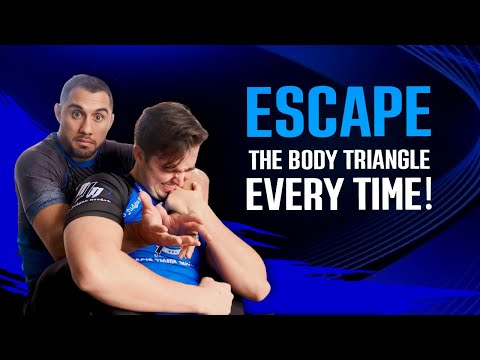
Matt Arroyo Jiu Jitsu — Escape the Body Triangle Every Time in Jiu Jitsu | Jiu Jitsu Tutorial | Matt Arroyo: Detailed defensive framework including prevention techniques (locking feet together before triangle is fully established), submission setup via ankle manipulation (toe hold by pushing heel toward glute while elevating hip), and multiple escape sequences including scissoring the legs to the outside and the 'grandi roll' escape when double-under position is achieved.
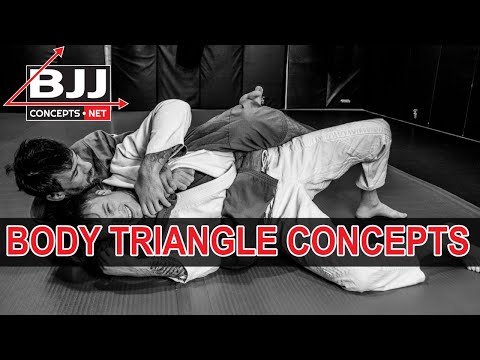
RVV BJJ — Body Triangle Concepts - Code "BLACKFRIDAY" 25% OFF: Conceptual analysis of body triangle's superiority for positional control over traditional hooks, explanation of the distinction between holding control versus maneuvering, and technical detail on switching the triangle (including foot placement on opponent's leg during the transition) and the importance of lacing the foot behind the knee for control maintenance and transition capability.
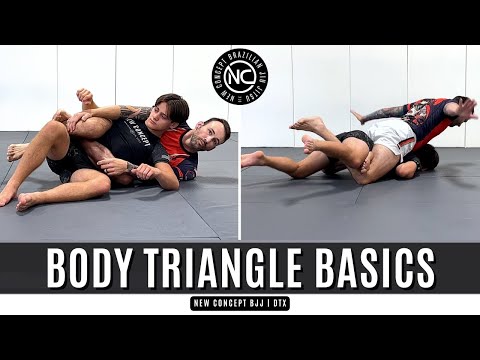
New Concept BJJ — New Concept BJJ | Body Triangle Basics | NoGi Coach Caleb Flippin: Technical focus on pressure mechanics (pinching knees rather than cranking), optimal lock placement (high position to prevent side-switching and rolling), foot positioning to avoid opponent leverage exploitation, energy conservation principles, and the distinction between the body triangle and lower-leg stepping alternatives for shorter-legged practitioners.
Learn This Technique
No instructional courses yet for this technique.
Sign in to suggest a course.
Ratings
Danger Rating
Risk of injury to the person this technique is applied to
4
Moderate4/10
Back control is dominant position; enables rear chokes (Danaher 2021)
Difficulty
Skill level needed to execute this technique reliably
Intermediate
Competition Legality
Whether this technique is allowed under major competition rule sets
— IBJJF — Legal, back control with hooks or body triangle s...
✓The under body triangle positions the locking leg under the opponent's bottom hip, applying upward compression — this variant is used when the over position is not available (Danaher, Back Attacks, 2018)
✓The under body triangle applies compression from below, pushing up into the opponent's diaphragm
✓This position often occurs when the opponent rolls or when the attacker needs to switch the triangle orientation
✓The under body triangle is slightly less common but equally effective for control
✓From the under position, the compression targets the diaphragm more directly — it can be very uncomfortable
✓The under body triangle can transition to the over position through a rolling adjustment
✓The under position sometimes offers better angle access for certain choke entries
✓Maintain active squeeze and seatbelt regardless of whether the body triangle is over or under
Common Mistakes
!Not squeezing sufficiently in the under position — the under body triangle still requires active compression
!Positioning the lock too low (on the thighs) — the lock should compress the lower torso area
!Allowing the opponent to exploit the different angle of the under position — prevent escape attempts specific to this orientation
!Not transitioning to the over position when it becomes available — the over position is generally preferred
!Neglecting the seatbelt while adjusting the body triangle — maintain upper body control at all times
!Locking the ankle incorrectly — the figure-four lock mechanics are the same regardless of over or under
!Not training the under body triangle specifically — it occurs naturally; knowing how to use it is important
1Achieve Position — transition into this position through passing, sweeping, or scrambling
2Stabilize — establish controlling grips and weight distribution
3Maintain — adjust to the opponent's escape attempts to hold position
4Attack — launch offensive techniques from the stabilized position
Sources & References
Primary Source
Brazilian Jiu-Jitsu: Theory and Technique (Renzo Gracie & Royler Gracie, 2001)
1BookJiu-Jitsu University (Ribeiro, 2008)
Alias sources — [1] Jiu-Jitsu University (Ribeiro, 2008) [2] Mastering Jujitsu (Gracie & Danaher, 2003)
2BookBrazilian Jiu-Jitsu: Theory and Technique (Gracie & Gracie, 2001)
Effectiveness sources — [1] Jiu-Jitsu University (Ribeiro, 2008)
3OtherJapanese Combat Sports Katakana Convention
Standard katakana transliteration of Western martial arts terminology (外来語) — used in Japanese MMA, boxing, and BJJ communities
4CitationJiu-Jitsu University (Ribeiro, 2008)
Alias sources — [1] Jiu-Jitsu University (Ribeiro, 2008) [2] Mastering Jujitsu (Gracie & Danaher, 2003)
5CitationBrazilian Jiu-Jitsu: Theory and Technique (Gracie & Gracie, 2001)
Effectiveness sources — [1] Jiu-Jitsu University (Ribeiro, 2008)
Community
Athletics
Requires
hook control, seatbelt grip endurance, hip connection
Favours
long legs for deep hooks, strong grip for seatbelt
Key muscles
hip adductors, biceps, forearms, core
Frequently Asked Questions
How do I prevent someone from locking in a body triangle on me?
According to Matt Arroyo, the best defense is to stop it before it's locked in. When your opponent takes your back and starts to bring their foot across your body, immediately push their foot between your legs to protect your neck before they can lock the triangle.
What should I do first if I get caught in a body triangle?
Matt Arroyo recommends your first priority is always to prevent being choked—grip the choke arm like you're holding a baseball bat and glue it to your chest so it can't wrap around your neck.
Should I try to escape the body triangle or submit my opponent first?
Matt Arroyo suggests attempting a submission before escaping, since if the submission succeeds the match is over; whereas if you escape first, you'll still have to pass guard and improve position before attempting a submission.
What are the key components of controlling someone with a body triangle?
According to RVV BJJ, effective body triangle control requires two main connections: chest-to-back attachment and hip-to-hip connection, which together create extremely powerful direct control.
How does the Under Body Triangle work?
The Under Body Triangle positions the locking leg underneath the opponent's body, typically threading beneath the hip and locking on the far side. The under configuration provides a different control angle than the over body triangle and can be more effective when the opponent attempts to escape by turning into the controlling fighter.
Where does the Under Body Triangle come from?
The under body triangle developed as an alternative to the over body triangle, used situationally when the standard over-lock is difficult to establish or when the opponent's escape attempts create a better angle for the under-lock. It is less commonly taught but recognised as a valuable alternative.
Is the Under Body Triangle legal in competition?
IBJJF: legal — Legal, back control with hooks or body triangle scores 4 points; IJF: legal — Legal — back control leads to pin or submission opportunities; ADCC: legal — Legal, back mount scores 3 points (4 from sweep); Unified MMA: legal — Legal — dominant position for ground-and-pound and rear naked choke; UWW: legal — Legal — back exposure is the primary scoring mechanism in wrestling; FIAS Sport Sambo: legal — Legal
How dangerous is the Under Body Triangle?
Danger rating 4/10. Moderate — back control is dominant position; enables rear chokes (Danaher 2021)
How do I set up the Under Body Triangle?
The standard setup chain: Achieve Position → Stabilize → Maintain → Attack.
How do I defend against the Under Body Triangle?
Standard counters include: Posture Control — maintain strong posture to limit the opponent's offensive options / Escape to Neutral — work back to standing or a neutral position.
What are the variants of the Under Body Triangle?
Common variants: Back control with hooks (both feet hooked inside the opponent's thighs); Body triangle back control (legs locked in a figure-four around the torso); Rear mount (mounted on the back with both hooks, opponent face-down); Chair sit back control (sitting behind the opponent with hooks, upright position).
How effective is the Under Body Triangle in competition?
Both body triangle variants are used in high-level BJJ and MMA competition.
What are common mistakes when doing the Under Body Triangle?
Top errors to watch for: Not squeezing sufficiently in the under position — the under body triangle still requires active compression / Positioning the lock too low (on the thighs) — the lock should compress the lower torso area / Allowing the opponent to exploit the different angle of the under position — prevent escape attempts specific to this… / Not transitioning to the over position when it becomes available — the over position is generally preferred.
What are other names for the Under Body Triangle?
The Under Body Triangle is also known as Andā Bodi Toraianguru, Bottom Lock Body Triangle, Under-Lock Body Triangle.