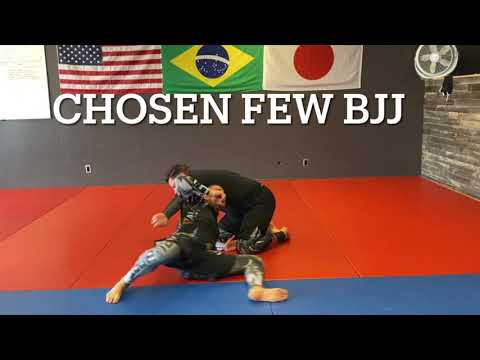
Sit Out escape from Turtle
0
Sit-Out Escape·Chosen Few BJJ
Sitout escape from bottom turtle One of my favorite techniques from Turtle to quickly take peoples back. Crypto donat…
Translation: sit-out escape
The Sit-Out Escape family covers turtle escapes where the turtled fighter sits the hips out to one side, rotating the body to face the opponent and create a more favourable position. [1] Sit-out escapes are among the most fundamental and widely used turtle escapes in all grappling disciplines because they use a simple, powerful hip motion to escape the turtle while maintaining the ability to face the opponent. [1],[2] This family includes the standard sit-out (sitting the hips through to face the opponent) and the Granby roll (a shoulder roll that combines inversion with a sit-out motion). [2],[3]
The sit-out is one of the most fundamental wrestling escapes, taught at all levels. [1]
The sit-out is one of the most commonly used escapes in wrestling competition. [1]
No images yet for this technique.
Sign in to suggest an image.
Sitout escape from bottom turtle One of my favorite techniques from Turtle to quickly take peoples back. Crypto donat…
No instructional courses yet for this technique.
Sign in to suggest a course.
Risk of injury to the person this technique is applied to
Turtle escapes involve rolling and granby movements; neck strain risk
Skill level needed to execute this technique reliably
Whether this technique is allowed under major competition rule sets
Jiu-Jitsu University (Saulo Ribeiro, 2008)
Alias sources — [1] Wrestling Physical Conditioning Encyclopedia (Welker, 2010) [2] NCAA Wrestling Rules and Interpretations
Effectiveness sources — [1] Wrestling Physical Conditioning Encyclopedia (Petrov, 1977) [2] Mastering Jujitsu (Gracie & Danaher, 2003)
Standard katakana transliteration of Western martial arts terminology (外来語) — used in Japanese MMA, boxing, and BJJ communities
Alias sources — [1] Wrestling Physical Conditioning Encyclopedia (Welker, 2010) [2] NCAA Wrestling Rules and Interpretations
Effectiveness sources — [1] Wrestling Physical Conditioning Encyclopedia (Petrov, 1977) [2] Mastering Jujitsu (Gracie & Danaher, 2003)
hip escape (shrimping) speed, framing strength, timing
flexible hips and quick lateral movement
hip flexors, obliques, triceps (framing), core
Every move, in any martial art, shares a few universal traits. Mix and match below to pinpoint the right tool — or compare equivalents across styles.
The Granby Roll is a dynamic wrestling escape from the turtle position where the bottom fighter rolls over their shoulder to invert, escape the opponent's top control, and recover guard or create a scramble — named after Granby High School in Norfolk, Virginia, where the technique was developed and made famous. [1] The Granby Roll uses shoulder-rolling momentum to escape when the opponent is riding or attempting to take the back from the turtle position, inverting underneath them and coming out the other side in guard or a neutral position. [1,2] The technique is a signature of American folkstyle wrestling that has been widely adopted into BJJ and MMA as a turtle escape, and has also influenced modern BJJ inversion-based guard play (berimbolo, rolling back takes) which use similar shoulder-rolling mechanics. [2,3] While athletic and requiring practice, the Granby Roll is one of the most effective escapes against heavy riders and back-take attempts from turtle. [3]
The Standard Sit-Out subfamily covers the fundamental turtle escape where the turtled fighter sits the hips out to one side, rotating to face the opponent from a defensive seated or guard position. [1] The sit-out is the most basic and universally taught turtle escape across all grappling disciplines — it uses a powerful hip kick-out motion to rotate the body 180 degrees, converting the turtle into a facing position. [1,2] The sit-out's effectiveness lies in its speed and simplicity — the hip motion is one of the most natural and powerful movements the body can perform. [2,3]
The sit-out is a fundamental wrestling escape from bottom (referee's position) — the bottom wrestler pivots on one hand, swings the legs through, and faces the opponent. Documented in every wrestling manual as one of the first bottom escapes taught. (Coaching Wrestling Successfully, Gable; 1943 US Navy H2H)
According to Chosen Few BJJ, you should get your chin down to your chest and bring your shoulder up at the same time to prevent them from taking a quick guillotine or getting to your back for a rear neck choke. You shouldn't stay in turtle for more than 5-10 seconds before executing an escape.
Chosen Few BJJ emphasizes staying tight by getting your chin down to your chest while simultaneously bringing your shoulder up, which prevents your opponent from quickly securing a guillotine or accessing your neck and back.
Yes, according to Chosen Few BJJ, the sit-out escape varies depending on your opponent's hand placement—whether they're going for a front headlock, head and arm control, or just general chest control.
The Sit-Out Escape family covers turtle escapes where the turtled fighter sits the hips out to one side, rotating the body to face the opponent and create a more favourable position. Sit-out escapes are among the most fundamental and widely used turtle escapes in all grappling disciplines because they use a simple, powerful hip motion to escape the turtle while maintaining the ability to face the opponent.
The sit-out is one of the oldest and most fundamental wrestling escapes, used in folk-style, freestyle, and Greco-Roman wrestling from the bottom position. It was adopted into BJJ and MMA as a primary turtle escape due to its simplicity and effectiveness.
Unified MMA: legal — Legal defensive/transitional technique; IBJJF: legal — Legal; IJF: legal — Legal; ADCC: legal — Legal; UWW: legal — Legal, escape scores 1 point (freestyle), reversal scores 1 point; FIAS Sport Sambo: legal — Legal; NCAA Folkstyle: legal — Legal, escape scores 1 point, reversal scores 2 points
Danger rating 3/10. Moderate — turtle escapes involve rolling and granby movements; neck strain risk
The standard setup chain: Create Space → Disrupt Control → Execute Escape → Recover Position.
Standard counters include: Maintain Pressure — keep consistent weight distribution to limit escape space / Anticipate Direction — read escape attempt direction and block early / Transition — flow to a new position when the current one is threatened.
Common variants: Shrimp to guard (framing and hip-escaping to recover full guard or half guard); Underhook escape (winning the underhook and coming to knees or reversing); Bridge to knees (bridging into the opponent and transitioning to turtle or…); Ghost escape (inverting under the opponent to re-guard from the opposit…).
The sit-out is one of the most commonly used escapes in wrestling competition.
Top errors to watch for: Sitting out without posting the hand — the post provides the structural support for the rotation / Kicking the wrong leg — kick through the leg that creates the rotation toward the opponent / Sitting out too far from the opponent — maintain contact; too much distance loses the reversal opportunity / Not turning to face the opponent after sitting out — the sit-out is incomplete until you're facing them.
The Sit-Out Escape is also known as Shitto Auto Esukēpu, Sit Through, Sit Out.