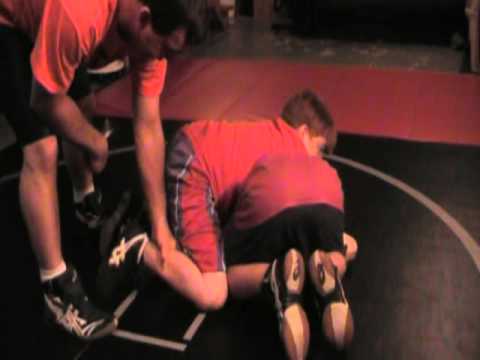
Sit out Series technique
0
Standard Sit-Out·NWcougarcoach
sit out to- gazonie, peterson roll, shrug
Translation: standard sit-out
The Standard Sit-Out subfamily covers the fundamental turtle escape where the turtled fighter sits the hips out to one side, rotating to face the opponent from a defensive seated or guard position. [1] The sit-out is the most basic and universally taught turtle escape across all grappling disciplines — it uses a powerful hip kick-out motion to rotate the body 180 degrees, converting the turtle into a facing position. [1],[2] The sit-out's effectiveness lies in its speed and simplicity — the hip motion is one of the most natural and powerful movements the body can perform. [2],[3]
The standard sit-out is the fundamental sitting escape from turtle. [1]
A core wrestling escape technique. [1]
Used in all wrestling competition. [1]
No images yet for this technique.
Sign in to suggest an image.
sit out to- gazonie, peterson roll, shrug
No instructional courses yet for this technique.
Sign in to suggest a course.
Risk of injury to the person this technique is applied to
Turtle escapes involve rolling and granby movements; neck strain risk
Skill level needed to execute this technique reliably
Whether this technique is allowed under major competition rule sets
Jiu-Jitsu University (Saulo Ribeiro, 2008)
Alias sources — [1] Wrestling Physical Conditioning Encyclopedia (John Jesse, 1974) [2] NCAA wrestling terminology [3] Common wrestling coaching terminology
Effectiveness sources — [1] Wrestling Physical Conditioning Encyclopedia (Petrov, 1977)
Standard katakana transliteration of Western martial arts terminology (外来語) — used in Japanese MMA, boxing, and BJJ communities
Alias sources — [1] Wrestling Physical Conditioning Encyclopedia (John Jesse, 1974) [2] NCAA wrestling terminology [3] Common wrestling coaching terminology
Effectiveness sources — [1] Wrestling Physical Conditioning Encyclopedia (Petrov, 1977)
hip escape (shrimping) speed, framing strength, timing
flexible hips and quick lateral movement
hip flexors, obliques, triceps (framing), core
Every move, in any martial art, shares a few universal traits. Mix and match below to pinpoint the right tool — or compare equivalents across styles.
According to NWcougarcoach, both look similar but have distinct differences. The swisher sit-out involves clearing your hips and keeping your arm tight to prevent your opponent from controlling it, while the power sit comes underneath your opponent with a different entry angle and follow-up sequence.
NWcougarcoach describes the leg motion as resembling windshield wipers on a car—your legs go back and forth in a clearing motion to create separation from your opponent.
NWcougarcoach emphasizes protecting your head and back during rolls—come down on your head (using a tripod position) rather than rolling over your shoulder, and avoid arching your back the wrong way which can cause injury. A smart wrestler in a precarious position will ball up and concede points rather than risk serious injury.
The Standard Sit-Out subfamily covers the fundamental turtle escape where the turtled fighter sits the hips out to one side, rotating to face the opponent from a defensive seated or guard position. The sit-out is the most basic and universally taught turtle escape across all grappling disciplines — it uses a powerful hip kick-out motion to rotate the body 180 degrees, converting the turtle into a facing position.
The sit-out is a foundational wrestling technique present in virtually every grappling tradition worldwide. Its universality reflects the natural biomechanical efficiency of the hip rotation motion it employs.
Unified MMA: legal — Legal defensive/transitional technique; IBJJF: legal — Legal; IJF: legal — Legal; ADCC: legal — Legal; UWW: legal — Legal, escape scores 1 point (freestyle), reversal scores 1 point; FIAS Sport Sambo: legal — Legal; NCAA Folkstyle: legal — Legal, escape scores 1 point, reversal scores 2 points
Danger rating 3/10. Moderate — turtle escapes involve rolling and granby movements; neck strain risk
The standard setup chain: Create Space → Disrupt Control → Execute Escape → Recover Position.
Standard counters include: Maintain Pressure — keep consistent weight distribution to limit escape space / Anticipate Direction — read escape attempt direction and block early / Transition — flow to a new position when the current one is threatened.
Common variants: Shrimp to guard (framing and hip-escaping to recover full guard or half guard); Underhook escape (winning the underhook and coming to knees or reversing); Bridge to knees (bridging into the opponent and transitioning to turtle or…); Ghost escape (inverting under the opponent to re-guard from the opposit…).
Used in all wrestling competition.
Top errors to watch for: Posting too far from the body — the post should be close for maximum stability / Kicking the leg straight back instead of through — the leg must go between you and the opponent / Not rotating fully to face the opponent — complete the 180-degree turn / Sitting out and then pausing — immediately transition to guard, standing, or a reversal.
The Standard Sit-Out is also known as Sutandādo Shitto Auto, Sit Out, Sit Through, Hip Heist.