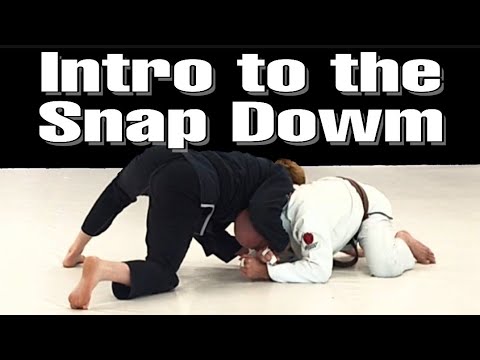
The Snap Down part 1( getting to the front head and turtle position)
0
Standard Snap Roll·Still Rolling·Added by Admin
Translation: standard snap roll
The Standard Snap Roll executes a quick lateral roll from turtle, tucking the shoulder and rolling explosively to the side to create separation and immediately transition to a guard position or stand up. [1] The turtled fighter tucks the chin, dips the near shoulder, and rolls sharply to the side, using the explosive rotation to dislodge the opponent's control and create space. [1],[2] The key to the snap roll is speed rather than technique — the explosive, committed rolling motion makes it difficult for the opponent to maintain control. [2],[3]
The standard snap roll is the baseline snapping turtle escape. [1]
A standard wrestling turtle escape. [1]
Used in wrestling competition. [1]
No images yet for this technique.
Sign in to suggest an image.
No instructional courses yet for this technique.
Sign in to suggest a course.
Risk of injury to the person this technique is applied to
Turtle escapes involve rolling and granby movements; neck strain risk
Skill level needed to execute this technique reliably
Whether this technique is allowed under major competition rule sets
Jiu-Jitsu University (Saulo Ribeiro, 2008)
Alias sources — [1] Wrestling Physical Conditioning Encyclopedia (John Jesse, 1974) [2] NCAA wrestling terminology
Effectiveness sources — [1] Wrestling Physical Conditioning Encyclopedia (Petrov, 1977)
Standard katakana transliteration of Western martial arts terminology (外来語) — used in Japanese MMA, boxing, and BJJ communities
Alias sources — [1] Wrestling Physical Conditioning Encyclopedia (John Jesse, 1974) [2] NCAA wrestling terminology
Effectiveness sources — [1] Wrestling Physical Conditioning Encyclopedia (Petrov, 1977)
hip escape (shrimping) speed, framing strength, timing
flexible hips and quick lateral movement
hip flexors, obliques, triceps (framing), core
Grabbing just the neck is ineffective because the neck is naturally strong and your opponent can resist easily. Instead, control the head by cutting at specific points and pulling down, which makes it much harder for them to pick their head up.
Keep your elbow down and come up into the head position rather than reaching out with your leading arm extended. If possible, establish wrist control first before grabbing the base of their head.
No—when snapping them down, pull backward while sprawling your legs back, rather than going straight down. This creates better control, especially when you're riding on top of them.
Get as deep as you can on their head for maximum control. Once you snap them down into position, transition to a chin strap hand grip that allows you to drive across and maintain control.
The Standard Snap Roll executes a quick lateral roll from turtle, tucking the shoulder and rolling explosively to the side to create separation and immediately transition to a guard position or stand up. The turtled fighter tucks the chin, dips the near shoulder, and rolls sharply to the side, using the explosive rotation to dislodge the opponent's control and create space.
The standard snap roll is a fundamental wrestling escape adapted for use in BJJ and MMA turtle escape situations. Its simplicity and reliance on explosive movement make it one of the most instinctive turtle escape methods.
Unified MMA: legal — Legal defensive/transitional technique; IBJJF: legal — Legal; IJF: legal — Legal; ADCC: legal — Legal; UWW: legal — Legal, escape scores 1 point (freestyle), reversal scores 1 point; FIAS Sport Sambo: legal — Legal; NCAA Folkstyle: legal — Legal, escape scores 1 point, reversal scores 2 points
Danger rating 3/10. Moderate — turtle escapes involve rolling and granby movements; neck strain risk
The standard setup chain: Create Space → Disrupt Control → Execute Escape → Recover Position.
Standard counters include: Maintain Pressure — keep consistent weight distribution to limit escape space / Anticipate Direction — read escape attempt direction and block early / Transition — flow to a new position when the current one is threatened.
Common variants: Shrimp to guard (framing and hip-escaping to recover full guard or half guard); Underhook escape (winning the underhook and coming to knees or reversing); Bridge to knees (bridging into the opponent and transitioning to turtle or…); Ghost escape (inverting under the opponent to re-guard from the opposit…).
Used in wrestling competition.
Top errors to watch for: Rolling toward the side the opponent is attacking — roll to the free side where there's space / Not using the legs to drive the rotation — the hip and leg swing provides the momentum / Tucking too tightly and getting stuck — the roll needs extension after the initial tuck / Not recovering guard upon completing the roll — the roll must end in a defensive position.
The Standard Snap Roll is also known as Sutandādo Sunappu Rōru, Basic Snap Roll, Standard Forward Roll Escape.