Fat Man Roll - Turtle Position Escape | Grappling Techniques
0
Roll Escape·The Fight Centre - Brisbane
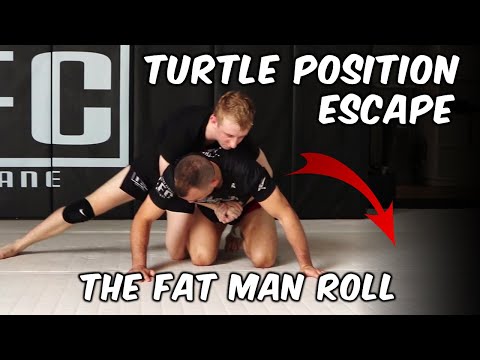
In this video we discuss a turtle position escape - the fat man roll. If you've been finding yourself in the turtle pos…
Translation: roll escape
The Roll Escape family covers turtle escapes that use rolling mechanics to reverse the position, moving the turtled fighter from a bottom defensive position to a more favourable one through rotational momentum. [1] Roll escapes are derived primarily from wrestling, where rolling from the referee's position is a fundamental escape technique. [1],[2] This family includes the Peterson roll (a shoulder roll that reverses the position) and the snap roll (a quick, explosive roll to create space), both of which use the opponent's top pressure against them by redirecting it through the roll. [2],[3]
Rolling escapes are found in judo, wrestling, and BJJ. [1]
Roll escapes are used in judo, wrestling, and BJJ competition. [1]
No images yet for this technique.
Sign in to suggest an image.
In this video we discuss a turtle position escape - the fat man roll. If you've been finding yourself in the turtle pos…
No instructional courses yet for this technique.
Sign in to suggest a course.
Risk of injury to the person this technique is applied to
Turtle escapes involve rolling and granby movements; neck strain risk
Skill level needed to execute this technique reliably
Whether this technique is allowed under major competition rule sets
Jiu-Jitsu University (Saulo Ribeiro, 2008)
Alias sources — [1] Wrestling Physical Conditioning Encyclopedia (Welker, 2010) [2] NCAA Wrestling Rules and Interpretations
Effectiveness sources — [1] Jiu-Jitsu University (Ribeiro, 2008) [2] Wrestling Physical Conditioning Encyclopedia (Petrov, 1977)
Standard Japanese martial arts terminology (kanji/hiragana)
Established Japanese martial arts naming convention — native Japanese term (和語/漢語)
Alias sources — [1] Wrestling Physical Conditioning Encyclopedia (Welker, 2010) [2] NCAA Wrestling Rules and Interpretations
Effectiveness sources — [1] Jiu-Jitsu University (Ribeiro, 2008) [2] Wrestling Physical Conditioning Encyclopedia (Petrov, 1977)
hip mobility, explosive bridge/shrimp power, timing
flexible hips and strong glutes for escape movements
glutes, hip flexors, core, triceps (framing)
Every move, in any martial art, shares a few universal traits. Mix and match below to pinpoint the right tool — or compare equivalents across styles.
The Peterson Roll subfamily covers the wrestling-derived turtle escape where the bottom fighter reaches across, hooks the opponent's far arm, and rolls over the shoulder to reverse the position. [1] Named after American wrestler John Peterson, this roll uses the opponent's forward pressure and a cross-body arm hook to create a rolling reversal that puts the escaping fighter on top. [1,2] The Peterson roll is particularly effective because it uses the opponent's own weight and pressure as the energy source for the roll. [2,3]
The Snap Roll subfamily covers quick, explosive rolling escapes from turtle that use a snapping rotational motion to create separation from the opponent and transition to a guard or standing position. [1] Unlike the Peterson roll which aims to reverse position, the snap roll prioritises speed and separation — the turtled fighter rolls quickly to create enough space to either reguard or stand up. [1,2] The snap roll is effective against opponents who are attempting to break down the turtle or set up back control, as the explosive roll catches them during their attack sequence. [2,3]
The granby roll (forward roll escape from turtle) uses momentum to invert and create scramble opportunities. Named after the Granby High School wrestling team in Norfolk, Virginia, which popularized the technique. A fundamental wrestling escape. (Wrestling coaching manuals)
The Fight Centre emphasizes avoiding stepping right over and hooking the leg, as this allows your opponent to figure for their legs and slows down the escape. Instead, focus on immediately transitioning to a more advantageous position.
Position your shin on top of your opponent's calf rather than wrapping the leg, which allows you to scoop your hips back and transition smoothly into a belly-down position or even mount as you roll.
If your opponent unlocks their hands to defend against the roll escape, switch to wrestling-focused escapes. The key is to threaten the roll when their hands are locked, and when they unlock to defend, immediately threaten the wrestling escapes instead.
The Roll Escape family covers turtle escapes that use rolling mechanics to reverse the position, moving the turtled fighter from a bottom defensive position to a more favourable one through rotational momentum. Roll escapes are derived primarily from wrestling, where rolling from the referee's position is a fundamental escape technique.
Turtle roll escapes are rooted in wrestling tradition, where the bottom referee's position is a standard starting point and rolls are fundamental escapes. The Peterson roll in particular has a storied history in wrestling before being adapted for BJJ and MMA.
Unified MMA: legal — Legal defensive/transitional technique; IBJJF: legal — Legal; IJF: legal — Legal; ADCC: legal — Legal; UWW: legal — Legal, escape scores 1 point (freestyle), reversal scores 1 point; FIAS Sport Sambo: legal — Legal; NCAA Folkstyle: legal — Legal, escape scores 1 point, reversal scores 2 points
Danger rating 3/10. Moderate — turtle escapes involve rolling and granby movements; neck strain risk
The standard setup chain: Create Space → Disrupt Control → Execute Escape → Recover Position.
Standard counters include: Maintain Pressure — keep consistent weight distribution to limit escape space / Anticipate Direction — read escape attempt direction and block early / Transition — flow to a new position when the current one is threatened.
Common variants: Standard escape (primary escape mechanic using frames, bridges, or hip mov…); Combination escape (chaining two escape directions or methods); Counter escape (using the opponent's attack attempt to create the escape …); Competition variation (modified for rule-set optimisation).
Roll escapes are used in judo, wrestling, and BJJ competition.
Top errors to watch for: Rolling without commitment — partial rolls are worse than no roll; commit to the full rotation / Rolling away from the opponent — rolls should use the opponent's pressure and weight direction / Rolling when the opponent is sitting back (not driving forward) — the roll needs their forward pressure / Not protecting the neck during the roll — tuck the chin and keep hands near the neck.
The Roll Escape is also known as Korogari Nige, Rolling Escape, Turtle Roll.