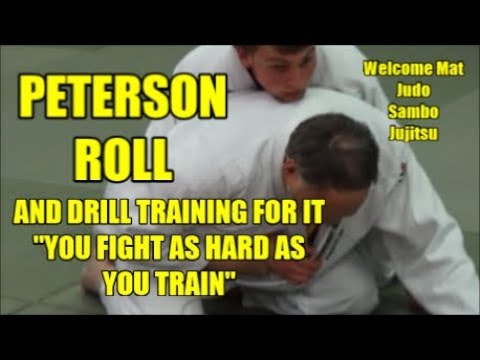
PETERSON ROLL & DRILL TRAINING FOR IT "YOU FIGHT AS HARD AS YOU TRAIN"
This video shows how to do the Peterson Roll, which is an effective way of getting from the bottom position in groundfig…
スタンダードピーターソンロール(Sutandādo Pītāson Rōru)
TransliterationTranslation: standard Peterson roll
The Standard Peterson Roll executes the wrestling reversal by hooking the opponent's far arm from the turtle position, then rolling over the shoulder on the hooked-arm side to reverse the position and come up on top. [1] The turtled fighter reaches the near hand across the body to hook the opponent's far wrist or forearm, then rolls forcefully over the shoulder, using the arm hook to drag the opponent into the roll. [1],[2] The roll carries both fighters over, with the escaping fighter ending up in a top position. [2],[3]
The Peterson brothers' wrestling careers demonstrated the effectiveness of bottom wrestling techniques at the Olympic level, and the Peterson roll became a standard technique in American wrestling programs. [2] It continues to be widely used in NCAA and international freestyle wrestling competition. [1]
No images yet for this technique.
Sign in to suggest an image.
No instructional courses yet for this technique.
Sign in to suggest a course.
Risk of injury to the person this technique is applied to
Turtle escapes involve rolling and granby movements; neck strain risk
Skill level needed to execute this technique reliably
Whether this technique is allowed under major competition rule sets
Jiu-Jitsu University (Saulo Ribeiro, 2008)
Alias sources — [1] Named after wrestler Ben Peterson [2] NCAA wrestling terminology
Effectiveness sources — [1] Wrestling for Fighting (Randy Couture, 2007) [2] Coaching Wrestling Successfully (Dan Gable, 1999)
Standard katakana transliteration of Western martial arts terminology (外来語) — used in Japanese MMA, boxing, and BJJ communities
Alias sources — [1] Named after wrestler Ben Peterson [2] NCAA wrestling terminology
Effectiveness sources — [1] Wrestling for Fighting (Randy Couture, 2007) [2] Coaching Wrestling Successfully (Dan Gable, 1999)
hip escape (shrimping) speed, framing strength, timing
flexible hips and quick lateral movement
hip flexors, obliques, triceps (framing), core
According to welcomematstevescott, you should develop equal skill on both the right and left hand because in a fight you never know which way your opponent will try to catch your hand, so you need to be prepared to roll either direction.
welcomematstevescott describes it as similar to a shoulder roll or a calling throw from judo, but executed on the ground rather than standing.
In ground fighting, your opponent can't see the roll if they can only feel the threat, which allows you to create positional advantage before they can react to counter it.
The Standard Peterson Roll executes the wrestling reversal by hooking the opponent's far arm from the turtle position, then rolling over the shoulder on the hooked-arm side to reverse the position and come up on top. The turtled fighter reaches the near hand across the body to hook the opponent's far wrist or forearm, then rolls forcefully over the shoulder, using the arm hook to drag the opponent into the roll.
The standard Peterson roll is a classical wrestling technique named after Olympic champion John Peterson, adapted for use in BJJ and MMA turtle escape situations. Its effectiveness in multiple combat sports has made it one of the most widely taught turtle reversals.
Unified MMA: legal — Legal defensive/transitional technique; IBJJF: legal — Legal; IJF: legal — Legal; ADCC: legal — Legal; UWW: legal — Legal, escape scores 1 point (freestyle), reversal scores 1 point; FIAS Sport Sambo: legal — Legal; NCAA Folkstyle: legal — Legal, escape scores 1 point, reversal scores 2 points
Danger rating 3/10. Moderate — turtle escapes involve rolling and granby movements; neck strain risk
The standard setup chain: Create Space → Disrupt Control → Execute Escape → Recover Position.
Standard counters include: Maintain Pressure — keep consistent weight distribution to limit escape space / Anticipate Direction — read escape attempt direction and block early / Transition — flow to a new position when the current one is threatened.
Common variants: Shrimp to guard (framing and hip-escaping to recover full guard or half guard); Underhook escape (winning the underhook and coming to knees or reversing); Bridge to knees (bridging into the opponent and transitioning to turtle or…); Ghost escape (inverting under the opponent to re-guard from the opposit…).
The Peterson brothers' wrestling careers demonstrated the effectiveness of bottom wrestling techniques at the Olympic level, and the Peterson roll became a standard technique in American wrestling programs. It continues to be widely used in NCAA and international freestyle wrestling competition.
Top errors to watch for: Shallow overhook that doesn't control the arm — the overhook must clamp the arm tightly / Not reaching deep enough for the far leg — the leg grip is what generates the rolling force / Rolling without the leg grip — the arm trap alone may not provide enough force for the roll / Releasing the grips during the roll — maintain both the overhook and the leg grip throughout.
The Standard Peterson Roll is also known as Sutandādo Pītāson Rōru, Basic Peterson Roll, Standard Peterson.