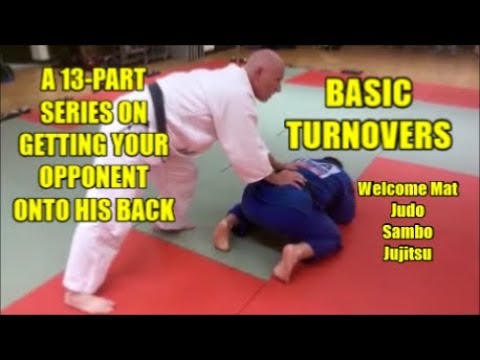
BASIC TURNOVERS 7 PETERSON ROLL
0
Peterson Roll·welcomematstevescott
In this seventh episode of our 13-part series, we look at the Peterson Roll-an excellent way to get from the bottom posi…
Translation: Peterson roll
The Peterson Roll subfamily covers the wrestling-derived turtle escape where the bottom fighter reaches across, hooks the opponent's far arm, and rolls over the shoulder to reverse the position. [1] Named after American wrestler John Peterson, this roll uses the opponent's forward pressure and a cross-body arm hook to create a rolling reversal that puts the escaping fighter on top. [1],[2] The Peterson roll is particularly effective because it uses the opponent's own weight and pressure as the energy source for the roll. [2],[3]
The Peterson roll is named after John Peterson, an Olympic gold medal wrestler (1976 Montreal Olympics) who was famous for using this technique. [1] The technique has been adopted into BJJ and MMA from wrestling, where it remains one of the primary escapes from the bottom referee's position. [2],[3]
The Peterson roll is a reversal from bottom that uses an arm trap and rolling motion to reverse the opponent. [1]
The Peterson roll was developed in American folkstyle wrestling. [1]
The Peterson roll is a common reversal in NCAA wrestling competition. [1]
No images yet for this technique.
Sign in to suggest an image.
In this seventh episode of our 13-part series, we look at the Peterson Roll-an excellent way to get from the bottom posi…
No instructional courses yet for this technique.
Sign in to suggest a course.
Risk of injury to the person this technique is applied to
Turtle escapes involve rolling and granby movements; neck strain risk
Skill level needed to execute this technique reliably
Whether this technique is allowed under major competition rule sets
Mastering Jujitsu (Renzo Gracie & John Danaher, 2003)
Alias sources — [1] Named after wrestler Ben Peterson (Olympic gold, 1972) [2] NCAA wrestling terminology [3] Wrestling Physical Conditioning Encyclopedia (John Jesse, 1974)
Effectiveness sources — [1] Wrestling Physical Conditioning Encyclopedia (Petrov, 1977)
Standard katakana transliteration of Western martial arts terminology (外来語) — used in Japanese MMA, boxing, and BJJ communities
Alias sources — [1] Named after wrestler Ben Peterson (Olympic gold, 1972) [2] NCAA wrestling terminology [3] Wrestling Physical Conditioning Encyclopedia (John Jesse, 1974)
Effectiveness sources — [1] Wrestling Physical Conditioning Encyclopedia (Petrov, 1977)
hip mobility, explosive bridge/shrimp power, timing
flexible hips and strong glutes for escape movements
glutes, hip flexors, core, triceps (framing)
Every move, in any martial art, shares a few universal traits. Mix and match below to pinpoint the right tool — or compare equivalents across styles.
A common mistake is reaching too far with your hand underneath instead of controlling the hip or leg, which weakens your position and control.
Grab your opponent's wrist and use your elbow to trap their elbow as well, maintaining wrist control throughout the roll into a rear-side position.
Don't just swing your leg over—trap your opponent's legs down to maintain control and hold them securely in the position.
The Peterson Roll is a viable escape option for the bottom person in a ride situation when you want to reverse position or control your opponent.
The Peterson Roll subfamily covers the wrestling-derived turtle escape where the bottom fighter reaches across, hooks the opponent's far arm, and rolls over the shoulder to reverse the position. Named after American wrestler John Peterson, this roll uses the opponent's forward pressure and a cross-body arm hook to create a rolling reversal that puts the escaping fighter on top.
The Peterson roll is named after John Peterson, an Olympic gold medal wrestler (1976 Montreal Olympics) who was famous for using this technique. The technique has been adopted into BJJ and MMA from wrestling, where it remains one of the primary escapes from the bottom referee's position.
Unified MMA: legal — Legal defensive/transitional technique; IBJJF: legal — Legal; IJF: legal — Legal; ADCC: legal — Legal; UWW: legal — Legal, escape scores 1 point (freestyle), reversal scores 1 point; FIAS Sport Sambo: legal — Legal; NCAA Folkstyle: legal — Legal, escape scores 1 point, reversal scores 2 points
Danger rating 3/10. Moderate — turtle escapes involve rolling and granby movements; neck strain risk
The standard setup chain: Create Space → Disrupt Control → Execute Escape → Recover Position.
Standard counters include: Maintain Pressure — keep consistent weight distribution to limit escape space / Anticipate Direction — read escape attempt direction and block early / Transition — flow to a new position when the current one is threatened.
Common variants: Standard escape (primary escape mechanic using frames, bridges, or hip mov…); Combination escape (chaining two escape directions or methods); Counter escape (using the opponent's attack attempt to create the escape …); Competition variation (modified for rule-set optimisation).
The Peterson roll is a common reversal in NCAA wrestling competition.
Top errors to watch for: Not trapping the arm securely — the arm trap is the foundation; without it, the opponent posts and stops the roll / Reaching for the far leg without the arm trap — sequence matters: trap the arm first / Rolling in the wrong direction — always roll forward over the trapped-arm shoulder / Not committing to the roll — a half-roll with the arm trap leaves you in a tangled position.
The Peterson Roll is also known as Pītāson Rōru, Peterson Roll, Peterson Reversal, Peterson Escape.