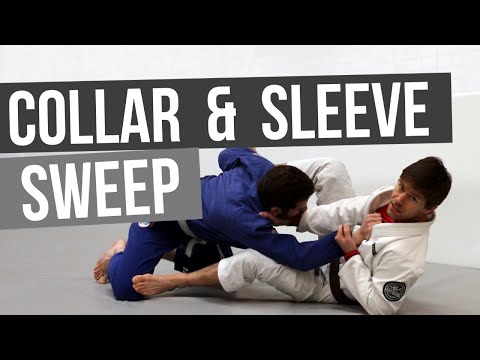
JIU JITSU - COLLAR AND SLEEVE SWEEP
0
Collar-Sleeve Sweep·East Midlands BJJ
Try our Collar and Sleeve Sweep from the open guard with our tutorial. Tired of opponents dropping their weight down th…
Translation: collar-sleeve sweep
The Collar-Sleeve Sweep subfamily covers sweeps from the collar-sleeve guard, where the guard player controls one collar and one sleeve while using the feet to manage distance and off-balance the opponent. [1] The collar-sleeve guard is one of the most versatile gi guard positions because the combination of collar and sleeve control gives the guard player both push-pull capability and prevents the opponent from posting. [1],[2] Collar-sleeve sweeps typically use foot placement on the hip or bicep combined with the grip controls to off-balance and sweep the opponent. [2],[3]
The collar-sleeve guard was developed in gi BJJ as one of the primary open guard systems, with practitioners like Leandro Lo bringing it to the forefront of competitive grappling with his dominant collar-sleeve game. [1] It remains one of the most effective gi guard positions at all competition levels. [2],[3]
Collar-sleeve sweeps use the collar and sleeve grips to off-balance and sweep from open guard. [1]
Developed in gi BJJ competition as part of the collar-sleeve guard system. [1]
Commonly scored in IBJJF competition. [1]
No images yet for this technique.
Sign in to suggest an image.
Try our Collar and Sleeve Sweep from the open guard with our tutorial. Tired of opponents dropping their weight down th…
The Tootsie Roll Sweep and defence of the guard with collar and sleeve control For more exclusive content, sign up at h…
The collar-sleeve sweep family encompasses techniques where a practitioner maintains grip control on the opponent's collar and sleeve while executing sweeps from open or butterfly guard positions. The unifying principle is using these dual grips to control posture and prevent base establishment, creating mechanical advantages for hip displacement and leg-driven reversals. Strategic selection among variants depends on opponent behavior: JM Modern Jiu Jitsu emphasizes the collar-sleeve grip's role in guard retention and defense against knee-slice passes, demonstrating how maintaining collar control prevents the opponent from solidifying position even under pressure, with the sweep emerging opportunistically when the opponent over-commits to passing by circling the guard. East Midlands BJJ frames the technique within an open-guard progression where standing opponents drop their base to defend against overhead sweeps, triggering a transition to same-side collar-sleeve control with foot placement on the bicep; from this lowered position, the sweep becomes mechanically favorable due to reduced base stability. Both instructors stress that collar-sleeve control functions primarily as a defensive anchor that naturally opens sweep entries—the grips themselves prevent the pass while creating the geometry needed for efficient hip displacement and leg extension. The choice between defensive guard recovery versus committed sweep execution depends on opponent commitment level and base stability.
Synthesized from 2 instructors
No instructional courses yet for this technique.
Sign in to suggest a course.
Risk of injury to the person this technique is applied to
Sweeps reverse position from bottom; moderate impact on landing for top player
Skill level needed to execute this technique reliably
Whether this technique is allowed under major competition rule sets
The Guard (Joe Moreira & Ed Beneville, 2008)
Alias sources — [1] Jiu-Jitsu University (Saulo Ribeiro, 2008) [2] Brazilian Jiu-Jitsu: Theory and Technique (Renzo Gracie & Royler Gracie, 2001)
Effectiveness sources — [1] Jiu-Jitsu University (Ribeiro, 2008)
Mixed Japanese-Western terminology — combines traditional Japanese terms with katakana loanwords
Alias sources — [1] Jiu-Jitsu University (Saulo Ribeiro, 2008) [2] Brazilian Jiu-Jitsu: Theory and Technique (Renzo Gracie & Royler Gracie, 2001)
Effectiveness sources — [1] Jiu-Jitsu University (Ribeiro, 2008)
timing, hip power, off-balancing skill
strong hips and active legs for sweeping leverage
hip flexors, glutes, quadriceps, core rotators
Every move, in any martial art, shares a few universal traits. Mix and match below to pinpoint the right tool — or compare equivalents across styles.
You want to secure a collar grip and a sleeve grip; JM Modern Jiu Jitsu recommends also establishing a pistol grip for added control in the gi.
Place your foot on the bicep with nice and heavy pressure, keeping your elbow out and pulling them in so their hips come away from their heels.
By maintaining good collar and sleeve grips from the right angle, you can frustrate passing attempts and force your opponent to struggle with your guard rather than successfully advance.
The Collar-Sleeve Sweep subfamily covers sweeps from the collar-sleeve guard, where the guard player controls one collar and one sleeve while using the feet to manage distance and off-balance the opponent. The collar-sleeve guard is one of the most versatile gi guard positions because the combination of collar and sleeve control gives the guard player both push-pull capability and prevents the opponent from posting.
The collar-sleeve guard was developed in gi BJJ as one of the primary open guard systems, with practitioners like Leandro Lo bringing it to the forefront of competitive grappling with his dominant collar-sleeve game. It remains one of the most effective gi guard positions at all competition levels.
Unified MMA: legal — Legal defensive/transitional technique; IBJJF: legal — Legal; IJF: legal — Legal; ADCC: legal — Legal; UWW: legal — Legal; FIAS Sport Sambo: legal — Legal
Danger rating 3/10. Moderate — sweeps reverse position from bottom; moderate impact on landing for top player
The standard setup chain: Control Grips → Off-Balance → Execute Sweep → Follow to Top.
Standard counters include: Base and Posture — maintain wide base and upright posture to resist the sweep / Grip Strip — break controlling grips before the sweep can be loaded / Back Step — retreat the leg being attacked to remove the sweep fulcrum.
Common variants: Standard sweep (primary off-balancing and reversal technique from the guard); Combination sweep (chaining two sweep directions to catch the opponent's adj…); Counter sweep (sweeping as the opponent initiates a guard pass attempt); Competition sweep (optimised for point-scoring in tournament settings).
Commonly scored in IBJJF competition.
Top errors to watch for: Not maintaining the sleeve grip — the sleeve grip is the most important control; never release it / Keeping both feet on the hips — one foot should be on the bicep for arm control / Pulling with the collar without using the feet — the feet and grips must work together / Playing collar-sleeve from too far away — keep the opponent within sweeping range.
The Collar-Sleeve Sweep is also known as Eri-sode Suīpu, Collar And Sleeve Sweep, Collar Sleeve Guard Sweep.