Standard Hip Bump

Genus

Translation: standard hip bump

Range & classification

Category
Strike & defenceLocksClose rangeFighting multiple people
Distance
CloseMiddleLong
Body target
Upper bodyMiddle bodyLower body

Overview

The Standard Hip Bump executes the sweep by sitting up explosively from closed guard, wrapping an overhook around the opponent's arm on one side, then driving the hips forward into the opponent's chest to push them backward and over. [1] The guard player uses the sit-up momentum and the overhook to generate a combined forward-upward force vector that destabilises the opponent backward. [1],[2] If the opponent posts a hand back to defend, the sweep can be converted into a triangle choke or kimura, making the hip bump a powerful combination technique. [2],[3]

Also known as
Basic Hip Bump Sweep[1]Standard Sit-Up Sweep[2]

History & Origin

The standard hip bump is one of the most widely taught sweeps in BJJ, famous for its synergy with the triangle and kimura submissions that arise from the opponent's defensive reactions. [1] This sweep-submission combination is one of the first compound attacks taught in BJJ. [2],[3]

Country of originΒ· shown in random order

  • BrazilBrazilian Jiu-Jitsu, MMA
  • JapanBrazilian Jiu-Jitsu
  • USAMMA

Effectiveness

The hip bump sweep is a fundamental closed guard sweep that is effective when the opponent sits back with an upright posture. [1] It works by explosively sitting up and driving the hips into the opponent while controlling the posting arm, toppling them backward. [1] Its effectiveness is enhanced when combined with the kimura and guillotine as a chain β€” if the opponent posts the hand to defend the sweep, the arm becomes available for the kimura. [2]

Lineage

The hip bump sweep is taught in all major BJJ lineages as a core closed guard technique. [3] It appears in Renzo Gracie and Royler Gracie's instructional texts as a fundamental sweep. [4]

Competition Record

The hip bump is a standard technique in BJJ competition. [1]

Images

No images yet for this technique.

Sign in to suggest an image.

Biomechanical Mechanism

Primary Action β€” Breaking the opponent's leg control to advance to a more dominant position
Joints Involved β€” Hips (posture and pressure), knees (opening the guard with knee-in or standing), hands (grip fighting)
Force Vector β€” Forward pressure (stack/smash) or backward posture (stand-up break) to open the closed guard
Passing Mechanic β€” Once the guard is opened, speed passing, pressure passing, or toreando passing advances the position

Position & Entry

From bottom side control β€” Create frames with the forearms against the opponent's neck and hip, hip escape (shrimp) to create space, insert the knee to recover guard
From underhook escape β€” Swim the near arm to an underhook, bridge into the opponent and come to knees or reverse
From opponent's transition β€” When the opponent moves to mount or north-south, use the movement to create space and escape

Variants

Standard sweep β€” primary off-balancing and reversal technique from the guard
Combination sweep β€” chaining two sweep directions to catch the opponent's adjustment
Counter sweep β€” sweeping as the opponent initiates a guard pass attempt
Competition sweep β€” optimised for point-scoring in tournament settings

Videos

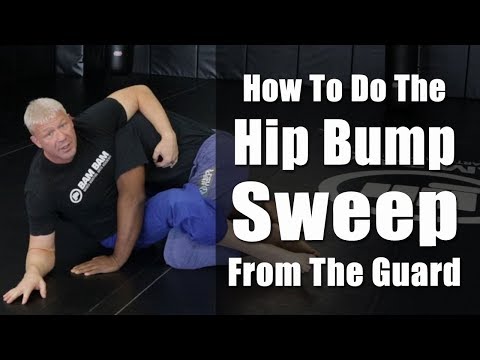
How To Do The Hip Bump Sweep From The Guard

0
Standard Hip BumpΒ·Bam Bam Martial Arts HoustonΒ·Added by Admin

www.BamBamMartialArts.com 713-307-5375 Bam Bam Martial Arts 4007 Bellaire Blvd. ii Houston Tx 77025 info@bambammartialar…

1 video

Learn This Technique

No instructional courses yet for this technique.

Sign in to suggest a course.

Ratings

Danger Rating

Risk of injury to the person this technique is applied to

3
Moderate3/10

Sweeps reverse position from bottom; moderate impact on landing for top player

Difficulty

Skill level needed to execute this technique reliably

Intermediate
Competition Legality

Whether this technique is allowed under major competition rule sets

β€” Unified MMA β€” Legal defensive/transitional technique
Unified Rules of MMA, August 2025PDF
β€” IBJJF β€” Legal
IBJJF Rules Book v6.0, June 2024PDF
β€” ADCC β€” Legal
ADCC Rules Update, April 2025PDF
β€” FIAS Sport Sambo β€” Legal
FIAS International Sambo Competition RulesPDF

Training Notes

βœ“Standard hip bump execution: from closed guard, post one hand on the mat behind the same-side hip, open the guard, explode up with a hip thrust into the opponent, and follow to mount (Saulo Ribeiro, Jiu-Jitsu University, 2008)
βœ“Step 1: wait for the opponent to sit upright or lean slightly back
βœ“Step 2: post the dominant hand on the mat behind the same-side hip
βœ“Step 3: open the guard and swing the same-side leg to help generate the explosive sit-up
βœ“Step 4: drive the hip into the opponent's body with maximum force
βœ“Step 5: the bump forces the opponent backward β€” follow them over to mount
βœ“If the opponent posts: immediately transition to kimura on the posting arm, or guillotine if the head is available
βœ“The explosion comes from the hips and the posted hand β€” drive from both for maximum force
βœ“Drill: partner sits in your closed guard, you execute the hip bump β€” 10 reps per side

Common Mistakes

!Posting the hand too far from the hip β€” close placement gives better base and force generation
!Not opening the guard for the sit-up β€” the guard must open to allow the explosive hip drive
!Bumping upward instead of forward and through β€” the bump must carry you into and over the opponent
!Not using the leg swing to generate momentum β€” the swinging leg adds rotational force to the sit-up
!Bumping gently β€” the hip bump requires explosive force; a gentle bump is easily resisted
!Not transitioning to kimura when the opponent posts β€” this is the highest-percentage follow-up
!Attempting the hip bump against an opponent in low posture β€” they must be upright for the bump to work

Related Techniques

Counter Techniques

Setup Chain

1Create Space β€” use frames, hip movement, or leverage to generate room to move
2Disrupt Control β€” break or weaken the opponent's grips and weight placement
3Execute Escape β€” apply the specific escape mechanic with timing and commitment
4Recover Position β€” establish a safe position (guard, standing, or top)

Sources & References

Primary Source

Jiu-Jitsu University (Saulo Ribeiro, 2008)

1BookThe Guard (Moreira & Beneville, 2008)

Alias sources β€” [1] Jiu-Jitsu University (Saulo Ribeiro, 2008) [2] Gracie Jiu-Jitsu (Gracie & Gracie, 2001)

2BookJiu-Jitsu University (Ribeiro, 2008)

Effectiveness sources β€” [1] Jiu-Jitsu University (Saulo Ribeiro, 2008) [2] Mastering Jujitsu (Renzo Gracie & John Danaher, 2003)

3OtherJapanese Combat Sports Katakana Convention

Standard katakana transliteration of Western martial arts terminology (ε€–ζ₯θͺž) β€” used in Japanese MMA, boxing, and BJJ communities

4CitationThe Guard (Moreira & Beneville, 2008)

Alias sources β€” [1] Jiu-Jitsu University (Saulo Ribeiro, 2008) [2] Gracie Jiu-Jitsu (Gracie & Gracie, 2001)

5CitationJiu-Jitsu University (Ribeiro, 2008)

Effectiveness sources β€” [1] Jiu-Jitsu University (Saulo Ribeiro, 2008) [2] Mastering Jujitsu (Renzo Gracie & John Danaher, 2003)

Community

Athletics

Requires

timing, hip power, off-balancing skill

Favours

strong hips and active legs for sweeping leverage

Key muscles

hip flexors, glutes, quadriceps, core rotators

Frequently Asked Questions

What are the first steps to set up a hip bump sweep from guard?

Uncross your feet, reach over your opponent's far shoulder, and come up on your elbow simultaneously. This positions you to execute the sweep effectively.

How do I prevent my opponent from posting their arm to stop the sweep?

Trap their arm close to your body and keep it tight against you so they cannot extend their arm outward to post and defend against the sweep.

What's the actual sweeping motion in a hip bump?

Once you've trapped the arm and have good positioning, lift your hips up into your opponent to execute the sweep over the trapped arm side.

When should I use the hip bump sweep?

You can use it as a counter when your opponent tries to stand up, or use it more offensively when your opponent is staying low and not actively moving.

How does the Standard Hip Bump work?

The Standard Hip Bump executes the sweep by sitting up explosively from closed guard, wrapping an overhook around the opponent's arm on one side, then driving the hips forward into the opponent's chest to push them backward and over. The guard player uses the sit-up momentum and the overhook to generate a combined forward-upward force vector that destabilises the opponent backward.

Where does the Standard Hip Bump come from?

The standard hip bump is one of the most widely taught sweeps in BJJ, famous for its synergy with the triangle and kimura submissions that arise from the opponent's defensive reactions. This sweep-submission combination is one of the first compound attacks taught in BJJ.

Is the Standard Hip Bump legal in competition?

Unified MMA: legal β€” Legal defensive/transitional technique; IBJJF: legal β€” Legal; IJF: legal β€” Legal; ADCC: legal β€” Legal; UWW: legal β€” Legal; FIAS Sport Sambo: legal β€” Legal

How dangerous is the Standard Hip Bump?

Danger rating 3/10. Moderate β€” sweeps reverse position from bottom; moderate impact on landing for top player

How do I set up the Standard Hip Bump?

The standard setup chain: Create Space β†’ Disrupt Control β†’ Execute Escape β†’ Recover Position.

How do I defend against the Standard Hip Bump?

Standard counters include: Maintain Pressure β€” keep consistent weight distribution to limit escape space / Anticipate Direction β€” read escape attempt direction and block early / Transition β€” flow to a new position when the current one is threatened.

What are the variants of the Standard Hip Bump?

Common variants: Standard sweep (primary off-balancing and reversal technique from the guard); Combination sweep (chaining two sweep directions to catch the opponent's adj…); Counter sweep (sweeping as the opponent initiates a guard pass attempt); Competition sweep (optimised for point-scoring in tournament settings).

How effective is the Standard Hip Bump in competition?

The hip bump is a standard technique in BJJ competition.

What are common mistakes when doing the Standard Hip Bump?

Top errors to watch for: Posting the hand too far from the hip β€” close placement gives better base and force generation / Not opening the guard for the sit-up β€” the guard must open to allow the explosive hip drive / Bumping upward instead of forward and through β€” the bump must carry you into and over the opponent / Not using the leg swing to generate momentum β€” the swinging leg adds rotational force to the sit-up.

What are other names for the Standard Hip Bump?

The Standard Hip Bump is also known as Sutandādo Hippu Banpu, Basic Hip Bump Sweep, Standard Sit-Up Sweep.