Defending Against The Triangle Choke (2 Options)
0
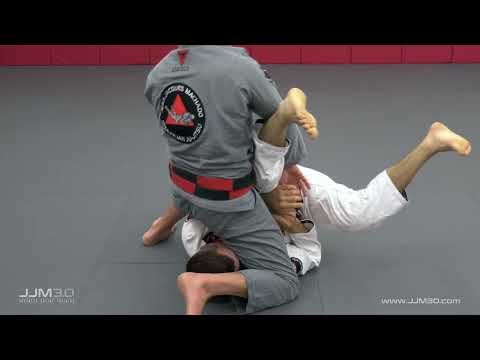
Stack Triangle Escape·JeanJacquesMachado
#escapes #jeanjacquesmachado #bjj Jean Jacques demonstrates two options for defending and escaping the triangle choke. …
Translation: stack triangle escape
The Stack Triangle Escape uses forward pressure to fold the attacker's body by driving the defender's weight over the top, compressing the attacker and changing the triangle angle to relieve the choke. [1] The defender drives forward, lifting the attacker's hips and folding them onto their shoulders, which opens the triangle angle and reduces the choking compression. [1],[2] Once stacked, the defender can work to extract the trapped arm and head, or use the positional advantage to pass the legs entirely. [2],[3]
The stacking triangle escape is the most commonly taught defense against the triangle choke, using posture and forward pressure to compress the attacker's hips and open the angle of the triangle. [1] It is most effective when the defender reacts immediately before the triangle is fully locked and the angle has been cut. [1],[2]
The stack escape pressures the opponent's spine by driving forward, opening the triangle. [1]
Stacking is a common triangle escape in competition. [1]
No images yet for this technique.
Sign in to suggest an image.
#escapes #jeanjacquesmachado #bjj Jean Jacques demonstrates two options for defending and escaping the triangle choke. …
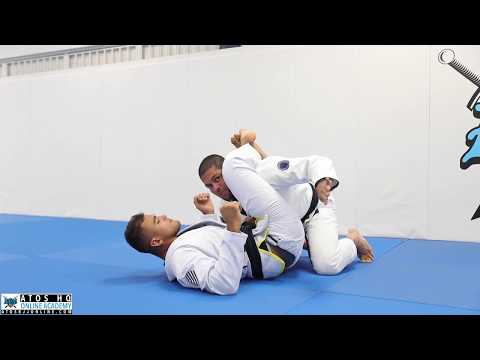
Legend of Jiu-Jitsu Andre Galvao teaches different ways to escape a triangle ttack! Learn from Andre Galvao daily at li…
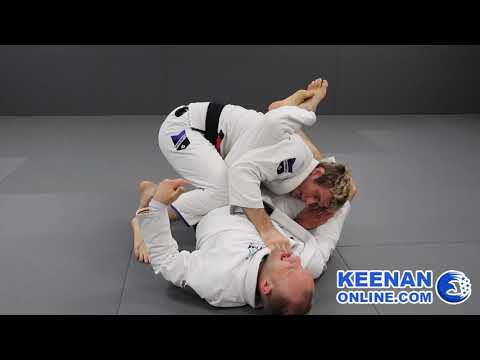
The final segment to a 3 part triangle defense sequence found on https://keenanonline.com/ Dont bother with other trian…
The stack triangle escape is a defensive technique executed when an opponent has achieved a locked or near-locked triangle choke from top position. Andre Galvao (Atos Jiu-Jitsu HQ) emphasizes preventing the triangle's completion by controlling the opponent's hips and denying the underhook, using elbow-to-thigh framing and pants control to disrupt angle adjustment. Once locked, Galvao teaches stepping the leg on the same side as the trapped arm over the opponent's body while maintaining grip, then bridging and rotating to escape. Keenan Cornelius presents an alternative approach using a lapel grip folded into a bow configuration to create a powerful handle that prevents the opponent from pulling the arm across the centerline; he then rotates while maintaining eye level and hip connection, eventually turning face-down to create space. Jean Jacques Machado (JeanJacquesMachado) stresses early defense—keeping the elbow tight and feeding the collar—then moving the body toward the trapped arm's side while raising the hips and walking out. For delayed escapes, Machado describes throwing the leg out sharply to break the position. All three instructors agree the escape requires controlled, purposeful movement rather than explosive posturing, and emphasize that stepping or driving on the correct side (same as trapped arm) prevents worsening the position.
Synthesized from 3 instructors
No instructional courses yet for this technique.
Sign in to suggest a course.
Risk of injury to the person this technique is applied to
Submission escapes carry risk of injury if executed too late; timing-critical
Skill level needed to execute this technique reliably
Whether this technique is allowed under major competition rule sets
Jiu-Jitsu University (Saulo Ribeiro, 2008)
Alias sources — [1] Jiu-Jitsu University (Saulo Ribeiro, 2008) [2] Gracie Jiu-Jitsu (Gracie & Gracie, 2001) [3] Brazilian Jiu-Jitsu: Theory and Technique (Renzo Gracie & Royler Gracie, 2001)
Effectiveness sources — [1] Jiu-Jitsu University (Saulo Ribeiro, 2008) [2] Brazilian Jiu-Jitsu: Theory and Technique (Renzo Gracie & Royler Gracie, 2001)
Mixed Japanese-Western terminology — combines traditional Japanese terms with katakana loanwords
Alias sources — [1] Jiu-Jitsu University (Saulo Ribeiro, 2008) [2] Gracie Jiu-Jitsu (Gracie & Gracie, 2001) [3] Brazilian Jiu-Jitsu: Theory and Technique (Renzo Gracie & Royler Gracie, 2001)
Effectiveness sources — [1] Jiu-Jitsu University (Saulo Ribeiro, 2008) [2] Brazilian Jiu-Jitsu: Theory and Technique (Renzo Gracie & Royler Gracie, 2001)
hip mobility, explosive bridge/shrimp power, timing
flexible hips and strong glutes for escape movements
glutes, hip flexors, core, triceps (framing)
According to Andre Galvao, you must escape your hips to the correct side—if you escape the wrong way, your opponent can either lock the triangle more easily or use their arm to attack you. The best approach is to step your leg on the same side as your opponent's arm that's inside the triangle.
Andre Galvao emphasizes not allowing your opponent to underhook your leg, as this gives them the angle to lock the triangle or transition to an armbar. Instead, keep your elbow out, control your opponent's pants, and put your chin to chest with your shoulder toward your ear so when they pull your head down, you're already protected.
Keep your arm across your opponent's body and across the centerline to prevent the moonplata transition, and avoid extending it fully as this creates an armbar opportunity. Keenan Cornelius recommends keeping your hand inside rather than bridging with your collar, as this prevents your arm from being extended for a submission.
Keenan Cornelius emphasizes keeping your eyes level and turning to look as far around as possible—even trying to see the wall behind you—while driving your elbow across your opponent's neck. This rotational movement prevents them from bringing their leg over your head and makes the escape much more difficult to defend against.
The Stack Triangle Escape uses forward pressure to fold the attacker's body by driving the defender's weight over the top, compressing the attacker and changing the triangle angle to relieve the choke. The defender drives forward, lifting the attacker's hips and folding them onto their shoulders, which opens the triangle angle and reduces the choking compression.
The stacking triangle escape is one of the oldest and most effective triangle defences, derived from the same stacking principle used against armbars. It is universally taught in grappling as a primary triangle escape alongside posture-based defence.
Unified MMA: legal — Legal defensive/transitional technique; IBJJF: legal — Legal; IJF: legal — Legal; ADCC: legal — Legal; UWW: legal — Legal; FIAS Sport Sambo: legal — Legal
Danger rating 4/10. Moderate — submission escapes carry risk of injury if executed too late; timing-critical
The standard setup chain: Create Space → Disrupt Control → Execute Escape → Recover Position.
Standard counters include: Maintain Pressure — keep consistent weight distribution to limit escape space / Anticipate Direction — read escape attempt direction and block early / Transition — flow to a new position when the current one is threatened.
Common variants: Standard escape (primary escape mechanic using frames, bridges, or hip mov…); Combination escape (chaining two escape directions or methods); Counter escape (using the opponent's attack attempt to create the escape …); Competition variation (modified for rule-set optimisation).
Stacking is a common triangle escape in competition.
Top errors to watch for: Stacking straight forward instead of toward the inside-arm side — the angle matters for both pressure and passing / Not walking the feet forward — the stack requires forward walking steps, not just leaning / Releasing the stack pressure before passing — maintain the compression until you've passed or freed the arm / Stacking with a rounded back — a straight back transfers more force into the compression.
The Stack Triangle Escape is also known as Sutakku Sankaku Nige, Triangle Stack Pass, Stacking Triangle Defense, Pressure Pass Triangle Escape.