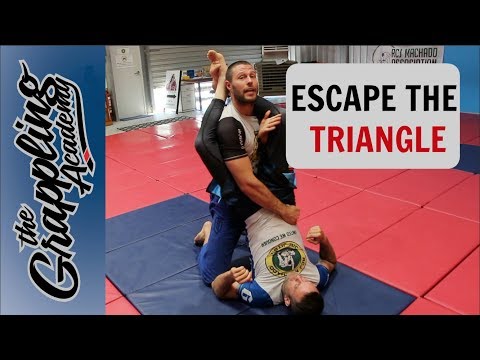
Escape That Triangle!
0
Triangle Escape·The Grappling Academy
SALE SALE SALE OVER 50% OFF – BOX SET – ALL 4 COURSES 50% OFF CLICK HERE – https://bit.ly/2lAOHmp • The Blue Belt Sup…
Translation: triangle escape
The Triangle Escape subfamily covers techniques for escaping the sankaku-jime (triangle choke), where the attacker uses the legs to form a triangle around the defender's head and one arm, creating a strangulation. [1] Triangle escapes must address the locked legs around the neck while managing the risk that escape attempts may tighten the choke further. [1],[2] The primary escape strategies are posturing (straightening the spine to relieve pressure) and stacking (driving forward to compress the attacker and change the choke angle). [2],[3]
Triangle escapes were developed in BJJ as the triangle choke became a dominant submission. [1]
Triangle defence is essential in BJJ and MMA competition. [1]
No images yet for this technique.
Sign in to suggest an image.
SALE SALE SALE OVER 50% OFF – BOX SET – ALL 4 COURSES 50% OFF CLICK HERE – https://bit.ly/2lAOHmp • The Blue Belt Sup…
No instructional courses yet for this technique.
Sign in to suggest a course.
Risk of injury to the person this technique is applied to
Submission escapes carry risk of injury if executed too late; timing-critical
Skill level needed to execute this technique reliably
Whether this technique is allowed under major competition rule sets
Jiu-Jitsu University (Saulo Ribeiro, 2008)
Alias sources — [1] Kodokan Judo (Jigoro Kano, 1986) [2] Jiu-Jitsu University (Saulo Ribeiro, 2008) [3] Brazilian Jiu-Jitsu: Theory and Technique (Renzo Gracie & Royler Gracie, 2001)
Effectiveness sources — [1] Mastering Jujitsu (Gracie & Danaher, 2003) [2] Jiu-Jitsu University (Ribeiro, 2008)
Standard Japanese martial arts terminology (kanji/hiragana)
Established Japanese martial arts naming convention — native Japanese term (和語/漢語)
Alias sources — [1] Kodokan Judo (Jigoro Kano, 1986) [2] Jiu-Jitsu University (Saulo Ribeiro, 2008) [3] Brazilian Jiu-Jitsu: Theory and Technique (Renzo Gracie & Royler Gracie, 2001)
Effectiveness sources — [1] Mastering Jujitsu (Gracie & Danaher, 2003) [2] Jiu-Jitsu University (Ribeiro, 2008)
hip mobility, explosive bridge/shrimp power, timing
flexible hips and strong glutes for escape movements
glutes, hip flexors, core, triceps (framing)
Every move, in any martial art, shares a few universal traits. Mix and match below to pinpoint the right tool — or compare equivalents across styles.
The Posture Triangle Escape uses postural alignment to relieve the choking pressure of the triangle by straightening the spine, lifting the trapped shoulder, and creating distance between the defender's neck and the attacker's legs. [1] The defender postures up by extending the back, planting the hands on the attacker's hips, and driving the trapped arm's shoulder forward into the triangle gap. [1,2] Good posture opens the triangle angle, reducing the compression on the carotid arteries and creating space to begin extracting the head. [2,3]
The Stack Triangle Escape uses forward pressure to fold the attacker's body by driving the defender's weight over the top, compressing the attacker and changing the triangle angle to relieve the choke. [1] The defender drives forward, lifting the attacker's hips and folding them onto their shoulders, which opens the triangle angle and reduces the choking compression. [1,2] Once stacked, the defender can work to extract the trapped arm and head, or use the positional advantage to pass the legs entirely. [2,3]
The biggest thing you need to do is get your posture back. Coach Tom from The Grappling Academy emphasizes that just because someone is threatening a triangle is a long way away from you actually tapping.
Get your left hand in and bring it through—don't try to get your trapped hand out as it will get you in trouble. Once you've got your hand in, it becomes hard for your opponent to get their elbow through.
Push your opponent's hips down, clamp your elbows, look up and drag them up onto your hips. You can also shimmy your shoulders to create space rather than trying to pry out, which puts excessive strain on your tricep.
Prevention is important—an ounce of prevention is worth a pound of cure. However, knowing how to resist the triangle once caught, regardless of strength and size, can be a fantastic way to pass guard.
The Triangle Escape subfamily covers techniques for escaping the sankaku-jime (triangle choke), where the attacker uses the legs to form a triangle around the defender's head and one arm, creating a strangulation. Triangle escapes must address the locked legs around the neck while managing the risk that escape attempts may tighten the choke further.
Triangle choke escapes developed alongside the triangle's evolution from a judo technique to one of the most commonly used submissions in BJJ and MMA. The triangle's prevalence in competition at all levels made triangle defence one of the most practiced defensive skills in grappling.
Unified MMA: legal — Legal defensive/transitional technique; IBJJF: legal — Legal; IJF: legal — Legal; ADCC: legal — Legal; UWW: legal — Legal; FIAS Sport Sambo: legal — Legal
Danger rating 4/10. Moderate — submission escapes carry risk of injury if executed too late; timing-critical
The standard setup chain: Create Space → Disrupt Control → Execute Escape → Recover Position.
Standard counters include: Maintain Pressure — keep consistent weight distribution to limit escape space / Anticipate Direction — read escape attempt direction and block early / Transition — flow to a new position when the current one is threatened.
Common variants: Standard escape (primary escape mechanic using frames, bridges, or hip mov…); Combination escape (chaining two escape directions or methods); Counter escape (using the opponent's attack attempt to create the escape …); Competition variation (modified for rule-set optimisation).
Triangle defence is essential in BJJ and MMA competition.
Top errors to watch for: Dropping the posture — a broken posture makes the triangle tighter; fight to keep the head up / Passing to the wrong side — always pass to the choking-arm side (your arm that's inside the triangle) / Trying to pull the head out directly — the lock is designed to prevent this; stack and pass instead / Reaching across with the trapped arm — this deepens the triangle; keep the trapped arm close to your body.
The Triangle Escape is also known as Sankaku-jime Nige, Sankaku Jime Escape, Triangle Choke Defense, Triangle Defense.