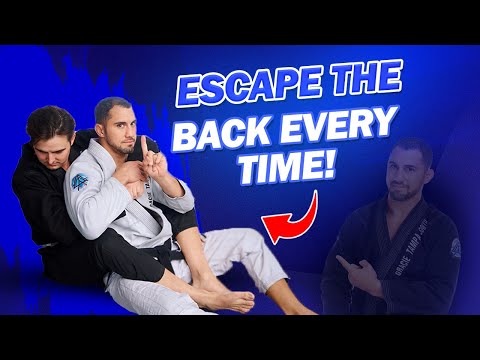
How to Escape the Back EVERY TIME | Jiu Jitsu Back Escape System
0
RNC Shoulder Walk Escape·Matt Arroyo Jiu Jitsu
Join My Online Academy to Improve Your Jiu Jitsu FAST!!! https://academy.mattarroyo.com/ Join My Online Academy to Imp…
Translation: RNC shoulder walk escape
The RNC Shoulder Walk Escape uses a walking motion on the shoulders to slide the body downward and out of the attacker's back control while defending the choke. [1] The defender plants the shoulders on the mat and walks them laterally, sliding the body downward relative to the attacker's grip, which simultaneously creates distance from the choking arms and helps clear the hooks. [1],[2] The shoulder walk is particularly effective because it works against both the choke and the positional control simultaneously. [2],[3]
The shoulder walk escape became a widely adopted back escape technique through competitive BJJ and MMA, where fighters needed efficient methods to escape back control while defending the RNC. [1] Its effectiveness at addressing both the choke and the position made it a standard back escape methodology. [2],[3]
The shoulder walk RNC escape uses shoulder-walking to slide down and escape the choking position. [1]
Shoulder walking was adapted from wrestling escapes into RNC defence. [1]
Used in MMA and BJJ competition. [1]
No images yet for this technique.
Sign in to suggest an image.
Join My Online Academy to Improve Your Jiu Jitsu FAST!!! https://academy.mattarroyo.com/ Join My Online Academy to Imp…
In today’s video I’ll be giving you the 10 first bjj submissions that every white belt should learn. These are the submi…
Ready to finish fights faster? Level up your ground game with a FREE custom 14-day Jiu-Jitsu training plan – take the su…
The RNC Shoulder Walk Escape is a defensive technique executed when an opponent secures back control and threatens a rear naked choke. Matt Arroyo Jiu Jitsu emphasizes the foundational mechanics: establishing a baseball grip on the choking arm's wrist to prevent the choke from tightening, clamping the bottom arm with the elbow to restrict opponent mobility, and falling toward the underhook side rather than the choke side. The escape proceeds by kicking out the bottom hook with the foot, trapping the opponent's heel against their own buttock, then using the floor or wall to scrape the opponent off the back through repeated body rotations. Once the back is completely flat against the ground, the defender turns into the opponent (never away, which risks back retake) and can transition to guard or half guard. Arroyo stresses that the choke arm's direction indicates the safe escape direction and demonstrates managing the common follow-up where the opponent attempts to transition to mount by bridging the hips high. TRITAC Martial Arts presents related standing escape variations including the Ipan Seo Inagi (dropping base and bowing forward), Osoto Gari (stepping and sweeping the leg), Judolock position (controlling the arm with two hands underneath), and Yoko Wakari (side fall sacrifice throw), though these address standing rear choke defenses rather than the ground-based shoulder walk scraping method. Jedi Does Jiujitsu covers the rear naked choke as an offensive submission from back control but does not detail this specific escape sequence. All instructors agree on the critical importance of hand defense before attempting positional escape.
Synthesized from 3 instructors
No instructional courses yet for this technique.
Sign in to suggest a course.
Risk of injury to the person this technique is applied to
Submission escapes carry risk of injury if executed too late; timing-critical
Skill level needed to execute this technique reliably
Whether this technique is allowed under major competition rule sets
Jiu-Jitsu University (Saulo Ribeiro, 2008)
Alias sources — [1] Back Attacks: Enter the System (John Danaher, 2018) [2] Jiu-Jitsu University (Saulo Ribeiro, 2008)
Effectiveness sources — [1] Jiu-Jitsu University (Ribeiro, 2008)
Mixed Japanese-Western terminology — combines traditional Japanese terms with katakana loanwords
Alias sources — [1] Back Attacks: Enter the System (John Danaher, 2018) [2] Jiu-Jitsu University (Saulo Ribeiro, 2008)
Effectiveness sources — [1] Jiu-Jitsu University (Ribeiro, 2008)
grip fighting ability, hip mobility for sliding to the mat, chin defence
strong hands for grip fighting, flexible hips
forearms (grip fighting), core, hip flexors, neck
According to Matt Arroyo, the first step is to protect your neck before thinking about any escape. Use a baseball grip to prevent the rear naked choke and stop your opponent from getting their thumb in.
Matt Arroyo recommends falling to the underhook side—the side where your opponent's arm is under your armpit—because it makes it harder for them to finish a choke and keeps you safer during the escape.
Reach up and find your opponent's heel, then punch it to the floor. Bring your knee through and place your foot over their ankle to prevent them from re-inserting the hook into your inner thigh.
Matt Arroyo emphasizes never turning away from your opponent when your back is against the wall, as this leads to back retake. Instead, scrape them off and turn into them to escape safely.
The RNC Shoulder Walk Escape uses a walking motion on the shoulders to slide the body downward and out of the attacker's back control while defending the choke. The defender plants the shoulders on the mat and walks them laterally, sliding the body downward relative to the attacker's grip, which simultaneously creates distance from the choking arms and helps clear the hooks.
The shoulder walk escape became a widely adopted back escape technique through competitive BJJ and MMA, where fighters needed efficient methods to escape back control while defending the RNC. Its effectiveness at addressing both the choke and the position made it a standard back escape methodology.
Unified MMA: legal — Legal defensive/transitional technique; IBJJF: legal — Legal; IJF: legal — Legal; ADCC: legal — Legal; UWW: legal — Legal; FIAS Sport Sambo: legal — Legal
Danger rating 4/10. Moderate — submission escapes carry risk of injury if executed too late; timing-critical
The standard setup chain: Create Space → Disrupt Control → Execute Escape → Recover Position.
Standard counters include: Maintain Pressure — keep consistent weight distribution to limit escape space / Anticipate Direction — read escape attempt direction and block early / Transition — flow to a new position when the current one is threatened.
Common variants: Slide to side (choking-arm side) (fighting hands and sliding hips to the mat on the choking…); Peel-and-turn (stripping the seatbelt grip and turning into the opponent); Trap-arm escape (trapping one arm and rolling to pin the opponent's back); Body triangle escape (addressing the body triangle lock before escaping the hooks).
Used in MMA and BJJ competition.
Top errors to watch for: Walking too fast and becoming predictable — vary the rhythm to prevent the opponent from adjusting / Not combining with hand fighting — the choke threat is constant; hands must stay on defence / Walking in the wrong direction — walk toward the bottom hook to position for its clearance / Expecting fast results — patience is key; 10-15 walks may be needed.
The RNC Shoulder Walk Escape is also known as Hadaka-jime Shorudā Wōku Nige, RNC Shoulder Slide, Rear Choke Shoulder Walk.