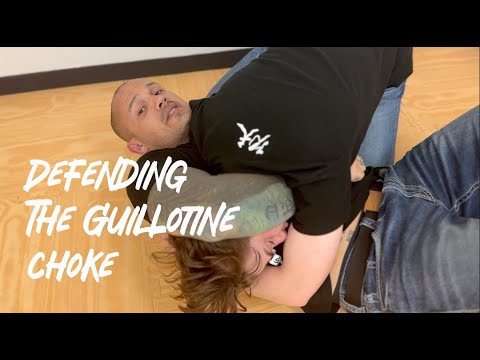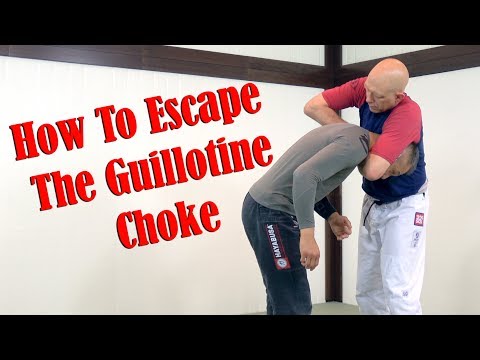
How To Escape The Guillotine Choke
0
Guillotine Escape·Ritchie Yip
https://www.infighting.ca/blog/brazilian-jiu-jitsu/ For more tips, techniques and videos on Brazilian Jiu Jitsu, check o…
Translation: guillotine escape
The Guillotine Escape subfamily covers techniques for escaping the guillotine choke (mae-hadaka-jime), a front headlock strangulation applied from standing or guard position. [1] Guillotine escapes must address the neck compression while managing the positional control — either escaping in the clinch (standing) or passing the guard (ground). [1],[2] The primary escape strategies involve posturing to relieve the choke angle, driving forward to create a Von Flue counter opportunity, or circling the head free of the grip. [2],[3]
Guillotine escapes were developed in BJJ and MMA as the guillotine became a high-frequency submission. [1]
Guillotine defence is essential in MMA, as the guillotine is one of the most commonly attempted submissions. [1]
No images yet for this technique.
Sign in to suggest an image.
https://www.infighting.ca/blog/brazilian-jiu-jitsu/ For more tips, techniques and videos on Brazilian Jiu Jitsu, check o…
A guillotine choke is not a good place to be especially in a fight for your life. Learning the tools to escape it in Sel…
No instructional courses yet for this technique.
Sign in to suggest a course.
Risk of injury to the person this technique is applied to
Submission escapes carry risk of injury if executed too late; timing-critical
Skill level needed to execute this technique reliably
Whether this technique is allowed under major competition rule sets
Jiu-Jitsu University (Saulo Ribeiro, 2008)
Alias sources — [1] Jiu-Jitsu University (Saulo Ribeiro, 2008) [2] Mastering Jujitsu (Renzo Gracie & John Danaher, 2003) [3] Kodokan Judo (Jigoro Kano, 1986)
Effectiveness sources — [1] Mastering Jujitsu (Gracie & Danaher, 2003) [2] Jiu-Jitsu University (Ribeiro, 2008)
Mixed Japanese-Western terminology — combines traditional Japanese terms with katakana loanwords
Alias sources — [1] Jiu-Jitsu University (Saulo Ribeiro, 2008) [2] Mastering Jujitsu (Renzo Gracie & John Danaher, 2003) [3] Kodokan Judo (Jigoro Kano, 1986)
Effectiveness sources — [1] Mastering Jujitsu (Gracie & Danaher, 2003) [2] Jiu-Jitsu University (Ribeiro, 2008)
hip mobility, explosive bridge/shrimp power, timing
flexible hips and strong glutes for escape movements
glutes, hip flexors, core, triceps (framing)
Every move, in any martial art, shares a few universal traits. Mix and match below to pinpoint the right tool — or compare equivalents across styles.
The Posture Guillotine Escape uses postural adjustment to relieve the choking pressure of the guillotine by extending the spine and lifting the chin line above the attacker's choking arm. [1] The defender drives the hips forward, straightens the back, and lifts the head, which changes the angle of the choke and reduces compression on the carotid arteries. [1,2] Once posture is established, the defender can work to strip the grip, pass the guard, or disengage entirely. [2,3]
The Von Flue Counter is a guillotine escape that converts the defender's position into a counter-submission by passing to side control while the attacker maintains the guillotine grip, then applying shoulder pressure to the attacker's neck to create a counter-choke. [1] Named after Jason Von Flue, who famously used this technique in the UFC, the counter exploits the guillotine holder's refusal to release the grip after the guard has been passed. [1,2] The defender passes to side control, drops shoulder pressure on the trapped side of the attacker's neck, and the attacker's own guillotine grip completes the choke on themselves. [2,3]
According to Kevin Goat Self Defense, the critical step is to grab and control your opponent's arm to prevent it from reaching your neck. If you're already caught and feel it getting tight, placing your hands on their legs makes it much harder for them to finish the choke.
Ritchie Yip explains that most people misunderstand the guillotine: it's not the opponent's other arm that chokes you, but rather their forearm, bicep, and rib cage working together. This remains true even in variations like the Marcello Garcia style where the forearm comes across the neck.
Ritchie Yip recommends first lifting your head up slightly to create space, then attempting to pull your head out. Even if your opponent is strong, trying to extend your weight upward and out is the initial escape sequence to attempt.
Kevin Goat Self Defense emphasizes that you should drive your opponent's head up as high as possible, as this makes it difficult for them to execute escape techniques. Keeping your hips close also helps secure the position.
The Guillotine Escape subfamily covers techniques for escaping the guillotine choke (mae-hadaka-jime), a front headlock strangulation applied from standing or guard position. Guillotine escapes must address the neck compression while managing the positional control — either escaping in the clinch (standing) or passing the guard (ground).
Guillotine escapes developed alongside the guillotine choke's evolution from a basic headlock to a sophisticated strangulation. The choke's prevalence in MMA, where it is one of the most common submissions, accelerated the development of specialised guillotine defence methodology.
Unified MMA: legal — Legal defensive/transitional technique; IBJJF: legal — Legal; IJF: legal — Legal; ADCC: legal — Legal; UWW: legal — Legal, escape scores 1 point (freestyle), reversal scores 1 point; FIAS Sport Sambo: legal — Legal; NCAA Folkstyle: legal — Legal, escape scores 1 point, reversal scores 2 points
Danger rating 4/10. Moderate — submission escapes carry risk of injury if executed too late; timing-critical
The standard setup chain: Create Space → Disrupt Control → Execute Escape → Recover Position.
Standard counters include: Maintain Pressure — keep consistent weight distribution to limit escape space / Anticipate Direction — read escape attempt direction and block early / Transition — flow to a new position when the current one is threatened.
Common variants: Standard escape (primary escape mechanic using frames, bridges, or hip mov…); Combination escape (chaining two escape directions or methods); Counter escape (using the opponent's attack attempt to create the escape …); Competition variation (modified for rule-set optimisation).
Guillotine defence is essential in MMA, as the guillotine is one of the most commonly attempted submissions.
Top errors to watch for: Pulling the head straight back — this often tightens the guillotine; posture up and circle instead / Passing to the wrong side — always pass to the choking-arm side for the safest angle / Not addressing the grip — posture buys time, but eventually the grip must be broken / Staying in closed guard while defending — open the guard by stacking to reduce choking pressure.
The Guillotine Escape is also known as Girochin Nige, Guillotine Defense, Front Headlock Escape, Mae Hadaka Jime Escape.