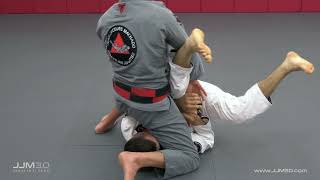
Initial Defense: Blocking the Connection
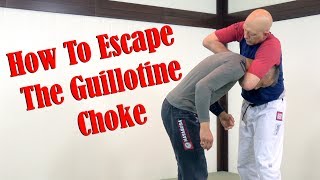
When caught in a guillotine choke attempt, the defender's primary objective is to prevent the attacker from connecting their hands. The defender grabs the attacker's choking arm and drives their opposite arm high to create an anchor point, making it mechanically difficult for the attacker to complete the grip.
Takedown Execution
Once the defender secures the high arm position, they step toward their trapped arm while trapping the attacker's leg on the same side. The defender must drive forward aggressively, pushing off their opposite leg to generate momentum for the takedown and force the attacker to the ground.
Upper Body Pressure if Choking Continues
If the attacker maintains the choke despite the takedown attempt, the defender can drive their shoulder into the attacker's face to encourage release. Following this, the defender can transition to knee-on-belly position and create additional facial pressure while maintaining head movement to escape.
Understanding the Tight Guillotine Position
In a properly executed guillotine, the attacker's arm wraps around the neck while their other arm reinforces by lifting upward. If the attacker establishes this control before the defender can defend, the defender must focus on preventing the attacker's arm from reaching the neck initially.
Hand Placement Counter
If the attacker achieves a tight squeeze, the defender can place their hands on the attacker's legs to create distance and make it mechanically harder for the attacker to maintain the choke. This positioning also prevents the attacker from moving closer to tighten the grip further.
Defensive Arm Raising as Primary Defense
The defender's primary goal throughout remains driving their arm up as high as possible, which creates space at the neck and forces the attacker to attempt the takedown. Better timing on this arm defense makes it significantly harder for the attacker to apply finishing pressure.
Leg Trap and Drive Mechanics
The defender traps the attacker's leg using their leg while stepping in the trapped arm's direction. The defender must drive forward aggressively with their entire body, pushing off the opposite leg to generate enough force to destabilize and take down the attacker.
Hand Down Consequence
If the defender places their hand on the ground to prevent falling during the takedown, they forfeit the ability to finish the guillotine and should disengage from the choke attempt. Slow takedown mechanics can create this vulnerability when the attacker still maintains tight pressure.
Counter to Committed Attacker: Shoulder Pressure
Against a highly committed attacker who squeezes tightly, the defender must establish a "bon flu trope" position by connecting their arms and driving their shoulder into the attacker's neck. The defender executes this by planking their body weight onto the attacker's neck and applying pressure through their legs, ultimately aiming to render the attacker unconscious.
Finding and Applying Shoulder Pressure
When the attacker maintains a tight squeeze, the defender must locate the optimal angle for shoulder pressure and drive into it with leg drive. This technique forces the attacker to release due to the accumulating pressure and danger, providing the defender an escape opportunity.
Escape the Guillotine Choke
Key Takeaways
- •Initial Defense: Blocking the Connection
- •Takedown Execution
- •Upper Body Pressure if Choking Continues
- •Understanding the Tight Guillotine Position
A guillotine choke is not a good place to be especially in a fight for your life. Learning the tools to escape it in Self Defense could save your life. #fit #mixedmartialarts #jujitsu #taekwondo #sport #grappling #kungfu #training #fighter #mma #martialartist #jiujitsu #wingchun #martialartstraining #martialartslifestyle #ufc #fighting #shaolinkungfu #wrestling #martialarts #selfdefense #gym #boxing #shaolin #judo #karate #kickboxing #bjj #brazilianjiujitsu #muaythai #safetytips #mma #selfdefence #martialarts #selfdefenseforkids #kungfu #thaiboxing #jeetkunedo #jiujitsu #staysafe #protection #youtube #wrestling #bjj #muaythai #training #taekwondo #brazilianjiujitsu #wingchun #selfdefensetips #boxing #judo #karate #womenempowerment #womensdefense #selfdefenseforwomen #kickboxing #selfdefense #grappling #warrior #guillotinechoke
Related Techniques
Frequently Asked Questions
What does this video teach about guillotine escape?
This video covers initial defense: blocking the connection, takedown execution, upper body pressure if choking continues. It provides detailed instruction from Kevin Goat Self Defense.
How long does it take to learn guillotine escape?
The basic mechanics can be understood in a single session, but developing reliable execution requires consistent drilling over weeks of practice. This 10-part breakdown helps structure your training by isolating each phase of the technique.
What are the key details for finishing guillotine escape?
Against a highly committed attacker who squeezes tightly, the defender must establish a "bon flu trope" position by connecting their arms and driving their shoulder into the attacker's neck. The defender executes this by planking their body weight onto the attacker's neck and applying pressure through their legs, ultimately aiming to render the attacker unconscious.